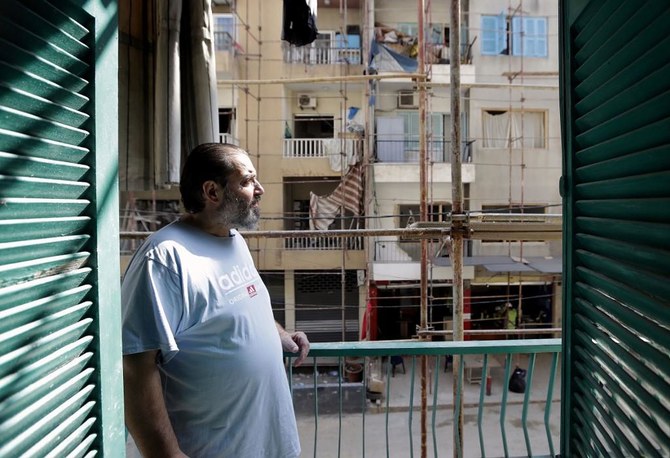
BEIRUT: Reconstruction is progressing slowly in the area of Beirut devastated by the Aug. 4 explosion in the Lebanese capital’s port.
“The first obstacle hindering restoration work is financial. All private and official international bodies have no confidence in the Lebanese government so they’ve refrained from giving aid,” Jad Thabet, head of the Engineers Syndicate, told Arab News.
“Any plan assumes the existence of a government, and the international campaign we saw when the explosion happened has withdrawn due to the political situation in Lebanon. Unfortunately there’s total chaos,” he said, adding that winter will make matters worse.
“There are people who’ll be displaced and buildings that will collapse. The rain will wash away stones and soil, and block roads and sewers. There will be subsequent disasters for the people.”
The explosion of some 2,750 tons of ammonium nitrate that had been stored in Beirut’s port since 2013 killed 195 people, injured about 6,500, displaced 300,000 and caused billions of dollars’ worth of damage.
Thabet said he intends to travel to Paris in an attempt to urge UNESCO to provide assistance to Lebanon, but he does not expect much in light of his country’s political situation.
Many residents in Beirut are complaining about the lack of repairs to their damaged homes, and have no faith in the government.
There is also a lack of progress on the judicial front, with Judge Fadi Sawan saying he “hasn’t yet received any report from any security service that was carrying out investigations in the explosion site.”
Among the teams that helped with the investigations were a French one and an American one.
An FBI spokesman said earlier this week that it has not been concluded that the explosion was a deliberate crime. The FBI is helping with the investigations at the Lebanese government’s request, he added.
Sawan issued two arrest warrants last Thursday against the Russian captain and the owner of the ship that transported the ammonium nitrate to Beirut. The state prosecutor has asked Interpol to arrest them.
Ali Hinnawi, head of the Public Safety Committee at the Engineers Syndicate, said: “People need to return to their homes, livelihoods, work and interests. Is there anyone who listens and is aware of the importance of this?”
He added: “Social conditions are getting more difficult and winter is approaching. People are kept away from their homes due to negligence and mismanagement.”


![]()

Beirut reconstruction making little progress
Short Url
https://arab.news/94qfa
Beirut reconstruction making little progress
- Many residents in Beirut are complaining about the lack of repairs to their damaged homes
- The explosion of some 2,750 tons of ammonium nitrate that had been stored in Beirut’s port since 2013 killed 195 people


Latest updates





© 2026 SAUDI RESEARCH & PUBLISHING COMPANY, All Rights Reserved And subject to Terms of Use Agreement.