Lebanon pins economic hopes on talks with Israel

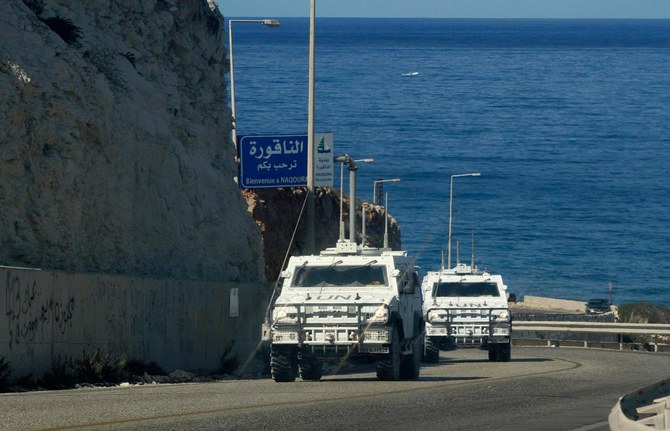
United Nations peacekeeping force (UNIFIL) vehicles patrol the area of Naqura, south of the Lebanese city of Tyre, on the border with Israel, on October 2, 2020. (AFP)
Short Url
Updated 04 October 2020
Follow

Lebanon pins economic hopes on talks with Israel

  • Hezbollah will lose justification for its weapons, analyst tells Arab News
  • The negotiations aim to demarcate the disputed maritime border and, later, the land border

BEIRUT: Successful border talks with Israel could revive Lebanon’s devastated economy and remove Hezbollah’s justification for its weapons, analysts told Arab News on Saturday. The first session of US-mediated Lebanese-Israeli talks under UN auspices will take place on Oct. 14 in the Lebanese border town of Naqoura. The negotiations aim to demarcate the disputed maritime border and, later, the land border. Lebanon is hoping that successful talks will provide an appropriate security environment for oil and gas companies to explore off its coast. The first session will have low-level representation, with military and Energy Ministry officials representing Lebanon. Lebanon and Israel are technically at war, and there are no agreed land or sea borders between them. Several points on the UN-demarcated land border — the Blue Line — are disputed by the two countries. Lebanon signed its first offshore oil and gas exploration and production contracts in 2018 with three companies — France’s Total, Italy’s Eni and Russia’s Novatek — to explore Block 4 and Block 9 in the Mediterranean. The latter block is disputed by Israel. Successful exploration would provide a lifeline for Lebanon’s ailing economy. The contracts signed between Lebanon and the consortium obligates the drilling of an exploration well before the end of 2020. These companies have two options: Either proceed with the drilling despite the Israeli-Lebanese dispute, or negotiate with Beirut to postpone the exploration.
“Negotiating with Israel has important political and security results as it will lead to reducing current tensions,” said Mohanad Hage Ali, a researcher at the Carnegie Middle East Center.
He said demarcating borders would remove the justification of the Lebanese Shiite militia Hezbollah for possessing weapons.
“Lebanon is entering a new phase. It’s possible to negotiate a final solution to the Lebanese-Israeli conflict, and then weapons will be included in Lebanon’s internal formula and, through a gradual phase, in a military strategy,” he said. “The Lebanese Army, therefore, becomes the umbrella, and Hezbollah’s cadres may be integrated into the army or be a stand-alone wing under the army’s command, in return for a political gain that doesn’t violate the balance and parity. There’s talk of making the army’s command Shiite.” On the feasibility of exploring for gas and oil, Ali said: “The political class in Lebanon has been too slow with this, but the gas revolution will remain a fact, and through bilateral agreements, Lebanon can catch up.”


Israel’s ‘deliberate intention of preventing births among Palestinians’ meets ‘legal criteria of Genocide Convention’: Reports

Updated 10 sec ago
Follow

Israel’s ‘deliberate intention of preventing births among Palestinians’ meets ‘legal criteria of Genocide Convention’: Reports

  • Births in Gaza fell by 41% during conflict as maternal deaths, miscarriages surged
  • ‘The destruction of maternal care in Gaza reflects the deliberate infliction of conditions of life calculated to bring about the destruction of the Palestinian people, in whole or in part’

LONDON: Births in Gaza fell by 41 percent due to Israel’s war on the territory, with the conflict resulting in catastrophic numbers of maternal deaths, miscarriages and birth complications, two reports have found.

The data on pregnant women, babies and maternity care in the war-torn Palestinian enclave also revealed a surge in newborn mortality and premature births, The Guardian reported on Wednesday.

Dangerous wartime conditions and Israel’s systematic destruction of Gaza’s health systems were blamed for the alarming statistics.

The two reports were conducted by Physicians for Human Rights, in collaboration with the University of Chicago Law School’s Global Human Rights Clinic and Physicians for Human Rights — Israel.

Researchers highlighted Israel’s “deliberate intention of preventing births among Palestinians, meeting the legal criteria of the Genocide Convention.”

The reports build on earlier findings by PHR’s Israel branch. They place the testimonies of pregnant women and new mothers within the context of health data and field reports, which recorded “2,600 miscarriages, 220 pregnancy-related deaths, 1,460 premature births, over 1,700 underweight newborns, and over 2,500 infants requiring neonatal intensive care” between January and June 2025.

PHRI’s Lama Bakri, a psychologist and project manager, said: “These figures represent a shocking deterioration from pre-war ‘normalcy,’ and are the direct result of war trauma, starvation, displacement and the collapse of maternal healthcare.

“These conditions endanger both mothers and their unborn babies, newborns, and breastfed infants, and will have consequences for generations, permanently altering families.”

She added: “Beyond the numbers, what emerges in this report are the women themselves, their voices, choices and lived realities, confronting impossible dilemmas that statistics alone cannot fully capture.”

Maternal and newborn care in Gaza has been damaged by Israel’s destruction of health infrastructure, as well as fuel shortages, blocked medical supplies, mass displacement and relentless bombardment.

As a result, survival in Gaza’s overcrowded tent encampments has become the sole option for pregnant women and new mothers.

During the first six months of Israel’s war on the territory, more than 6,000 mothers were killed, at an average of two every hour, according to UN Women estimates.

It is also believed that about 150,000 pregnant women and new mothers have been forcibly displaced by the conflict.

In the first months of last year, just 17,000 births were recorded in Gaza, a 41 percent fall compared to the same period in 2022.

The researchers examined Israel’s apparent strategy to undermine Palestinian births, highlighting a targeted strike in December 2023 on the Al-Basma IVF clinic.

The attack on Gaza’s largest fertility center destroyed about 5,000 reproductive specimens and ended a pattern of 70-100 IVF procedures each month.

The strike was deliberately designed to target the reproductive potential of Palestinians, the Independent International Commission of Inquiry later found.

“Reproductive violence constitutes a violation under international law; when carried out systematically and with them intent to destroy, it falls within the definition of genocide of the Genocide Convention,” the reports said.

“The destruction of maternal care in Gaza reflects the deliberate infliction of conditions of life calculated to bring about the destruction of the Palestinian people, in whole or in part.”