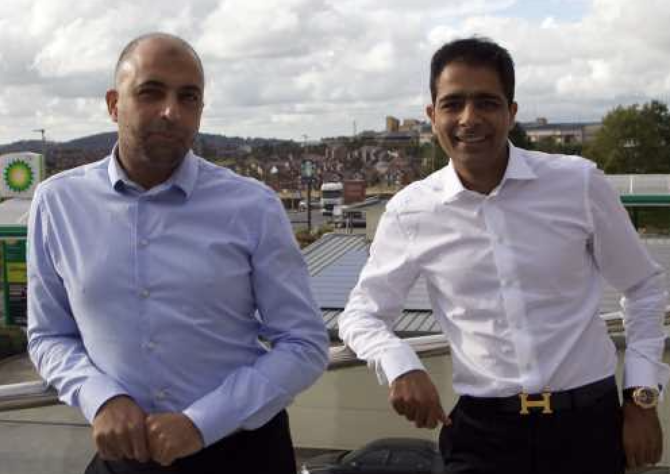
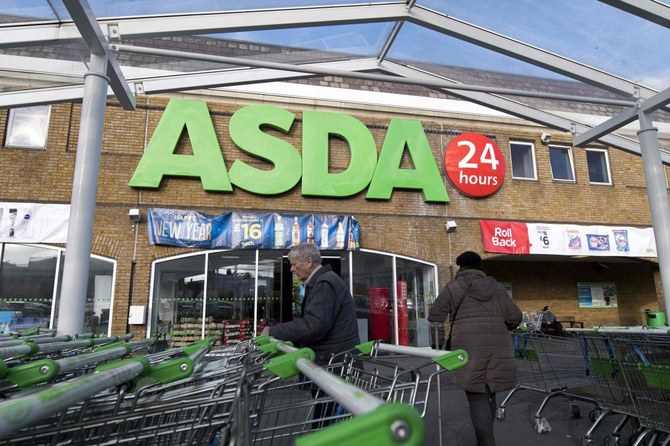
LONDON: The British Muslim billionaire Issa brothers and private equity group TDR Capital have agreed to buy the British supermarket chain Asda from Walmart for an enterprise value of $8.8 billion and plan to roll out more smaller stores.
The deal will enable Mohsin and Zuber Issa, who founded petrol station operator EG Group nearly two decades ago, to take Asda back under British ownership for the first time since 1999, when Walmart paid 6.7 billion pounds for the business.
The new owners want to drive growth at Britain’s third-biggest supermarket chain by expanding its presence into smaller neighborhood shops to add to its large supermarket format, bringing it more in line with competitors Tesco and Sainsbury’s which offer both.
Walmart will retain an unspecified equity investment in the business, an ongoing commercial relationship and a seat on the board, while British retail veteran Roger Burnley will remain in charge at Asda.
“After a successful period as part of Walmart we are looking forward to helping Asda build a differentiated business that will continue to serve customers brilliantly in communities across the UK,” the brothers said.
The new owners will invest more than 1 billion pounds in the next three years in Asda to keep prices low and to protect its supply chains.
British finance minister Rishi Sunak welcomed the deal for Asda which will retain its headquarters in the northern English city of Leeds.
Britain’s highly competitive supermarket sector has been upended this year by the COVID-19 crisis which sparked a jump in sales — and costs — as shoppers stocked up on goods during lengthy lockdowns.
While Asda’s sales increased, the chain still lagged market leader Tesco, Sainsbury’s, and smaller rival Morrisons.
All of the so-called big-four supermarket chains have also faced fierce competition from German discounters Aldi and Lidl in recent years.
In response, Walmart previously sought to sell Asda to Sainsbury’s for 7.3 billion pounds but the deal was thwarted by Britain’s competition regulator last year.
The lower price announced on Friday reflects the integration benefits that a merged Asda-Sainsbury’s would have produced. ($1 = 0.7744 pounds)


Walmart sells Asda to billionaire British Muslim brothers and TDR for $8.8 bln
https://arab.news/wedd8
Walmart sells Asda to billionaire British Muslim brothers and TDR for $8.8 bln

- The new owners want to drive growth at the supermarket chain by expanding its presence into smaller neighborhood shops to add to its large supermarket format
- The new owners will invest more than 1 billion pounds in the next three years in Asda to keep prices low


Al Habtoor Group to take legal measures against Lebanon over $1.7bn investment losses
RIYADH: Al Habtoor Group said it will move forward with legal action against Lebanon after years of unresolved investment disputes and mounting losses of $1.7 billon linked to banking restrictions and state inaction, according to an official statement.
The UAE-based conglomerate said it has been a long-term foreign investor in Lebanon, with investments across hospitality, luxury hotels, and retail, as well as leisure, real estate and banking-related activities, describing these as “an integral part of the Group’s long-term productive presence in the country.”
The firm said measures taken by the country’s goverment, combined with Lebanon’s prolonged political, economic, financial, and social crises, have caused the damages and losses.
The company said its investments were made “in good faith and in reliance on Lebanese law,” as well as on obligations set out under the bilateral investment treaty between the UAE and Lebanon, in force since 1999.
According to the statement, the group’s assets in Lebanon have suffered “severe and sustained harm” as a result of measures imposed by Lebanese authorities and the Banque du Liban that prevented it from accessing and transferring lawfully deposited funds.
“These enormous losses are not limited to the unlawful deprivation of access to the Group’s funds in the Lebanese banks, but also arise from the broader collapse of institutional stability and the failure of the Lebanese government to take timely and necessary measures to protect foreign investments and private properties,” the statement said.
Al Habtoor Group said the obligation to safeguard investments and compensate for losses “is not a matter of discretion or goodwill, but rather a legal obligation arising under binding bilateral agreements and international investment treaties concluded with the United Arab Emirates.” It added that these treaties impose “clear duties on Lebanon to ensure protection, fair treatment, and effective remedies for investors.”
In early January 2024, the group said it formally notified the Lebanese government of an investment dispute through an international law firm specializing in sovereign and treaty-based cases, triggering the six-month cooling-off period prescribed under the bilateral treaty. The objective, the company said, was to reach an amicable resolution.
However, the statement said that “despite sustained good-faith efforts and extensive institutional engagement,” no meaningful progress or corrective action was taken by the relevant authorities.
“Investor protection is not discretionary, it is a fundamental obligation under international law and a prerequisite for economic credibility and stability,” the statement said.
While the group said it remains open to “lawful and constructive solutions that restore its rights in full,” it added that it “cannot and will not continue to absorb additional losses arising from prolonged inaction, negligence and systemic failure.”
As a result, the company said it has exhausted all reasonable efforts to resolve the dispute amicably and “has no other alternative but to advance this matter further and proceed to take all legal measures necessary to protect and enforce its rights under applicable international agreements and legal frameworks.”
Al Habtoor Group is one of the largest conglomerates in the UAE, with operations spanning hospitality, automotive, real estate and education.
The legal escalation outlined in the group’s latest statement follows a series of public warnings made by Al Habtoor Group and its chairman in late 2023, when the company signaled it was prepared to withdraw entirely from Lebanon if protections for foreign investors were not restored.
In a December 2023 interview with Arab News, chairman Khalaf Al-Habtoor said the group was prepared to pursue international legal remedies, stating that it was ready to enlist “high-caliber law firms overseas” to recover assets affected by banking restrictions and the broader economic collapse.
He warned that continued inaction by the Lebanese authorities would leave the group with limited options, adding: “If I find a buyer now for everything I invested there with a negotiable price, I will sell it.”
At the time, Al-Habtoor said the group’s direct investments in Lebanon exceeded $1 billion, with a further $500 million in indirect exposure, but noted that the current value of those investments had been severely eroded.
He also highlighted the human cost of the crisis, citing approximately 500 employees in Lebanon and explaining the decision to keep hotel operations running despite losses