US says ‘can’t tolerate’ attacks by Iranian-backed militias in Iraq

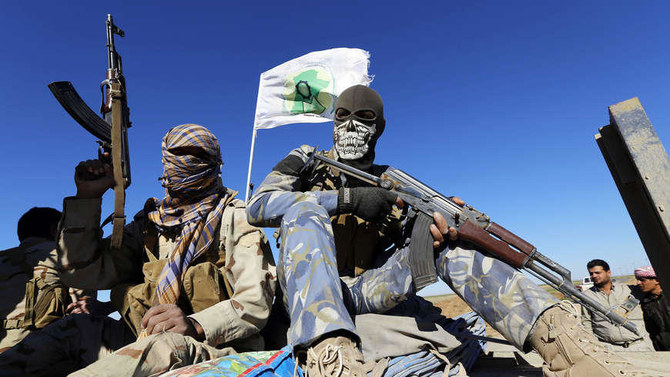
Masked Shiite fighters hold their weapons in Al Hadidiya, south of Tikrit, Iraq. (Reuters/File Photo)
Short Url
Updated 01 October 2020
Follow

US says ‘can’t tolerate’ attacks by Iranian-backed militias in Iraq

  • Iraq has long been caught in a tug-of-war between its allies Iran and the US
  • Iraq said Monday it was “not happy” with the reported American pullout threat

WASHINGTON: The US administration warned Thursday that it would not tolerate attacks on American interests in Iraq by Iran-backed militias, as Baghdad worries about a possible US withdrawal.

“We can’t tolerate the threats to our people, our men and women serving abroad,” David Schenker, assistant secretary of state, for near Eastern affairs, told reporters.

Schenker did not confirm or deny a reported US threat to withdraw its troop and close its embassy in Baghdad unless the attacks against them stop.

“We are working, and we look forward to continuing to work with our Iraqi partners to keep our personnel and our facility safe,” he said.

Also on Thursday, the US envoy on Iran Elliott Abrams said Tehran was the “main engine of violence” in the Middle East and remained one of the main sponsors of global terrorism.

Several political and diplomatic sources have told AFP that US Secretary of State Mike Pompeo issued an ultimatum last week that all US personnel would leave Iraq unless the government puts a stop to a rash of attacks against them.

On Monday a wayward rocket targeting American troops killed seven civilians near Baghdad — one of around 40 attacks targeting US interests since early August.

Iraq said Monday it was “not happy” with the reported pullout threat.

A US withdrawal could lead to further pullouts by members of the US-led coalition fighting holdout extremists, which would be “dangerous, because the Daesh group threatens not only Iraq but the whole region,” Iraqi Foreign Minister Fuad Hussein said.

Iraq has long been caught in a tug-of-war between its allies Iran and the US, rendered rockier by Washington’s “maximum pressure” policy against Tehran since 2018.

On Wednesday evening several rockets fell in Iraq’s autonomous Kurdish region in the environs of a base used by the Democratic Party of Iranian Kurdistan, a commander for that group said.

Kurdish Iraqi authorities pinned the blame on the Hashed Al-Shaabi, an Iraqi state-sponsored paramilitary network dominated by pro-Iran forces.

“The single biggest problem in Iraq is the Iranian-backed militias that are undermining stability there, and attacking the United States,” Schenker said.

“The arms are not under the control of the central government. Groups continue to launch rockets at our embassy, attack Americans,” he said.


Sudan paramilitary advances near Ethiopia border

Updated 04 February 2026
Follow

Sudan paramilitary advances near Ethiopia border

  • Sudan’s Kordofan region, where the SPLM-N has its other foothold in the Nuba Mountains, is currently the war’s fiercest battleground

KHARTOUM: Sudanese paramilitary forces have advanced on army positions near the southeastern border with Ethiopia, according to the group and an eyewitness who spoke to AFP Wednesday.
Control over Sudan’s southeastern Blue Nile State, bordering both Ethiopia and South Sudan, is split between the army and a faction of the Sudan People’s Liberation Movement-North, allies of the paramilitary Rapid Support Forces.
In a statement released Tuesday, the SPLM-N, led by Abdelaziz Al-Hilu, said they had “liberated the strategic city of Deim Mansour and areas of Bashir Nuqu and Khor Al-Budi.”
Since April 2023, the Sudanese army has been at war with the RSF. In February of last year, the RSF announced a surprise alliance with the SPLM-N, securing experienced fighters, land and border access.
Deim Mansour lies between the SPLM-N stronghold Yabus, birthplace of their deputy commander Joseph Tuka, and the army-held town of Kurmuk, which hosts a large army contingent.
Babiker Khaled, who fled to Kurmuk, told AFP that SPLM-N fighters began amassing in the forests around Deim Mansour on Sunday.
“The shelling began on Monday, they entered the city on Tuesday,” he said, adding that “some people fled into Ethiopia, others arrived in Kurmuk.”
From its foothold in the southern Blue Nile, a thin strip of land jutting south between Ethiopia and South Sudan, the SPLM-N maintains reported supply lines from both countries, building on decades-old links.
Close to three years of war in Sudan have left tens of thousands dead and around 11 million displaced, creating the world’s largest hunger and displacement crises.
It has also torn the country apart, with the army holding the center, north and east of Sudan while the RSF and its allies dominate the west and parts of the south.
Sudan’s Kordofan region, where the SPLM-N has its other foothold in the Nuba Mountains, is currently the war’s fiercest battleground.
On Tuesday, the army broke a paramilitary siege on South Kordofan state capital Kadugli, days after breaking another on the nearby city of Dilling.