Pompeo calls for Greece-Turkey dialogue to ease tensions

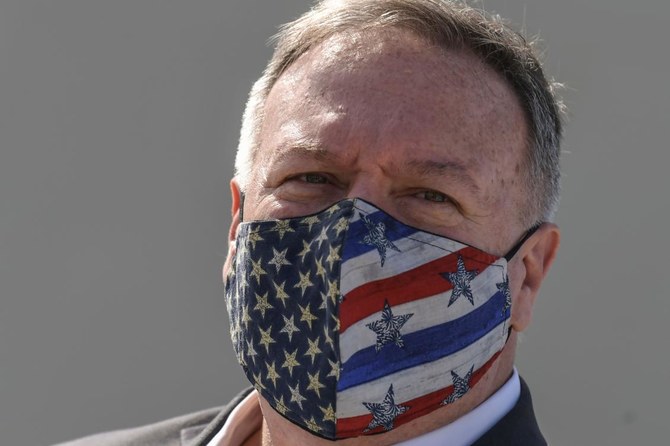
US Secretary of State Mike Pompeo last October signed a defense agreement with Greek authorities allowing US forces a broader use of Greek military facilities. (AFP)
Short Url
Updated 29 September 2020
Follow

Pompeo calls for Greece-Turkey dialogue to ease tensions

  • Pompeo is on a two-day visit to Greece – his second in a year – aimed at easing tensions between Greece and Turkey

SOÚDA, Greece: US Secretary of State Mike Pompeo on Tuesday said his country strongly backed talks between Greece and Turkey to de-escalate tensions over energy exploration in the eastern Mediterranean.
He also called for an end to fighting between Azerbaijani and Armenian forces in the breakaway region of Nagorny Karabakh and a return to negotiations “as quickly as possible.”
Pompeo is on a two-day visit to Greece – his second in a year – aimed at easing tensions between Greece and Turkey.
The two countries have spent weeks at loggerheads after Ankara sent exploration vessels into disputed, potentially resource-rich waters in a crisis that roped in other European powers and raised concern about a wider escalation.
“We strongly support dialogue between NATO allies Greece and Turkey and encourage them to resume discussion of these issues as soon as possible,” he said after visiting the NATO base of Souda Bay on Crete with Greek Prime Minister Kyriakos Mitsotakis.
On Wednesday, Pompeo will fly to Rome for meetings with Italian government and Vatican officials. He will subsequently visit Croatia on Friday.
Pompeo and Mitsotakis had earlier spoken to Souda base commanders and boarded a US special forces CCM speedboat and a Greek frigate, prior to a sit-down meeting.
Washington has urged the NATO allies and neighbors, who have agreed to continue exploratory talks interrupted in 2016, to find “good solutions” to regional disputes exacerbated by energy exploration disagreements.
“We hope the exploratory talks not only get kicked off right, but it’s important that they’re resolved in a way that delivers outcomes that each of the two nations find more than acceptable,” Pompeo told Greek state agency ANA on Monday.
“It’s not just talking, we need to get to good solutions,” he added.
In a joint statement on Monday after talks in Thessaloniki in northern Greece, Pompeo and his Greek counterpart Nikos Dendias said rival claims to territory in the Mediterranean should be resolved “peacefully in accordance with international law.”
The 44-hectare Naval Support Activity base at Souda is the foremost US naval facility in the eastern Mediterranean.
Mitsotakis — who is hosting Pompeo at his family home in Crete — wants closer military ties with the United States.
Pompeo last October signed a defense agreement with Greek authorities allowing US forces a broader use of Greek military facilities.
Greece intends to further upgrade the naval facilities at Souda for its own navy operations, Defense Minister Nikos Panagiotopoulos told parliament on Monday.
“Our country wants to make its presence felt in the eastern Mediterranean, and this will be done through the upgrade of Souda,” Panagiotopoulos said, according to ANA.
On Tuesday, Pompeo also called for an end to fighting between separatists in the ethnic Armenian enclave of Nagorny Karabakh and Azerbaijani forces.
“Both sides must stop the violence and work with the Minsk group ... to return to substantive negotiations as quickly as possible,” Pompeo said, referring to the so-called Minsk Group of mediators that includes France, Russia and the United States.
At least 95 people have been killed in the clashes that have been raging since the weekend, including 11 civilians, according to the latest available tallies.


What will the new Israeli measures change in the West Bank?

A Palestinian policeman directs the traffic in Hebron in the Israeli-occupied West Bank, February 9, 2026. (REUTERS)
Updated 7 sec ago
Follow

What will the new Israeli measures change in the West Bank?

  • The measures expand Israeli control over two major religious sites in the southern West Bank: Rachel’s Tomb near Bethlehem and the Cave of the Patriarchs in Hebron, both holy to Jews, Christians and Muslims
  • More than 500,000 Israeli settlers live among three million Palestinians in the West Bank

RAMALLAH, Palestinian Territories: New Israeli measures for the occupied West Bank, announced over the weekend, are expected to accelerate the territory’s annexation, ease land purchases by settlers and push Palestinians into increasingly isolated enclaves.
The full text of the latest decisions remains classified, but some details were disclosed in a statement. While it was unclear when the new rules would take effect, they do not require further approval.
Below are key changes that are expected to reshape the West Bank.

- Easy land purchases by settlers? -

Far-right Finance Minister Bezalel Smotrich, a member of the security cabinet who himself lives in a settlement, said the moves would make it easy for settlers to purchase land in the West Bank, occupied by Israel since 1967.
Until now, land acquisitions for settlers were typically carried out through intermediary companies.
The new measures repeal a decades-old law that barred Jews from directly purchasing land in the West Bank.
“This will allow Jews to purchase land in Judea and Samaria exactly as they do in Tel Aviv or Jerusalem,” Smotrich said.
Under the new rules, Israelis or companies registered in their name will no longer require a special permit from the state to complete land transactions.
Peace Now, an Israeli anti-settlement watchdog, said the permit system had been intended “to prevent forgeries and to curb settlers’ real-estate initiatives that contradict government policy.”
More than 500,000 Israeli settlers live among three million Palestinians in the West Bank.
Members of Netanyahu’s coalition like Smotrich or fellow far-right National Security Minister Itamar Ben Gvir are ardent supporters of the settlement movement, and have long advocated annexing the West Bank.
“Smotrich, Ben Gvir and the rest of them have been telling us that this is their policy,” Palestinian political scientist Ali Jarbawi told AFP.
“Now it has come to fruition.”
The current Israeli government has fast-tracked settlement expansion, approving a record 52 settlements in 2025.

- Palestinians to live in enclaves? -

The measures will also increase Israel’s control in parts of the West Bank where the Ramallah-based Palestinian Authority exercises power.
Under the Oslo Accords of the 1990s, the West Bank was divided into areas A, B, and C — under Palestinian, mixed and Israeli governance respectively.
According to Smotrich, the new measures will extend greater Israeli authority into A and B “with regard to water offenses, damage to archaeological sites, and environmental hazards that pollute the entire region.”
Palestinian experts warn the initiatives would displace Palestinians living near archaeological sites, landfills or springs, with Jarbawi saying Israel wants “to drive Palestinians into small pieces of land, basically, their major cities, enclaves.”
Yonatan Mizrachi of Peace Now said the steps would further weaken the Palestinian Authority — established under the Oslo Accords as an interim governing body pending the creation of a Palestinian state — accusing Israel of “advancing annexation.”

- More Israeli control over religious sites? -

The measures expand Israeli control over two major religious sites in the southern West Bank: Rachel’s Tomb near Bethlehem and the Cave of the Patriarchs in Hebron, both holy to Jews, Christians and Muslims.
In Hebron, the West Bank’s largest Palestinian city, municipal bylaws will be amended to transfer building-permit authority in areas around the Cave of the Patriarchs, known to Muslims as the Ibrahimi Mosque, to COGAT, Israel’s military body overseeing civilian affairs in the Palestinian territories.
Asma Al-Sharbati, Hebron’s deputy mayor, called the move “the most dangerous ongoing Israeli trend,” adding settlement expansion was happening at a “rapid pace.”
Rachel’s Tomb, currently administered by the Bethlehem municipality, will similarly be placed under a newly created Israeli authority.