

Arabs must ‘wake up’ to growing threats to regional identity: Arab League chief

1 / 2
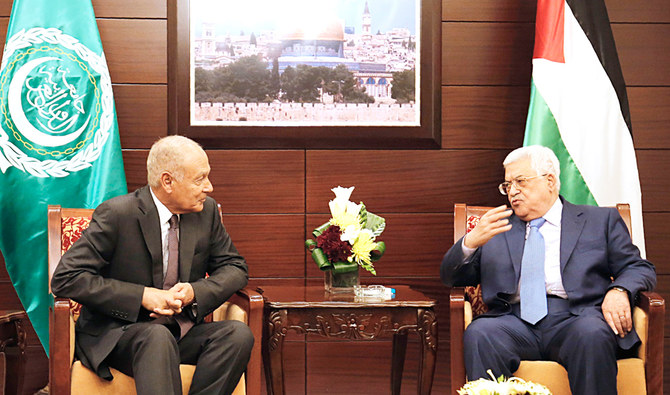
Arab League Secretary-General Ahmed Aboul Gheit holds talks with Palestinian President Mahmoud Abbas in the West Bank city of Ramallah last year. (File/AFP)
2 / 2
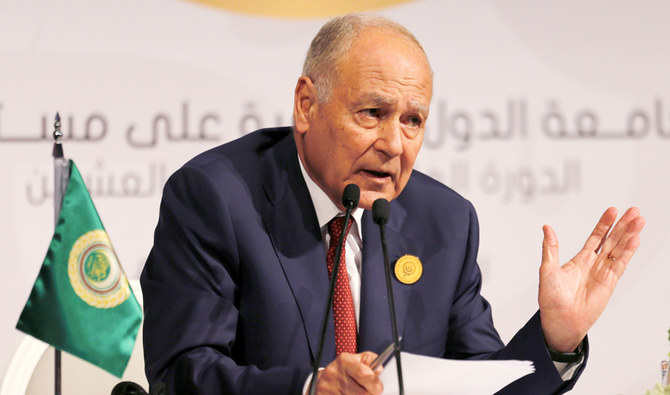
Secretary-General of Arab League, Ahmed Aboul Gheit speaks during a news conference after the 29th Arab Summit in Dhahran, Saudi Arabia, April 15, 2018. (REUTERS)
Short Url
Updated 29 September 2020
Follow

Arabs must ‘wake up’ to growing threats to regional identity: Arab League chief

  • The so-called Abraham Accords between Israel, Bahrain, and the UAE were signed under the auspices of Trump at the White House on Sept. 15

CAIRO: The Arab League’s secretary-general has appealed for Arabs to “wake up” to the growing threats to regional identity posed by Iran, Turkey, and Israel.
Ahmed Aboul Gheit warned that any erosion of the league’s role — to promote closer political, economic, cultural, and social relations among member states — may lead to a “handover” of control of the region to other countries.
He pointed out that Iran and Turkey were interfering in the affairs of many Arab states, Ethiopia was imposing its power over Nile waters, and the Palestinian issue was becoming more complicated, all of which was putting pressure on the Arab League and the whole region. And he condemned recent calls for the work of the Arab League to be ended.
“End the Arab League and we hand over the region to Turkey and Iran who will establish the Middle East region, allow Israel in and control the entire region.

FASTFACT

Arab League Secretary-General Ahmed Aboul Gheit said he appreciated Palestinian concerns regarding the agreements signed by the UAE and Bahrain with Israel.

“We Arabs must wake up because there is a threatening pressure on the Arab identity of the region,” he added. Aboul Gheit’s comments came as he spoke to media about his hope for Palestinian “action” following the agreement between Israel and the UAE to establish normal political and economic relations.
He said the historic peace deal, along with a similar US-brokered normalization accord between Israel and Bahrain, had succeeded in irreversible halting of Israeli plans for annexing parts of the West Bank.
He added that he appreciated Palestinian concerns regarding the agreements and accused US President Donald Trump’s administration of having been unfair to the Palestinians. In the wake of the Oslo Accords (between Israel and the Palestine Liberation Organization), Arab states had started opening offices in Israel, noted Aboul Gheit, but following the uprising they had withdrawn their representatives.
Since the Arab Spring, a number of Arab countries had collapsed or had been weakened under the bullying influences of other regional parties, he said, and internal conditions had led to the emergence of political Islam on an unprecedented scale, leaving a current situation he described as catastrophic.
The so-called Abraham Accords between Israel, Bahrain, and the UAE were signed under the auspices of Trump at the White House on Sept. 15.


Iran temporarily closes airspace to most flights

Updated 13 sec ago
Follow

Iran temporarily closes airspace to most flights

WASHINGTON: Iran temporarily closed its airspace to all flights except international ones to and from Iran with official ​permission at 5:15 p.m. ET  on Wednesday, according to a notice posted on the Federal Aviation Administration’s website. The prohibition is set to last for more than two hours until 7:30 p.m. ET, or 0030 GMT, but could be extended, the notice said. The United States was withdrawing some personnel from bases in the Middle East, a US official said on Wednesday, after a senior Iranian official said ‌Tehran had warned ‌neighbors it would hit American bases if ‌Washington ⁠strikes. Missile ​and drone ‌barrages in a growing number of conflict zones represent a high risk to airline traffic. India’s largest airline, IndiGo said some of its international flights would be impacted by Iran’s sudden airspace closure. A flight by Russia’s Aeroflot bound for Tehran returned to Moscow after the closure, according to tracking data from Flightradar24. Earlier on Wednesday, Germany issued a new directive cautioning the ⁠country’s airlines from entering Iranian airspace, shortly after Lufthansa rejigged its flight operations across the Middle ‌East amid escalating tensions in the ‍region.
The United States already prohibits ‍all US commercial flights from overflying Iran and there are no ‍direct flights between the countries. Airline operators like flydubai and Turkish Airlines have canceled multiple flights to Iran in the past week. “Several airlines have already reduced or suspended services, and most carriers are avoiding Iranian airspace,” said Safe Airspace, a ​website run by OPSGROUP, a membership-based organization that shares flight risk information. “The situation may signal further security or military activity, ⁠including the risk of missile launches or heightened air defense, increasing the risk of misidentification of civil traffic.” Lufthansa said on Wednesday that it would bypass Iranian and Iraqi airspace until further notice while it would only operate day flights to Tel Aviv and Amman from Wednesday until Monday next week so that crew would not have to stay overnight. Some flights could also be canceled as a result of these actions, it added in a statement. Italian carrier ITA Airways, in which Lufthansa Group is now a major shareholder, said that it would similarly suspend night flights ‌to Tel Aviv until Tuesday next week.
