

UK to return looted Sumerian artifact to Iraq

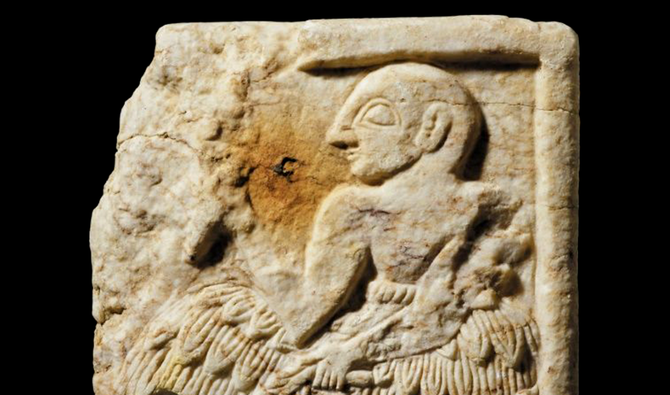
A handout picture released by the British Museum in London on 28 September 2020 shows a Sumerian plaque, dating to around 2400BC, and belonging to the Early Dynastic III period of southern Iraq, that was smuggled out of Iraq and then seized from an online auction site by the UK authorities. (Reuters)
Short Url
Updated 28 September 2020
Follow

UK to return looted Sumerian artifact to Iraq

  • Temple plaque found in online auction spotted by experts at British Museum
  • Thought to have been stolen from Tello in southern Iraq, site of ancient city of Girsu

LONDON: An ancient artifact that may have been looted before being smuggled to the UK is set to return to Iraq.

The item is a Sumerian temple plaque featuring the seated figure of a high priest or ruler, carved from limestone and dating from around 2400 BC.

It will be sent to Iraq, where it is thought to have originated, after it was spotted for sale and seized by police in 2019 following a tip off by experts at the British Museum in London.

The plaque will be put on display to the public for the next two months at the museum before its repatriation.

Prior to its discovery, no record of the plaque was found in any official record or museum inventory, lending credence to the theory that it may have been looted.

It bears physical resemblances to other Sumerian artifacts discovered at Girsu, one of the world’s oldest known settlements, at modern-day Tello in southern Iraq.

Girsu, originally excavated by French archaeologists from the late 19th century, has also been the focus of researchers from the British Museum in recent years. Even now, only a small part of the site has been successfully excavated.

The trade in stolen and smuggled items of huge value from the Middle East is lucrative, and a constant source of dialogue between the British Museum and international police forces hunting stolen goods.

“We’re used to coming across tablets, pots, metalwork, seals and figurines on the art market or in seizures that have been trafficked. But it’s really exceptional to see something of this quality,” said Dr. St. John Simpson, the museum’s senior curator.

“There are only about 50 examples of these known from ancient Mesopotamia. So that immediately places it on the high-rarity scale,” he added.

“We can be fairly sure that this object comes from the Sumerian heartland. That is the area that got very badly looted between the 1990s and 2003.”

Christopher Wren of TimeLine Auctions, where the plaque was spotted for sale by Simpson’s colleague Sebastien Rey, admitted that it was possible that it had been looted from Iraq. 

“The vendor, who had casually and innocently acquired it from a German arts fair some years ago, was horrified to hear this and immediately volunteered to renounce any claim to ownership and expressed the wish that it be returned to its place of origin,” Wren said.

“The piece is not documented as having been looted and is not listed on any database, so it did not show on the checks undertaken by us.”

Mohammad Jaafar Al-Sadr, Iraq’s ambassador to the UK, said: “We extend our gratitude to the British Museum staff for their efforts and cooperation with us.”


From trends to routines — how beauty is evolving in the Gulf region

Updated 36 min 30 sec ago
Follow

From trends to routines — how beauty is evolving in the Gulf region

DUBAI: The beauty landscape in the Gulf is shifting, driven by a new generation of consumers who see skincare, self-care and digital discovery as part of their everyday lives. According to Nicole Nitschke, managing director of FACES Beauty Middle East, the region has moved far beyond simply buying products.

“Beauty in the GCC (Gulf Cooperation Council) has evolved from being product-focused to increasingly experience-driven, with consumers seeking solutions that combine effectiveness, self-care and personalization,” she told Arab News. 

Shoppers today may browse online, but many still want to touch, test and experience products in-store, creating what she describes as a balance between digital inspiration and physical retail.

That evolution is being led by Gen Z — those born between the late 1990s and early 2010s. “Gen Z in the GCC is informed, experimental and digitally connected,” Nitschke said. “Social media plays a major role in how young consumers discover and engage with beauty trends, and routines that support both appearance and wellbeing have become especially important to them.”

One of the most powerful trends shaping this generation is the rise of Asian and Korean beauty. Nitschke said: “The success of Korean beauty in the GCC is driven by a convergence of product excellence and innovation, accessible pricing and cultural influence. K-beauty is not just about products; it represents a broader lifestyle movement.”

From K-pop to K-dramas, Korean pop culture has created an aspirational pull that resonates strongly with young consumers in the region. But it is also about results, Nitschke said: “Its products deliver high quality and visible results.” 

In the Gulf’s climate, skincare routines have also become more purposeful. “GCC consumers are gravitating toward hydration-focused and barrier-supporting products, including essences, serums, ampoules and lightweight creams,” she said, adding that multi-step routines centered on skin health and self-care are especially popular.

Shoppers in the region are also highly aware of what they are putting on their skin, she says: “They are highly ingredient-conscious, value education and seek guidance that combines expertise with accessibility.”

Looking ahead, Nitschke believes Korean beauty is here to stay: “Korean beauty has become structurally integrated into the GCC market, influencing routines, expectations, and retail offerings.” It is no longer a passing trend, but a permanent part of how beauty is understood in the region.