

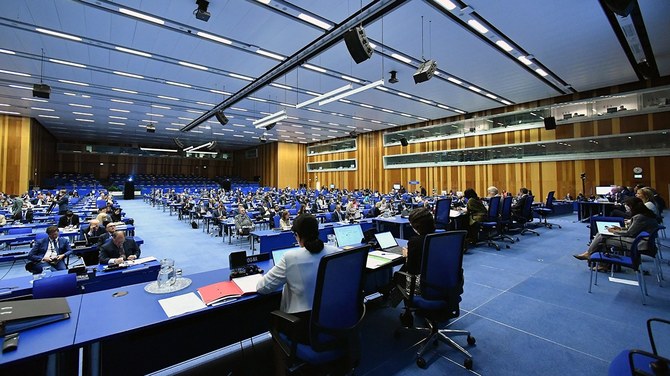
UAE re-elected to IAEA Board of Governors

The UAE had previously occupied the Board of Governors, one of International Atomic Energy Agency’s policy-making bodies. (WAM)
Short Url
Updated 26 September 2020
Follow

UAE re-elected to IAEA Board of Governors

  • The UAE recently activated the reactor of Unit 1 of the Barakah nuclear facility

DUBAI: The UAE has been re-elected to the Board of Governors of the International Atomic Energy Agency (IAEA) for another two-year period during the group’s annual general conference.

The UAE recently activated the reactor of Unit 1 of the Barakah nuclear facility, the first Arab country to develop and operate a nuclear power plant, achieving 50 percent of its electricity production capacity.

The Gulf nation had previously occupied the seat, one of IAEA’s policy-making bodies, from 2016 to 2018, from 2013 to 2015 and from 2010-2012.

The 35-member board examines and makes recommendations to the General Conference on the IAEA’s financial statements, program and budget. It considers applications for membership, approves safeguards agreements and the publication of the agency’s safety standards.

“The election of the UAE on IAEA’s Board of Governors underscores the confidence of the international community in the active role of the UAE in the international nuclear policy-making process,” said Hamad Al-Kaabi, permanent representative of the UAE to the IAEA, said in a statement.

“The move also underlines the global appreciation for the UAE’s successful efforts and its responsible approach towards the development of a peaceful nuclear energy program.”

With the recent startup of the first nuclear power reactor, UAE has progressed well in the development of its national peaceful nuclear energy program.


Iraq announces complete withdrawal of US-led coalition from federal territory

Updated 3 sec ago
Follow

Iraq announces complete withdrawal of US-led coalition from federal territory

  • The vast majority of coalition forces had withdrawn from Iraqi bases under a 2024 deal between Baghdad and Washington
  • US and allied troops had been deployed to Iraq and Syria since 2014 to fight the Daesh group

BAGHDAD: Iraq said on Sunday US-led coalition forces had finished withdrawing from bases within the country’s federal territory, which excludes the autonomous northern Kurdistan region.
“We announce today... the completion of the evacuation of all military bases and leadership headquarters in the official federal areas of Iraq of advisers” of the US-led coalition, the military committee tasked with overseeing the end of the coalition’s mission said.
With the withdrawal, “these sites come under the full control of Iraqi security forces,” it said in the statement, adding that they would transition to “the stage of bilateral security relations with the United States.”
The vast majority of coalition forces had withdrawn from Iraqi bases under a 2024 deal between Baghdad and Washington outlining the end of the mission in Iraq by the end of 2025 and by September 2026 in the Kurdistan region.
US and allied troops had been deployed to Iraq and Syria since 2014 to fight the Daesh group, which had seized large swathes of both countries to declare their so-called “caliphate.”
The militant group, also known as “Islamic State,” was territorially defeated in Iraq in 2017 and in Syria in 2019, but continues to operate sleeper cells.
The vast majority of coalition troops withdrew from Iraq over previous stages, with only advisers remaining in the country.
The military committee on Sunday said Iraqi forces were now “fully capable of preventing the reappearance of IS in Iraq and its infiltration across borders.”
“Coordination with the international coalition will continue with regards to completely eliminating IS’s presence in Syria,” it added.
It pointed to “the coalition’s role in Iraq offering cross-border logistical support for operations in Syria, through their presence at an air base in Irbil,” the capital of Iraq’s Kurdistan region.
In December, two US soldiers and a civilian interpreter were killed in Syria in an attack blamed on IS, sparking fears of a resurgence in the country.
The statement added that anti-IS operations would be coordinated with the coalition through the Ain Assad base in Anbar province in western Iraq.
IS attacks in Iraq have massively declined in recent years, but the group maintains a presence in the country’s mountainous areas.
A UN Security Council report in August said: “In Iraq, the group has focused on rebuilding networks along the Syrian border and restoring capacity in the Badia region.”