

Yemen’s terrifying, severely damaged road to Taiz on brink of collapse

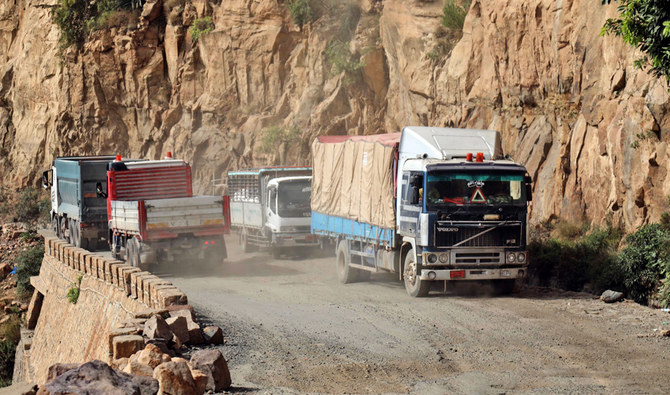
Vehicles are pictured on a damaged road, the only travel route between Yemen’s cities of Taiz and Aden. Yemen has been left in ruins by six years of war, where over 24 million people are in need of aid and protection. (AFP)
Short Url
Updated 26 September 2020
Follow

Yemen’s terrifying, severely damaged road to Taiz on brink of collapse

  • Convoys of vehicles big and small move at a snail’s pace as they squeeze past each other on the narrow road that has been severely damaged over the years by heavy rainfall

TAIZ: Lorries filled to the brim with goods labor up and down the dangerously winding and precipitous road of Hayjat Al-Abed, the mountainous lifeline to Yemen’s third largest city.
Unlike all other routes linking southwest Taiz to the rest of the war-torn country, the road — with its dizzying drop-offs into the valley below — is the only one that has not fallen into the hands of the Houthi rebels.
Some 500,000 inhabitants of the city, which is besieged by the Iran-backed Houthis, depend on the 7-km stretch of crater-filled road for survival, as the long conflict between the insurgents and the government shows no signs of abating.
Convoys of vehicles big and small move at a snail’s pace as they squeeze past each other on the narrow road that has been severely damaged over the years by heavy rainfall.
“As you can see, it is full of potholes, and we face dangerous slopes,” Marwan Al-Makhtary, a young truck driver, told AFP. “Sometimes trucks can no longer move forward, so they stop and roll back.”
Makhtary said nothing was being done to fix the road, and fears are mounting that the inexorable deterioration will ultimately bring the supply of goods to a halt.
Dozens of Taiz residents on Tuesday urged the government to take action, forming a human chain along the road — some of them carrying signs saying: “Save Taiz’s Lifeline.”

NUMBER

500,000 inhabitants of Taiz, which is besieged by the Iran-backed Houthis, depend on the 7-km stretch of crater-filled road for survival.

“We demand the legitimate government and local administration accelerate efforts to maintain and fix the road,” said one of the protesters, Abdeljaber Numan.
“This is the only road that connects Taiz with the outside world, and the blocking of this artery would threaten the city.”
Sultan Al-Dahbaly, who is responsible for road maintenance in the local administration, said the closure of the road would represent a “humanitarian disaster” in a country already in crisis and where the majority of the population is dependent on aid.
“It is considered a lifeline of the city of Taiz, and it must be serviced as soon as possible because about 5 million people (in the province) would be affected,” he told AFP.

Humanitarian aid
Meanwhile, Yemen’s president on Thursday urged his government’s rival, the Iran-backed Houthi rebels, to stop impeding the flow of urgently needed humanitarian aid following a warning from the UN humanitarian chief last week that “the specter of famine” has returned to the conflict-torn country.
President Abed Rabbo Mansour Hadi’s plea came in a prerecorded speech to the UN General Assembly’s ministerial meeting being held virtually because of the COVID-19 pandemic. It aired more than a week after Human Rights Watch warned that all sides in Yemen’s conflict were interfering with the arrival of food, health care supplies, water and sanitation support.


UN: Sudan war civilian death toll more than doubled in 2025

Updated 3 sec ago
Follow

UN: Sudan war civilian death toll more than doubled in 2025

  • Rights chief Volker Turk says RSF paramilitaries inflicted "carnage” in attacks last year on Zamzam campand El-Fasher in Darfur
  • Recent drone attacks in Kordofan region and elsewhere have 'killed or injured nearly 600 civilians'
GENEVA: Killings of civilians in Sudan’s war more than doubled in 2025 compared with the previous year, the United Nations rights chief said Thursday, warning that thousands more dead are unidentified or remain missing.
Since April 2023, Sudan has been engulfed in a conflict between the army and the Rapid Support Forces (RSF) that has killed tens of thousands, displaced 11 million people and triggered one of the world’s worst humanitarian crises.
“This war is ugly. It’s bloody and it’s senseless,” Volker Turk told the UN Human Rights Council, blaming both warring sides, which have so far rejected any form of humanitarian truce. He also blamed foreign sponsors funding what he called a “high-tech” conflict.
“In 2025, my office’s documentation points to an over two and a half times increase in killings of civilians compared with the previous year. Many thousands are still missing or unidentified,” Turk said.
There have been no official figures on the overall death toll in the conflict.
Turk condemned what he called the “heinous and ruthless” brutalities committed, including sexual violence, summary executions and arbitrary detentions.
He highlighted “carnage” inflicted by the RSF during an attack on the Zamzam displacement camp in April, and again in October in El-Fasher, which was the army’s last foothold in western Darfur.
Sexual violence, including rape, gang rape, sexual torture and slavery, has also surged, Turk said, with more than 500 victims documented in 2025. “The bodies of Sudanese women and girls have been weaponized to terrorize communities.”
He added that he is “extremely worried these crimes may be repeated.”

- ‘Madness’ -

Since the fall of El-Fasher, the fighting has moved deeper into neighboring Kordofan where drone strikes have killed dozens at a time.
Since January, escalating drone attacks in the southern Kordofan region and beyond have “killed or injured nearly 600 civilians,” Turk said, including in attacks on humanitarian aid convoys.
The UN’s resident and humanitarian coordinator for Sudan, Denise Brown, said on Thursday that access to the cities of Kadugli and Dilling in South Kordofan — long cut off by an RSF siege until the army recently lifted it — had been effectively impossible.
“We were not able to get supplies in. We had to remove our staff for their own safety,” she said, after stepping off the first UN flight to Khartoum since the war began on Thursday.
Famine was declared last November in the North Darfur capital El-Fasher and in Kadugli, the capital of South Kordofan, according to a UN-backed assessment. The same assessment said Dilling in South Kordofan is also likely facing famine conditions.
Turk said both the army and the RSF continued to use “explosive weapons in densely populated areas, often without warning — showing utter disregard for human life.”
Turk highlighted the “increased use of advanced long-range drones,” which has “expanded harm to civilians in areas far from the front lines that were previously peaceful.”
Turk also voiced concern over “the growing militarization of society,” including the recruitment of children and young people into the fighting.