

A Middle East coronavirus web resource has global resonance

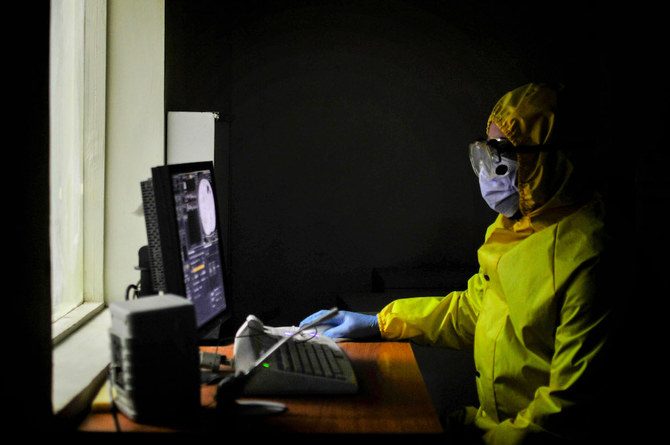
One of the most popular websites for monitoring activity relating to the SARS-CoV-2 coronavirus comes from the Middle East region. (AFP/File Photo)
Short Url
Updated 26 September 2020
Follow

A Middle East coronavirus web resource has global resonance

  • Corona Meter is a free resource that attracts tens of thousands of visitors every day from across the world
  • Building the coronameter.co website took the team of developers a few days from conception to launch

DUBAI: One of the most popular websites for monitoring activity relating to the SARS-CoV-2 coronavirus comes from this very region. Launched in March, coronameter.co is a free resource that attracts tens of thousands of visitors every day, getting traffic from as far afield as Argentina and India.

Using daily data from the renowned Johns Hopkins University in the US, the website displays a vast array of statistics presented for easy comprehension.

Data includes the total number of confirmed cases, mortality rates and infection doubling time in the preceding seven days, all broken down by country. A time-lapse graph shows how the disease initially struck China, Iran and Italy before the US, Brazil and Britain became the worst affected nations.

There is also a globe that enables users to click on any country and see its COVID-19 statistics.

“It all started when the (World Health Organization) classified the coronavirus as a pandemic because, at that point, I knew it was going to be something for the long run. We had this urge to stay on top of it,” said Paris-based entrepreneur Amr Sobhy.
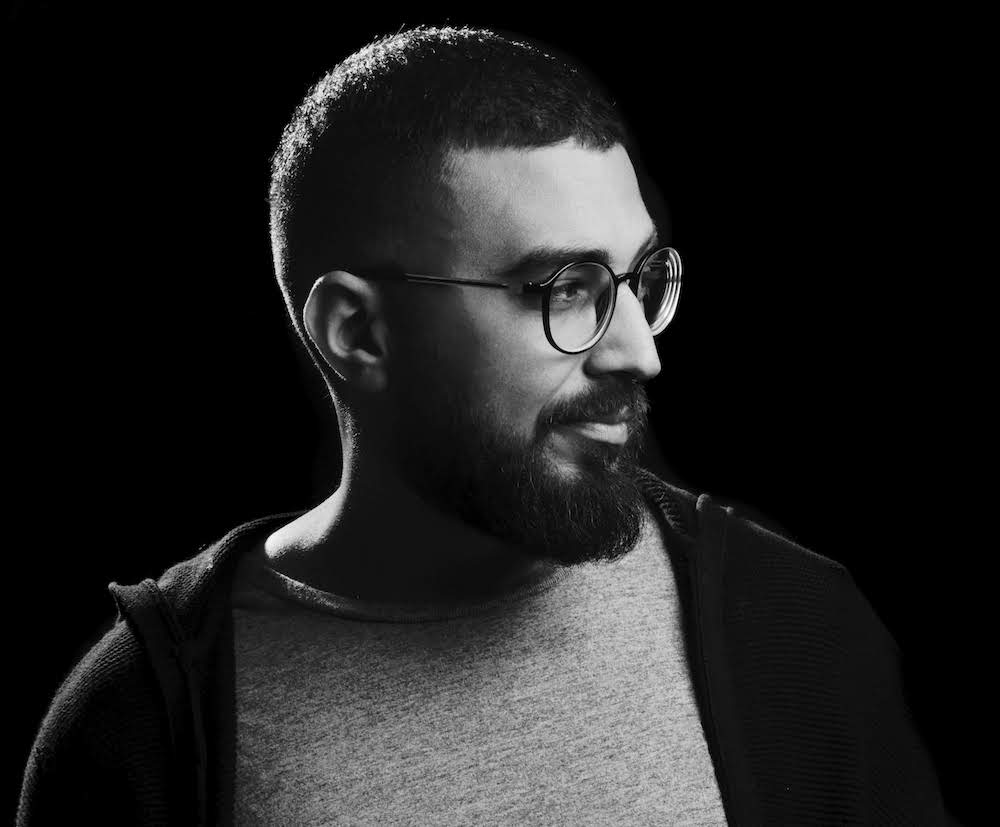


Paris-based entrepreneur Amr Sobhy who founded wesbite Corona Meter. (Supplied)

The 31-year-old talked with his friend and Corona Meter co-creator Mohamed Reda Eldehiry about their approach. Building the website took the team a few days from conception to launch, although the original idea has been expanded steadily, with more data points and graphics added.

“It’s a perpetual work in progress,” Sobhy said. “We wanted to provide something reliable in Arabic. Once we had enough data, we wanted to use (it) to answer the questions we thought were important.

“I wanted to see how the pandemic was developing over time in order to understand the gravity of the situation. Once we had things up and running, I started adding interesting visualizations.”

Initially available in Arabic and English, the website is now also in Russian, Hindi, French, Italian and Spanish.

“It’s an automated data stream although we have to keep on updating the software because inevitably there are bugs due to it not being designed to run on every device,” Sobhy said.

------

READ MORE: Egypt fitness startup eyes new market in coronavirus protective gear

------

As the demands grew, another engineer, Osama Sayed, joined the team to help manage the website.

What sets this product apart from other international ones is that it is accessible in the region. “Once you get the data, the next step is to use it to give people something meaningful,” said Sobhy, who is also the founder and CEO of PushBots, which sold two software-as-a-service (SaaS) products to an Austrian company last year.

IPtrace gives applications users’ geolocation data, while CurrencyStack provides real-time exchange rates for over 150 currencies.

“There are a lot of ways to make digital products, and we from the MENA region can compete globally,” he said. “Code is a building block to solve problems. It’s not an end but a means.”
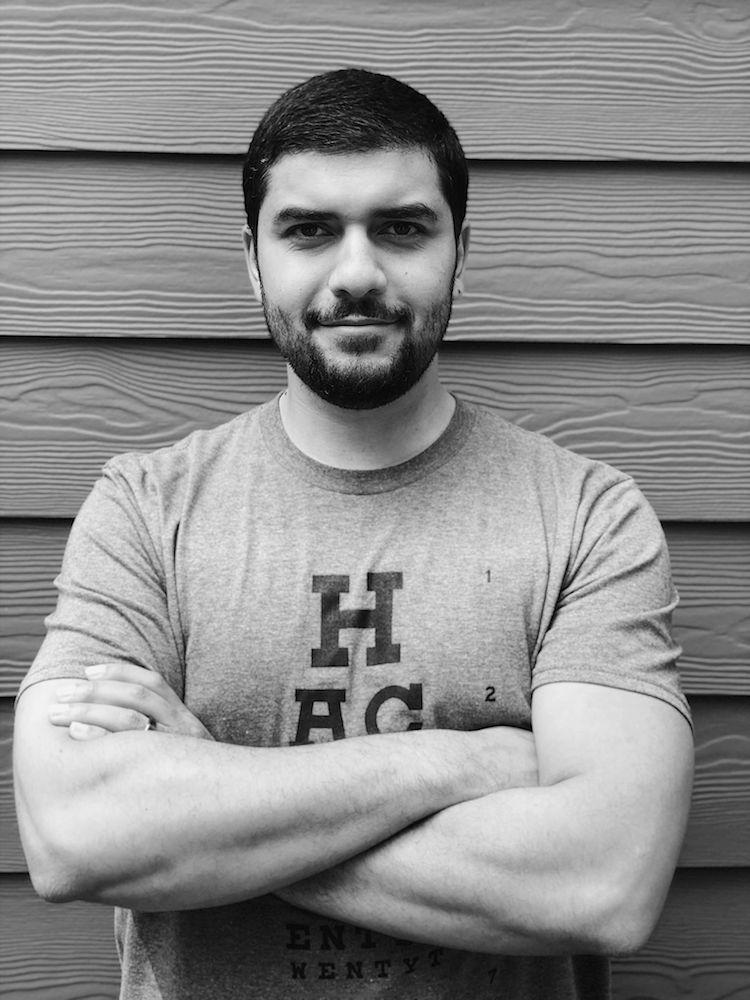


Corona Meter co-creator Mohamed Reda Eldehiry. (Supplied)

He believes the success of Corona Meter shows that the people of the Middle East can create products and services that will resonate globally.

“What I could see us do more in MENA is to use existing technologies to answer our own questions because otherwise, we’re just hoping that someone else does it for us,” Sobhy said.

“With technology comes the empowerment that we don’t have to wait. We can actually do it ourselves.”

-----------------------

This report is being published by Arab News as a partner of the Middle East Exchange, which was launched by the Mohammed bin Rashid Al Maktoum Global Initiatives to reflect the vision of the UAE prime minister and ruler of Dubai to explore the possibility of changing the status of the Arab region.


Women main victims of Sudan conflict abuses: minister to AFP

Updated 4 sec ago
Follow

Women main victims of Sudan conflict abuses: minister to AFP

  • Khalifa said sexual violence has been reported on both sides, but she insisted it is “systematic” among the RSF
  • Her ministry has documented more than 1,800 rapes between April 2023 and October 2025

PORT SUDAN: Women are the main victims of abuse in Sudan’s war, facing “the world’s worst” sexual violence and other crimes committed with impunity, a rights activist turned social affairs minister for the army-backed government told AFP.
The Sudanese army and the paramilitary Rapid Support Forces (RSF) have been locked in a brutal conflict since April 2023 that has killed tens of thousands of people, displaced around 11 million and been marked by widespread sexual violence.
Sulaima Ishaq Al-Khalifa said abuses against women routinely accompanied looting and attacks, with reports of rape often perpetrated as “the family witnessed” the crime.
“There is no age limit. A woman of 85 could be raped, a child of one year could be raped,” the trained psychologist told AFP at her home in Port Sudan.
The longtime women’s rights activist, recently appointed to the government, said that women were also being subjected to sexual slavery and trafficked to neighboring countries, alongside forced marriages arranged to avoid shame.
Khalifa said sexual violence has been reported on both sides, but she insisted it is “systematic” among the RSF, who she says use it “as a weapon of war” and for the purposes of “ethnic cleansing.”
Her ministry has documented more than 1,800 rapes between April 2023 and October 2025 — a figure that does not include atrocities documented in western Darfur and the neighboring Kordofan region from late October onwards.
“It’s about... humiliating people, forcing them to leave their houses and places and cities. And also breaking... the social fabrics,” Khalifa said.
“When you are using sexual violence as a weapon of war, that means you want to extend... the war forever,” because it feeds a “sense of revenge,” she added.

- ‘War crimes’ -

A report by the SIHA Network, an activist group that documents abuses against women in the Horn of Africa, found that more than three-quarters of recorded cases involved rape, with 87 percent attributed to the RSF.
The United Nations has repeatedly raised alarm over what it describes as targeted attacks on non?Arab communities in Darfur, while the International Criminal Court (ICC) has opened a formal investigation into “war crimes” by both sides.
Briefing the UN Security Council in mid-January, ICC deputy prosecutor Nazhat Shameem Khan said investigators had uncovered evidence of an “organized, calculated campaign” in El-Fasher — the army’s last stronghold in Darfur captured by the RSF in late October.
The campaign, Khan added, involved mass rapes and executions “on a massive scale,” sometimes “filmed and celebrated” by the perpetrators and “fueled by a sense of complete impunity.”
Darfur endured a brutal wave of atrocities in the early 2000s, and a former Janjaweed commander — from the militia structure that later evolved into the RSF — was recently found guilty by the International Criminal Court of multiple war crimes, including rape.
“What’s happening now is much more ugly. Because the mass rape thing is happening and documented,” said Khalifa.
RSF fighters carrying out the assaults “have been very proud about doing this and they don’t see it as a crime,” she added.
“You feel that they have a green light to do whatever they want.”
In Darfur, several survivors said RSF fighters “have been accusing them of being lesser people, like calling them ‘slaves’, and saying that when I’m attacking you, assaulting you sexually, I’m actually ‘honoring’ you, because I am more educated than you, or (of) more pure blood than you.”

- ‘Torture operation’ -

Women in Khartoum and Darfur, including El-Fasher, have described rapes carried out by a range of foreign nationals.
These were “mercenaries from West Africa, speaking French, including from Mali, Burkina Faso, Nigeria, Chad, as well as Colombia and Libya” — allegedly fighting alongside the RSF, Khalifa added.
Some victims were abducted and held as sexual slaves, while others were sold through trafficking networks operating across Sudan’s porous borders, said Khalifa.
Many of these cases remain difficult to document because of the collapse of state institutions.
In conservative communities, social stigma also remains a major obstacle to documenting the scale of the abuse.
Families often force victims into marriage to “cover up what happened,” particularly when pregnancies result from rape, according to the minister.
“We call it a torture operation,” she said, describing “frightening” cases in which children and adolescent girls under 18 are forced into marriage.