ISLAMABAD: Pakistani Prime Minister Imran Khan’s office has launched a new Twitter handle @ArabicIk to put out news and information about the PM in the Arabic language.
The account, which was launched in May 2020, has videos of Khan’s speeches and interviews along with Arabic messages.
Khan has 12.5 million followers on his official Twitter account, the largest of any Pakistani.
Pakistan enjoys close ties with many Arab countries, especially Saudi Arabia and the United Arab Emirates (UAE). Around 3 million Pakistani expats live and work in Saudi Arabia and UAE is also the second largest labor market for Pakistan workers.


![]()
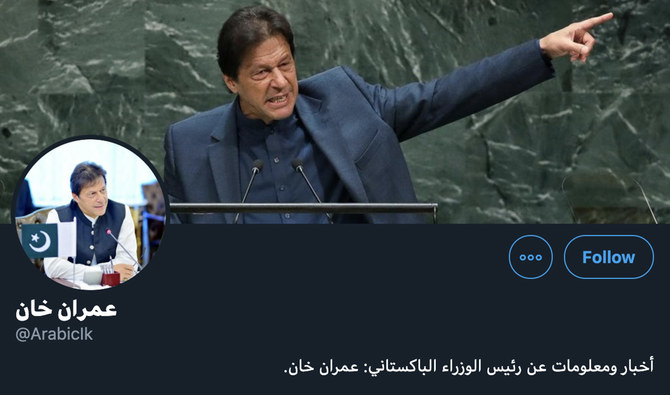

Pakistan PM launches Arabic language Twitter account

Short Url
https://arab.news/w8nez
Pakistan PM launches Arabic language Twitter account
- Khan has 12.5 million followers on his official Twitter account, the largest of any Pakistani
- Pakistan enjoys close ties with many Arab countries, especially Saudi Arabia and United Arab Emirates
Pakistan says Afghan forces opened ‘unprovoked’ border fire, warns of retaliation
- Incident follows Pakistan’s weekend strikes on TTP and Daesh targets inside Afghanistan
- Escalation threatens fragile ceasefire along 2,600-km frontier linking South and Central Asia
ISLAMABAD: Pakistan on Tuesday accused Afghan Taliban forces of opening “unprovoked” fire along their shared border and warned that any further aggression would draw a swift response.
The latest exchange comes amid sharply rising tensions between the two neighbors following Pakistan’s weekend strikes targeting what it described as Tehreek-e-Taliban Pakistan (TTP) and Daesh militant camps inside Afghanistan. Kabul said the strikes killed civilians and condemned them as violations of its sovereignty, vowing to respond.
Cross-border violence has intensified since Pakistan blamed recent suicide bombings in Islamabad, Bajaur and Bannu on militants it says are based in Afghanistan. Islamabad maintains that militant safe havens across the border are driving a surge in attacks inside Pakistan, a charge Kabul denies.
Mosharraf Zaidi, Prime Minister Shehbaz Sharif’s spokesperson for foreign media, said Afghan forces opened fire near the Torkham border crossing and Tirah Valley in Pakistan’s northwest.
“Pakistan’s security forces responded immediately and effectively silencing the Taliban aggression,” he told Arab News. “Any further provocation will be responded to immediately and severely, god willing. Pakistan will continue to protect its citizens and guard its territorial integrity.”
The incident marks the second major escalation in less than a year. Similar Pakistani strikes last year triggered weeklong clashes before Qatar, Turkiye and other regional actors mediated a tenuous ceasefire in October.
The 2,600-kilometer (1,600-mile) frontier, a key trade and transit corridor linking Pakistan to landlocked Afghanistan and onward to Central Asia, has faced repeated closures amid tensions, disrupting commerce and humanitarian movement. Trade between the two nations has remained closed since October.
Analysts warn that sustained military exchanges risk undermining diplomatic efforts to stabilize ties, including a Saudi-mediated initiative earlier this month that secured the release of three Pakistani soldiers.
Separately on Tuesday, Prime Minister Sharif discussed the situation in Afghanistan with Qatar’s Deputy Prime Minister Sheikh Saoud Al-Thani during talks in Doha, according to a statement from Sharif’s office. Both sides emphasized dialogue and de-escalation to promote regional stability.
Latest updates


© 2026 SAUDI RESEARCH & PUBLISHING COMPANY, All Rights Reserved And subject to Terms of Use Agreement.