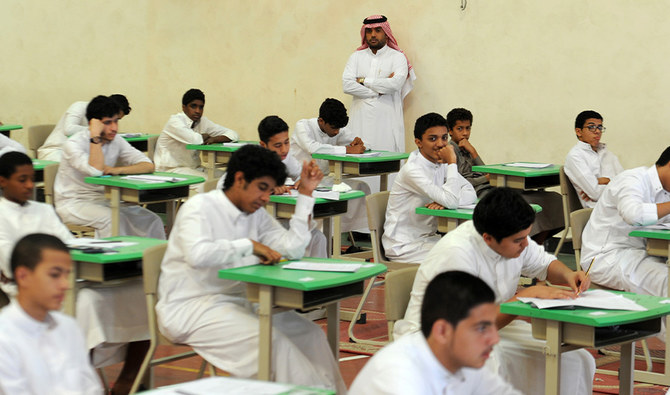
RIYADH: Saudi Arabia will teach the English language from first grade of primary school starting from the next academic year, the education minister said on Sunday.
Speaking during an interview with state-run Al-Ekhbariya TV’s Al-Raasd program, Hamad bin Mohammed Al-Asheikh, said that five courses have been approved for the next academic year, including a focus on science and mathematics.
The minister also said that digital education would begin from the fourth year.
“There will be some changes that aim to benefit students and the future citizen to become a graduate of education and qualified to compete on an international level,” Al-Asheikh said.
Four of the courses will be introduced to all schools, but he said the fifth would only be implemented in the major schools distributed throughout the Kingdom.
“The general education stage is an important stage and we cannot improve higher education without improving secondary education, and this will happen in 2021,” the minister said.
The minister added there would be certain subjects that would be taught remotely, and distance education will continue even after the coronavirus pandemic.

Saudi Arabia to introduce English language from first grade of primary school starting next academic year
https://arab.news/vxycb
Saudi Arabia to introduce English language from first grade of primary school starting next academic year
- The Ministry of Education says there will also be a focus on science and mathematics
- Digital education will begin from the fourth year
Saudi deputy FM attends OIC ministers’ meeting on Somalia situation
JEDDAH: Saudi Arabia Vice Minister of Foreign Affairs Waleed Elkhereiji has reaffirmed the Kingdom’s full support for Somalia’s sovereignty, unity and territorial integrity, while strongly rejecting any actions that undermine the country’s stability.
Speaking at an extraordinary meeting of foreign ministers from member states of the Organization of Islamic Cooperation, Elkhereiji condemned the declaration of mutual recognition between Israeli occupation authorities and the Somaliland region, describing it as a unilateral separatist move that violated international law, the UN Charter and the OIC Charter.
He stressed the Kingdom’s categorical rejection of any attempts to impose parallel entities that contradict Somalia’s unity and territorial integrity, or that seek to divide or diminish its sovereignty. Elkhereiji also reiterated Saudi Arabia’s support for Somalia’s legitimate state institutions and its commitment to preserving the country’s stability and the security of its people.
Elkhereiji called on the OIC and its member states to adopt a firm and unified Islamic position rejecting any recognition of, or engagement with, separatist entities in Somalia. He urged coordinated action in international forums to affirm Somalia’s unity and prevent what he described as dangerous precedents that could threaten the sovereignty of OIC member states.
He further called for holding the Israeli entity fully responsible for any political or security consequences resulting from such actions, and for rejecting any cooperation arising from the declaration of mutual recognition.
During the meeting, he also reiterated the Kingdom’s position on the Palestinian cause, emphasizing its centrality and Saudi Arabia’s support for efforts to secure a ceasefire in the Gaza Strip. He said this would enable the Palestinian people to exercise their right to self-determination and establish an independent state along the 1967 borders, with East Jerusalem as its capital.


