

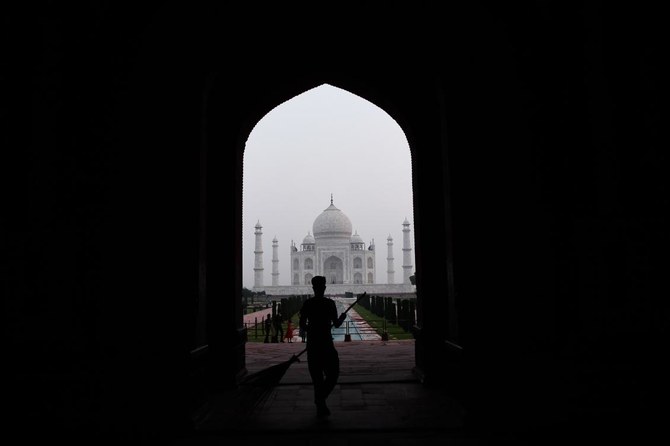
Taj Mahal reopens even as India coronavirus cases soar

The Taj Mahal reopens to visitors on September 21 in a symbolic business-as-usual gesture, even as India looks set to overtake the US as the global leader in coronavirus infections. (AFP)
Short Url
Updated 21 September 2020
Follow

Taj Mahal reopens even as India coronavirus cases soar

  • India, home to 1.3 billion people and some of the world’s most crowded cities, has recorded more than 5.4 million Covid-19 cases
  • Taj Mahal usually draws seven million visitors a year, but has been closed since March

AGRA: India’s famed Taj Mahal and some schools reopened on Monday as authorities pressed ahead with kickstarting the nation’s coronavirus-battered economy despite soaring infection numbers.
India, home to 1.3 billion people and some of the world’s most crowded cities, has recorded more than 5.4 million Covid-19 cases, second only to the United States which it could overtake soon.
But after a strict lockdown in March that devastated the livelihoods of tens of millions of people, Prime Minister Narendra Modi is reluctant to copy some other nations and tighten the screw on activity again.
Instead in recent months his government has eased more and more restrictions including on many train routes, domestic flights, markets, restaurants — and now, visiting the Taj Mahal.
“So many people lost their job during the lockdown. People have suffered a lot and it is time the country opens up fully,” said bank official Ayub Sheikh, 35, visiting the Taj with his wife and baby daughter.
“We are not afraid of the virus. If it has to infect us, it will,” Sheikh told AFP. “Not many people are dying now. I don’t think it is going to go away soon. We have to get used to it now.”
The jaw-dropping white-marble mausoleum in Agra south of New Delhi is India’s most popular tourist site. It usually draws seven million visitors a year, but has been closed since March.
Officials said strict social distancing rules were in place and visitors were not allowed to touch the marble. The famous bench where visitors sit for a photo — most memorably Princess Diana in 1992 — has been specially laminated so that it can be regularly sanitised without damage.
Early on Monday a couple of hundred of visitors were inside. Security personnel were reminding everyone to wear masks once photos have been clicked. Daily visitor numbers have been capped at 5,000 — a quarter the normal rate.
“Coronavirus is there in every country,” Spanish visitor Ainhoa Parra told AFP. “We are taking all the safety measures that we can. We have to be careful but if we have to get infected we will.”
“So many livelihoods depend on the Taj. It’s great to be back in business,” said local official Satish Joshi.

Elsewhere in India, particularly in rural areas where infections are soaring, anecdotal evidence suggests that government guidelines on avoiding the virus are more often ignored than adhered to.
“I think, not just in India but all over the world, fatigue with extreme measures that were taken to restrict the growth of the coronavirus is setting in,” said Gautam Menon, professor of physics and biology at Ashoka University, predicting that infections will keep rising as a result.
Many experts say that even though India is testing more than a million people per day, this is still not enough and the true number of cases may be much higher than officially reported.
The same goes for deaths, which currently stand at more than 86,000, with many fatalities not properly recorded even in normal times in one of the world’s worst-funded health care systems.
There is however some resistance to Modi’s unlocking of the world’s second-most populated country, which saw its economy contract by almost a quarter between April and June.
Schools were allowed to resume Monday on a voluntary basis for students aged 14 to 17, but most Indian states have said it is still too soon.
In those states where they can open, schools themselves refused to open and parents are wary of sending their children in.
In one rural school in the northeastern state of Assam for instance, out of 400 students only eight showed up on Monday morning.
“I am prepared for my son to lose an academic year by not going to school rather than risk sending him,” said Nupur Bhattacharya, the mother of a nine-year-old boy in the southern city of Bangalore.


Only 4% women on ballot as Bangladesh prepares for post-Hasina vote

Updated 26 January 2026
Follow

Only 4% women on ballot as Bangladesh prepares for post-Hasina vote

  • Women PMs have ruled Bangladesh for over half of its independent history
  • For 2026 vote, only 20 out of 51 political parties nominated female candidates

DHAKA: As Bangladesh prepares for the first election since the ouster of its long-serving ex-prime minister Sheikh Hasina, only 4 percent of the registered candidates are women, as more than half of the political parties did not field female candidates.

The vote on Feb. 12 will bring in new leadership after an 18-month rule of the caretaker administration that took control following the student-led uprising that ended 15 years in power of Hasina’s Awami League party.

Nearly 128 million Bangladeshis will head to the polls, but while more than 62 million of them are women, the percentage of female candidates in the race is incomparably lower, despite last year’s consensus reached by political parties to have at least 5 percent women on their lists.

According to the Election Commission, among 1,981 candidates only 81 are women, in a country that in its 54 years of independence had for 32 years been led by women prime ministers — Hasina and her late rival Khaleda Zia.

According to Dr. Rasheda Rawnak Khan from the Department of Anthropology at Dhaka University, women’s political participation was neither reflected by the rule of Hasina nor Zia.

“Bangladesh has had women rulers, not women’s rule,” Khan told Arab News. “The structure of party politics in Bangladesh is deeply patriarchal.”

Only 20 out of 51 political parties nominated female candidates for the 2026 vote. Percentage-wise, the Bangladesh Socialist Party was leading with nine women, or 34 percent of its candidates.

The election’s main contender, the Bangladesh Nationalist Party, whose former leader Zia in 1991 became the second woman prime minister of a predominantly Muslim nation — after Pakistan’s Benazir Bhutto — was the party that last year put forward the 5 percent quota for women.

For the upcoming vote, however, it ended up nominating only 10 women, or 3.5 percent of its 288 candidates.

The second-largest party, Jamaat-e-Islami, has not nominated a single woman.

The 4 percent participation is lower than in the previous election in 2024, when it was slightly above 5 percent, but there was no decreasing trend. In 2019, the rate was 5.9 percent, and 4 percent in 2014.

“We have not seen any independent women’s political movement or institutional activities earlier, from where women could now participate in the election independently,” Khan said.

“Real political participation is different and difficult as well in this patriarchal society, where we need to establish internal party democracy, protection from political violence, ensure direct election, and cultural shifts around female leadership.”

While the 2024 student-led uprising featured a prominent presence of women activists, Election Commission data shows that this has not translated into their political participation, with very few women contesting the upcoming polls.

“In the student movement, women were recruited because they were useful, presentable for rallies and protests both on campus and in the field of political legitimacy. Women were kept at the forefront for exhibiting some sort of ‘inclusive’ images to the media and the people,” Khan said.

“To become a candidate in the general election, one needs to have a powerful mentor, money, muscle power, control over party people, activists, and locals. Within the male-dominated networks, it’s very difficult for women to get all these things.”
