

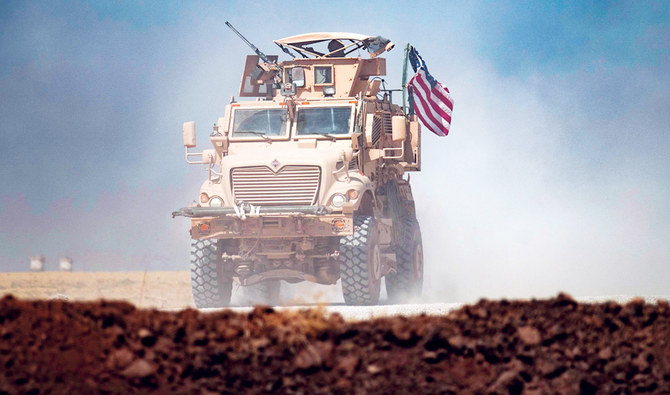

WASHINGTON: The US Army announced on Friday it was stepping up its military deployment — both troops and equipment — in northeastern Syria despite a push to limit its presence there, a move that follows tensions with Russia in the region.
US Central Command (Centcom) “has deployed Sentinel radar, increased the frequency of US fighter patrols over US forces, and deployed Bradley Fighting Vehicles to augment US forces” in the area, which is controlled by the US and its Kurdish allies, spokesman Captain Bill Urban said in a statement.
The number of armored vehicles sent as reinforcement did not exceed half a dozen, and “less than 100 people” were sent to maneuver them, a US official who spoke on condition of anonymity said.
Without mentioning Russia, Urban said the moves were meant “to help ensure the safety and security of coalition forces,” and that the US “does not seek conflict with any other nation in Syria, but will defend coalition forces if necessary.”
The US official, who spoke on condition of anonymity, said however that the actions “are a clear signal to Russia to adhere to mutual de-confliction processes and for Russia and other parties to avoid unprofessional, unsafe and provocative actions in northeast Syria.”
US Bradley Fighting Vehicles were pulled out of the region last October by President Donald Trump, who tried in early 2019 to recall all US troops from Syria, before agreeing to leave a few hundred to protect oil wells.
Several incidents in recent weeks have pitted the US military against Russian forces now deployed along the Turkish border under an agreement with Ankara.
At the end of August, seven American soldiers were injured in a collision with a Russian vehicle.
Videos posted on Twitter, apparently filmed by witnesses and the Russians themselves, showed Russian armor and helicopters attempting to block American vehicles and then force them out of the area.
HIGHLIGHT
Several incidents in recent weeks have pitted the US military against Russian forces now deployed along the Turkish border under an agreement with Ankara.
The tanks were flown in from a base in Kuwait, anti-militant coalition spokesman Col. Wayne Marotto said in another statement.
US and Russian troops frequently interact in Syria, but confrontations have been rare.
Meanwhile, the Syrian regime criticized the Netherlands on Saturday for launching a new bid through international bodies to hold it responsible for alleged gross human rights violations.
A Foreign Ministry source quoted by state news agency SANA accused the Netherlands of abusing its position as host of a number of the bodies concerned.
“The Dutch government ... is determined to use the International Court of Justice (ICJ) in The Hague to serve the political agendas of its American master,” the ministry source said.
The source accused the Netherlands of doing so “in a flagrant violation of its obligations and commitments as the headquarters state of this international organization.”
On Friday, the Dutch government announced that it was pursuing all legal avenues to ensure that the Syrian regime was held to account for its human rights record.
An attempt to refer top Syrian government officials to the International Criminal Court (ICC) in The Hague for prosecution was blocked by Chinese and Russian vetoes in May 2014.
But the Dutch government said that, if arbitration failed, it would pursue action through an international court, the most likely being the ICJ, also in The Hague.
Unlike the ICC, which deals with cases against individuals, the ICJ deals with disputes between UN member states and breaches of UN treaties, and is the world body’s top judicial organ.
Syria signed the UN Convention against Torture in 2004 and the Dutch government said its legal action would focus on alleged breaches of that treaty.
The US and the EU have targeted numerous figures linked to the Damascus regime with economic sanctions since the civil war erupted in 2011.
But concerted international action has been blocked by deep divisions over the conflict.
The war has killed more than 380,000 people and driven millions from their homes since it started with the brutal repression of anti-government protests.


