

Japan’s ‘Suganomics’ will target quick wins, not grand visions

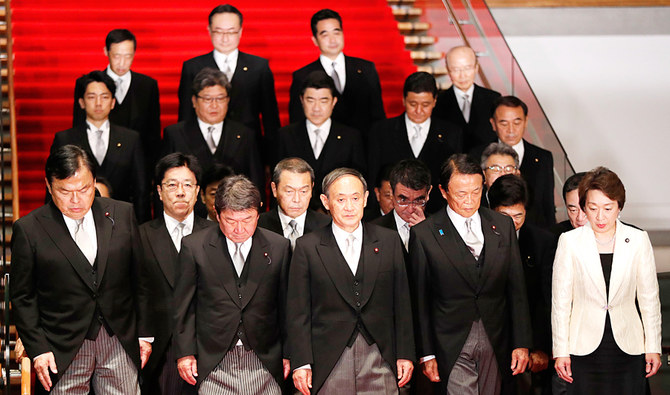
Japan’s Prime Minister Yoshihide Suga, center, with cabinet ministers this week. Suga’s plans for structural reforms will focus more on spurring competition, rather than deeper social change. (AP)
Short Url
Updated 19 September 2020
Follow

Japan’s ‘Suganomics’ will target quick wins, not grand visions

  • New prime minister to build political capital in lead-up to introducing tougher reforms, officials say

TOKYO: Japan’s new prime minister will pursue economic structural reforms through a mixed bag of policies that target specific industries, rather than a grand strategy to reshape society and boost long-term growth.

Armed with a strong grip on Japan’s bureaucracy, Yoshihide Suga knows which levers to pull to get results, say government and ruling party officials who know him or have worked with him.
But an initial need to consolidate popular support means he will first target quick policy wins that will later give him the political capital to pursue tougher reforms, they said.
“He isn’t after visions. He’s someone who wants to accomplish small goals one by one,” said political analyst Atsuo Ito, a former ruling party staffer. “He’ll initially focus on pragmatic goals that directly affect people’s livelihood.”
Suga has said he will continue his predecessor Shinzo Abe’s pro-growth “Abenomics” strategy aimed at pulling Japan out of deflation with heavy monetary and fiscal stimulus coupled with structural reforms.
But unlike Abe, Suga’s plans for structural reforms will focus more on spurring competition, rather than deeper social change.
For Suga, economic reform will be a political priority in its own right, unlike Abe, whose reforms were wrapped up in a broader political agenda that included the thorny challenge of revising Japan’s pacifist constitution.
Suga must act quickly as his current term lasts for only for a year unless he calls a snap election to win the public’s mandate to run a full, three-year term.

HIGHLIGHTS

• Reform mix of ideas rather than grand strategy.

• Suga armed with strong grip on bureaucracy.

• Targets “quick-hit” reforms appealing to voters.

• Plans include consolidating small firms, lenders.

That means he will first seek “quick-hit” achievements that directly channel money to households. Among the sweeteners would be to slash cellphone charges by about 40 per cent, raise the minimum wage and increase payouts to cushion the blow from the pandemic.
“At this moment, he has to focus on very short-term issues like how to stimulate economy,” said Heizo Takenaka, who served in the cabinet of reformist former premier Junichiro Koizumi.
Removing protections in industry will be one such objective, even if that riles some parts of corporate Japan.
“Introducing competition among mobile phone carriers could be a very symbolic policy for Suga because he loves competition,” said Takenaka, who retains close contact with Suga. “He hates people with vested interests.”
If successful, Suga could pursue bolder reforms such as liberalising the heavily protected medical sector, consolidating weak regional banks and breaking barriers that hamper competition among small- and mid-sized firms.
Having served as Abe’s top spokesman, Suga already knows his way around Japan’s massive bureaucracy.
Suga relaxed visa requirements to boost inbound tourism, overcoming push-back from the justice ministry. He also cut through bureaucratic opposition and expanded a scheme that gave tax breaks for donations to Japan’s regional areas.
“Suga may not be charismatic, but he gets things done,” said Taimei Yamaguchi, a ruling party lawmaker close to Suga. “Some of the best advice I got from him was to make the most of the expertise the bureaucrats have.”
Some government officials say Suga’s focus on deregulation makes his policies closer to those of Koizumi, who consolidated big banks and deregulated the labor market in the early 2000s.
Suga’s slogan urging the public to “look after yourself before seeking government help” reflects his background as a self-made politician who made his way up from a son of a strawberry farmer to Japan’s leader, people who know him say.


First EU–Saudi roundtable on critical raw materials reflects shared policy commitment

Updated 16 January 2026
Follow

First EU–Saudi roundtable on critical raw materials reflects shared policy commitment

RIYADH: The EU–Saudi Arabia Business and Investment Dialogue on Advancing Critical Raw Materials Value Chains, held in Riyadh as part of the Future Minerals Forum, brought together senior policymakers, industry leaders, and investors to advance strategic cooperation across critical raw materials value chains.

Organized under a Team Europe approach by the EU–GCC Cooperation on Green Transition Project, in coordination with the EU Delegation to Saudi Arabia, the European Chamber of Commerce in the Kingdom and in close cooperation with FMF, the dialogue provided a high-level platform to explore European actions under the EU Critical Raw Materials Act and ResourceEU alongside the Kingdom’s aspirations for minerals, industrial, and investment priorities.

This is in line with Saudi Vision 2030 and broader regional ambitions across the GCC, MENA, and Africa.

ResourceEU is the EU’s new strategic action plan, launched in late 2025, to secure a reliable supply of critical raw materials like lithium, rare earths, and cobalt, reducing dependency on single suppliers, such as China, by boosting domestic extraction, processing, recycling, stockpiling, and strategic partnerships with resource-rich nations.

The first ever EU–Saudi roundtable on critical raw materials was opened by the bloc’s Ambassador to the Kingdom, Christophe Farnaud, together with Saudi Deputy Minister for Mining Development Turki Al-Babtain, turning policy alignment into concrete cooperation.

Farnaud underlined the central role of international cooperation in the implementation of the EU’s critical raw materials policy framework.

“As the European Union advances the implementation of its Critical Raw Materials policy, international cooperation is indispensable to building secure, diversified, and sustainable value chains. Saudi Arabia is a key partner in this effort. This dialogue reflects our shared commitment to translate policy alignment into concrete business and investment cooperation that supports the green and digital transitions,” said the ambassador.

Discussions focused on strengthening resilient, diversified, and responsible CRM supply chains that are essential to the green and digital transitions.

Participants explored concrete opportunities for EU–Saudi cooperation across the full value chain, including exploration, mining, and processing and refining, as well as recycling, downstream manufacturing, and the mobilization of private investment and sustainable finance, underpinned by high environmental, social, and governance standards.

From the Saudi side, the dialogue was framed as a key contribution to the Kingdom’s industrial transformation and long-term economic diversification agenda under Vision 2030, with a strong focus on responsible resource development and global market integration.

“Developing globally competitive mineral hubs and sustainable value chains is a central pillar of Saudi Vision 2030 and the Kingdom’s industrial transformation. Our engagement with the European Union through this dialogue to strengthen upstream and downstream integration, attract high-quality investment, and advance responsible mining and processing. Enhanced cooperation with the EU, capitalizing on the demand dynamics of the EU Critical Raw Materials Act, will be key to delivering long-term value for both sides,” said Al-Babtain.

Valere Moutarlier, deputy director-general for European industry decarbonization, and directorate-general for the internal market, industry, entrepreneurship and SMEs at European Commission, said the EU Critical Raw Materials Act and ResourceEU provided a clear framework to strengthen Europe’s resilience while deepening its cooperation with international partners.

“Cooperation with Saudi Arabia is essential to advancing secure, sustainable, and diversified critical raw materials value chains. Dialogues such as this play a key role in translating policy ambitions into concrete industrial and investment cooperation,” she added.