

Bangladesh economy shows early signs of pandemic recovery

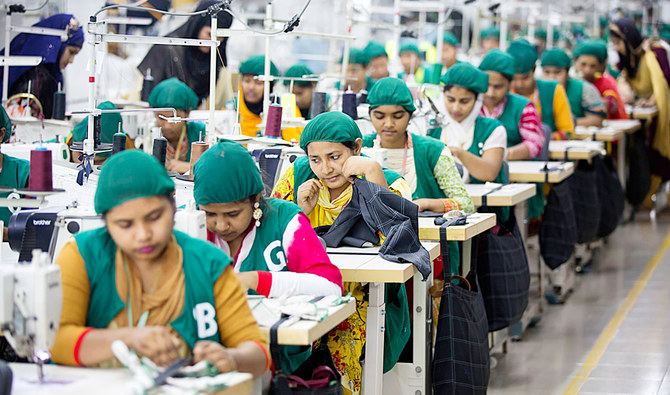
A garment factory in Dhamrai, near Dhaka, Bangladesh. After months of decline in garment exports, Bangladesh’s economy appears to be in recovery. (AP)
Short Url
Updated 19 September 2020
Follow

Bangladesh economy shows early signs of pandemic recovery

  • In August, exports rose 4.3 percent from a year earlier, to $2.96 billion, mostly driven by apparel shipments, according to the government’s Export Promotion Bureau

DHAKA: A rebound in garment orders after demand crashed during spring shutdowns is helping to revive the Bangladesh economy.
Apparel makers, the country’s main export industry, say they are looking ahead to Christmas orders from the US and other major markets.
Remittances from Bangladeshi workers employed overseas have also recovered, helping to relieve pressures from a pandemic quasi-shutdown during the spring.
The Asian Development Bank reported this week that the economic comeback was encouraging. It is forecasting the economy will grow at a robust 6.8 percent annual pace in the fiscal year that ends in June if current conditions persist.
That’s a much brighter outlook than in April-May, when global clothing brands suspended or canceled orders worth more than $3 billion, affecting about 4 million workers and thousands of factories.
“At the moment we can say that the ready-made garment industry has been able to regain its growth trajectory upward compared to March-May,” said Rubana Huq, president of the Bangladesh Garment Manufacturers and Exporters Association, or BGMEA.
“As economies in the West were turning around we were successfully able to get the buyers back to the negotiating table, which is why 80 percent to 90 percent of the $3.18 billion in canceled orders have been reinstated,” she said.
Bangladesh earns about $35 billion annually from garment exports, mainly to the US and Europe. The industry is the world’s second largest after China’s. Bangladesh’s exports rose 0.6 percent to $3.9 billion in July,

FASTFACT

Bangladesh’s exports rose 0.6 percent to $3.9 billion in July, after plummeting 83 percent to $520 million in April.

after plummeting 83 percent to $520 million in April. Imports, which are reported on a quarterly basis, began recovering earlier, rising 36 percent in May-June.
In August, exports rose 4.3 percent from a year earlier, to $2.96 billion, mostly driven by apparel shipments, according to the government’s Export Promotion Bureau. Garment shipments totaled $5.7 billion in July and August.
“The garment sector is making a good comeback. Our agriculture is doing well. Remittances are coming. These all are good signs for the economy,” said Ahsan H. Mansur, executive director of the Policy Research Institute, a think tank in Dhaka.
“The pace of the recovery is clearly visible. But challenges have been there too. The pace of the recovery will depend on how the pandemic behaves in the West over the next few months,” Mansur said. That’s the inestimable question facing everyone.
As of Thursday, Bangladesh had reported more than 342,000 confirmed coronavirus infections and 4,823 deaths. The country confirmed its first positive case on March 8.
Some experts say that the actual number of infections is higher than the official count. The garment industry says few workers in its factories have fallen ill thanks to precautions such as employing fewer people on the production lines and imposing safety guidelines. The government imposed a nationwide lockdown on March 26, and the garments sector was closed for nearly three months, reopening only gradually.
The country director for the ADB, Manmohan Parkash, said that the government has managed the crisis well, “with appropriate economic stimulus and social protection measures.”
“We are encouraged by the increase in exports and remittances, and hope the recovery will be sustained, which will help in achieving the projected growth rate,” Parkash said.


As world fractures, experts weigh in on the politics of AI at WGS

Updated 26 sec ago
Follow

As world fractures, experts weigh in on the politics of AI at WGS

  • e& group CEO Hatem Dowidar said there was increasing pressure to choose between the Chinese and US ecosystems

DUBAI: Across three days of rigorous debate at the World Government Summit in Dubai, experts from some of the world’s largest tech and telecommunication companies debated what the future political landscape of artificial intelligence development would be.

Speaking at the summit on Thursday, e& group CEO Hatem Dowidar said there was increasing pressure to choose between the Chinese and US ecosystems, which could have impacts on the sovereign capabilities of countries, like Gulf Cooperation Council member states, which thus far have stayed in the middle.

“I think the fracture and the pressure today is if you use this technology, you cannot use the other. You must separate them completely and this is something that never happened before,” Dowidar said.

He warned that whilst people around the world currently have access to both the leading large language models in the US and China, ChatGPT and Deepseek, this would not always be the case, and middle powers would need to develop their own capability to maintain their sovereignty.

“Europe is trying to find its own way as well, because Europe — having been caught now in the middle — they don’t have platforms, they don’t have the data center capability,” he said.

“So now, Europe is focusing a lot on building sovereign capability, sovereign data centers to run AI applications within Europe.”

Dowidar said the GCC had been ahead of the curve in this regard, having worked out early on that sovereign capability would be necessary in the new multipolar world and subsequently investing heavily in local infrastructure and capability.

“We were lucky here in the region that already — I would say a couple of years ago —we have kind of ironed out how this works,” he said.

“I think that everyone will try to see how they can either utilize the global platforms in a sovereign manner, or they end up trying to push to develop their own platforms.” 

This sentiment was echoed by Chamath Palihapitiya, the founder and managing partner of Social Capital, who said that China’s dedication to open-source models — whose code is released under a license granting users rights to view, study, modify, and redistribute it freely — could make Chinese AI more popular in the long run for nations looking to keep some level of sovereignty.

“I do think that there are a handful of American open-source models that are quite good. I think Nvidia’s models are excellent. But in fairness, the Chinese open-source models are just superb,” he told the summit on Wednesday.

“It’s going to be important for every country to make their own decisions about their own sovereignty, and in that realm, I think the open-source models provide the clearest path, because it just gives you total transparency to what’s happening underneath the hood.”

This was reiterated by Joseph Tsai, the chairman and co-founder of Alibaba Group, who said Chinese open-source systems would be favored by middle powers — but warned they had yet to find a way to be economically self-sufficient. 

“Because countries care about the sovereignty aspect and care about their data privacy, you can take an open-source model and deploy it on your own infrastructure … giving you ownership and control” he said.

“But it remains to be seen how economically all the model companies are going to make it sort of sustainable with an open-source approach … This is the biggest challenge for the Chinese firms.”