Japan ruling party head Yoshihide Suga preparing cabinet, continuity in foreground

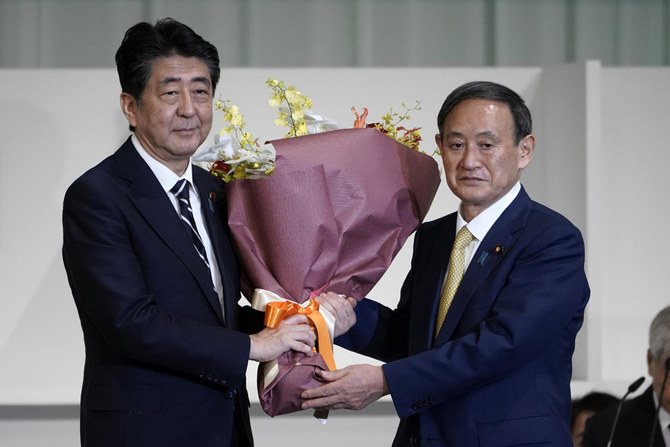
Japan’s Prime Minister Shinzo Abe, left, presents Chief Cabinet Secretary Yoshihide Suga with flowers after Suga was elected as new head of Japan’s ruling party on Monday, Sept. 14, 2020. (AP)
Short Url
Updated 15 September 2020
Follow

Japan ruling party head Yoshihide Suga preparing cabinet, continuity in foreground

  • Suga is virtually certain to be elected prime minister in a parliamentary vote on Wednesday

TOKYO: Japanese ruling party head Yoshihide Suga, in line to become the next prime minister, appeared set on Tuesday to continue his predecessor’s policies by keeping key cabinet ministers and party officials in their posts, as he had promised.
Suga, long a loyal aide and chief cabinet secretary under outgoing Prime Minister Shinzo Abe, on Monday won a landslide victory to take over the Liberal Democratic Party (LDP). He pledged to carry on many of Abe’s programs, including his signature “Abenomics” economic strategy.
He faces a vast array of challenges, including tackling COVID-19 while reviving a battered economy and dealing with a rapidly aging society in which nearly a third of the population is older than 65.
Finance Minister Taro Aso and Foreign Minister Toshimitsu Motegi are likely to stay in their positions, according to multiple media reports. Yasutoshi Nishimura is likely to be reappointed as economy minister.
Trade and industry minister Hiroshi Kajiyama, the son of a politician whom Suga looked up as his mentor, is seen retaining his post. Environment Minister Shinjiro Koizumi, the son of maverick former premier Junichiro Koizumi, is also seen staying.
Defense Minister Taro Kono is expected to become administrative reform minister and Nobuo Kishi, an LDP lawmaker who is Abe’s younger brother, will take up the defense portfolio, domestic media said.
Toshihiro Nikai, who was instrumental in helping Suga cement the support of LDP members and was re-appointed as the party’s secretary-general, told a news conference the top priority is dealing with the new coronavirus, a view echoed by party policy chief Hakubun Shimomura.
“We will do everything we can to secure the vaccines and the medications to protect the people’s lives and health, as well as support medical institutions,” said Shimomura, a former education minister, adding that reviving the economy would be given nearly equal weight.
Suga may name Health Minister Katsunobu Kato, who has become well known to the public as the face of Japan’s efforts to tackle the coronavirus, as chief cabinet secretary, Nippon TV said. Kato is close to Suga, under whom he served as deputy chief cabinet secretary.
“Many different elements are needed,” Suga said on Monday, when asked about who should replace him. “One is their fit with the prime minister, but thinking about it overall, they also need to have broad strengths, that will be the most calming.”
Suga is virtually certain to be elected prime minister in a parliamentary vote on Wednesday because of the LDP’s lower-house majority. He will serve out Abe’s term as party leader through September 2021.
Known more for his work behind the scenes, Suga emerged as favorite to replace Abe, Japan’s longest-serving premier, after Abe said last month he would resign because of ill health.
There is widespread speculation that Suga could take advantage of strong support ratings to dissolve the lower house of parliament and call snap elections to earn a full three-year term as LDP head, but he appears wary.


‘I admire Vision 2030’: Bangladesh’s new PM aims for stronger Saudi, GCC ties

Updated 4 sec ago
Follow

‘I admire Vision 2030’: Bangladesh’s new PM aims for stronger Saudi, GCC ties

  • Saudi Arabia congratulates Tarique Rahman on assuming Bangladesh’s top office
  • Relations between Bangladesh and Kingdom were formalized during his father’s rule

DHAKA: After 17 years in exile, Tarique Rahman has taken office as prime minister of Bangladesh, inheriting his parents’ political legacy and facing immediate economic and political challenges.

Rahman led his Bangladesh Nationalist Party to a landslide victory in the Feb. 12 general election, winning an absolute majority with 209 of 300 parliamentary seats and marking the party’s return to power after two decades.

The BNP was founded by his father, former President Ziaur Rahman, a 1971 Liberation War hero. After his assassination in 1981, Rahman’s mother, Khaleda Zia, took over the party’s helm and served two full terms as prime minister — in 1991 and 2001.

Rahman and his cabinet, whose members were sworn in alongside him on Tuesday, take over from an interim administration which governed Bangladesh for 18 months after former premier Sheikh Hasina — the BNP’s archrival who ruled consecutively for 15 years — was toppled in the 2024 student-led uprising.

As he begins his term, the new prime minister’s first tasks will be to rebuild the economy — weakened by uncertainty during the interim administration — and to restore political stability. Relations with the Middle East, particularly Saudi Arabia and other GCC states, are also high on his agenda.

“Saudi Arabia is one of our long-standing friends,” Rahman told Arab News at his office in Dhaka, two days before his historic election win.

“I admire the Saudi Vision 2030, and I am sincerely looking forward to working with the leadership of the Kingdom of Saudi Arabia. BNP always had a great relationship with the Muslim world, especially GCC nations — UAE, Qatar, Bahrain, Kuwait and Oman — and I look forward to working closely with GCC countries and their leadership to build a long-term trusting partnership with mutual interest,” Rahman said.

The Saudi government congratulated him on assuming the top office on Tuesday, wishing prosperity to the Bangladeshi people. 

Bangladesh and Saudi Arabia established formal diplomatic relations in August 1975, and the first Bangladeshi ambassador presented his credentials in late 1976, after Rahman’s father rose to power. That year, Bangladesh also started sending laborers, engineers, doctors, and teachers to work in the Kingdom.

Today, more than 3 million Bangladeshis live and work in Saudi Arabia — the largest expat group in the Kingdom and the biggest Bangladeshi community outside the country.

“I recall that when my father, President Ziaur Rahman, was in office, bilateral relations between our two nations were initiated,” Rahman said. “During the tenure of my mother, the late Begum Khaleda Zia, as prime minister, those relations became even stronger.”

Over the decades, Saudi Arabia has not only emerged as the main destination for Bangladesh’s migrant workers but also one of its largest development and emergency aid donors.

Weeks after Rahman’s mother began her first term as prime minister in 1991, Bangladesh was struck by one of the deadliest tropical cyclones in its history. Riyadh was among the first who offered assistance, and Zia visited Saudi Arabia on her earliest foreign tour and performed Hajj in June 1991.

For Rahman, who had been living in London since 2008 and returned to Bangladesh in December — just days before his mother’s death — the Kingdom will also be one of the first countries he plans to visit.

“I would definitely like to visit Saudi Arabia early in my term,” he said. “Personally, I also wish to visit the holy mosque, Al-Masjid Al-Haram, Makkah, to perform Umrah.”