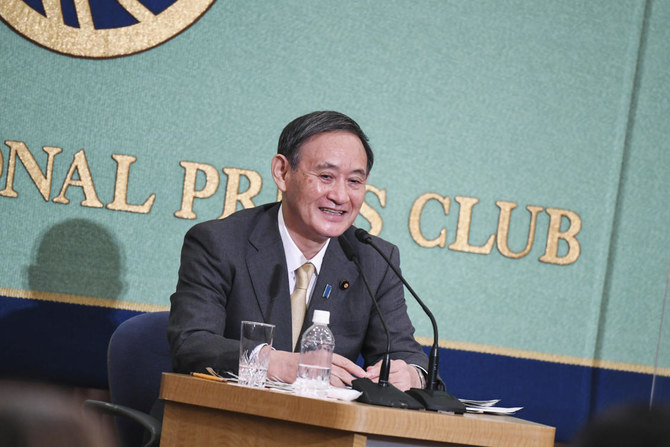
TOKYO: Japan’s ruling party on Monday elected chief cabinet secretary Yoshihide Suga as its new leader, making him all but certain to replace Shinzo Abe as the country’s next prime minister.
Suga easily won the ballot, taking 377 of a total of 534 valid votes from Liberal Democratic Party lawmakers and regional representatives.
His rivals, former defense minister Shigeru Ishiba and LDP policy chief Fumio Kishida, trailed far behind.
Given the LDP’s legislative majority, Suga is expected to handily win a parliamentary vote Wednesday and become prime minister, taking over from Abe, who is resigning for health reasons.
A powerful government adviser and spokesman, 71-year-old Suga is seen as promising stability and a continuation of Abe’s policies.
He has specifically said his candidacy was motivated by a desire to continue the outgoing prime minister’s programs.
Ishiba, who is popular with the Japanese public but less so within his own party, won just 68 votes, with Kishida, who was once considered Abe’s favored successor, taking 89.
Abe, who smashed records as Japan’s longest-serving prime minister before being forced to resign after a recurrence of ulcerative colitis, declined to publicly endorse any candidate.
The son of a strawberry farmer, Suga was raised in Japan’s northern Akita region, and the issues of rural areas suffering depopulation are said to be among his top concerns.
But not much is known about his personal ideology, and he is generally viewed as an adherent of neither the LDP’s most hawkish nor its more reformist wings.
As prime minister, he will face a series of tough challenges, including containing the coronavirus and righting the world’s third-biggest economy, which was in recession even before the pandemic.

Japan ruling party elects Yoshihide Suga as PM successor
https://arab.news/962ac
Japan ruling party elects Yoshihide Suga as PM successor
- Suga is seen as promising stability and a continuation of Shinzo Abe’s policies
- As prime minister, he will face a series of tough challenges, including containing the coronavirus
US bars five Europeans it says pressured tech firms to censor American viewpoints online
WASHINGTON: The State Department announced Tuesday it was barring five Europeans it accused of leading efforts to pressure US tech firms to censor or suppress American viewpoints.
The Europeans, characterized by Secretary of State Marco Rubio as “radical” activists and “weaponized” nongovernmental organizations, fell afoul of a new visa policy announced in May to restrict the entry of foreigners deemed responsible for censorship of protected speech in the United States.
“For far too long, ideologues in Europe have led organized efforts to coerce American platforms to punish American viewpoints they oppose,” Rubio posted on X. “The Trump Administration will no longer tolerate these egregious acts of extraterritorial censorship.”
The five Europeans were identified by Sarah Rogers, the under secretary of state for public diplomacy, in a series of posts on social media. They include the leaders of organizations that address digital hate and a former European Union commissioner who clashed with tech billionaire Elon Musk over broadcasting an online interview with Donald Trump.
Rubio’s statement said they advanced foreign government censorship campaigns against Americans and US companies, which he said created “potentially serious adverse foreign policy consequences” for the US
The action to bar them from the US is part of a Trump administration campaign against foreign influence over online speech, using immigration law rather than platform regulations or sanctions.
The five Europeans named by Rogers are: Imran Ahmed, chief executive of the Center for Countering Digital Hate; Josephine Ballon and Anna-Lena von Hodenberg, leaders of HateAid, a German organization; Clare Melford, who runs the Global Disinformation Index; and former EU Commissioner Thierry Breton, who was responsible for digital affairs.
Rogers in her post on X called Breton, a French business executive and former finance minister, the “mastermind” behind the EU’s Digital Services Act, which imposes a set of strict requirements designed to keep Internet users safe online. This includes flagging harmful or illegal content like hate speech.
She referred to Breton warning Musk of a possible “amplification of harmful content” by broadcasting his livestream interview with Trump in August 2024 when he was running for president.
Breton responded Tuesday on X by noting that all 27 EU members voted for the Digital Services Act in 2022. “To our American friends: ‘Censorship isn’t where you think it is,’” he wrote.
French Foreign Minister Jean-Noël Barrot said France condemns the visa restrictions on Breton and the four others. Also posting on X, he said the DSA was adopted to ensure that “what is illegal offline is also illegal online.” He said it “has absolutely no extraterritorial reach and in no way concerns the United States.”
Most Europeans are covered by the Visa Waiver Program, which means they don’t necessarily need visas to come into the country. They do, however, need to complete an online application prior to arrival under a system run by the Department of Homeland Security, so it is possible that at least some of these five people have been flagged to DHS, a US official said, speaking on condition of anonymity to discuss details not publicly released.
Other visa restriction policies were announced this year, along with bans targeting foreign visitors from certain African and Middle Eastern countries and the Palestinian Authority. Visitors from some countries could be required to post a financial bond when applying for a visa.


