


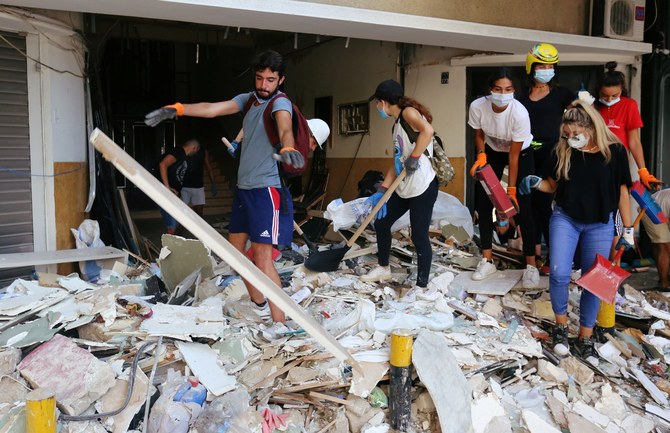

DUBAI: No sooner had the explosion of Aug. 4 devastated Beirut than the Lebanese diaspora came to their home country’s rescue.
The extent of the damage to homes and infrastructure was still not clear, but no one was under any illusion about the blast’s severity given that the shockwaves were felt more than 200 km away in Cyprus.
By the morning of Aug. 5, Impact Lebanon, a non-profit based in London, had collected close to £1.5 million ($2 million).
Since then the organization, which was founded by a group of UK-based Lebanese when anti-government protests erupted in Lebanon in October last year, has built up an impressive $8.23 million.
But as fundraising activities by diaspora communities continue worldwide, a concern that looms large over them is how Lebanese civil-society groups will be able to access the money.
One of the biggest challenges the Lebanese people face, as they pick up the pieces after last month’s explosion in Beirut, is the country’s troubled financial system.
A complex set of regulations that govern transactions involving dollar bank accounts in Lebanese banks meant that Impact Lebanon was able to begin transferring the funds it had raised from Aug. 25 — three weeks after the blast.
The transfers were made in small instalments in order to reduce the risk of loss while navigating a corrupt banking system.
Under a scheme known as “fresh money,” individuals outside the country can transfer dollars into a “fresh money” account in Lebanese banks.
But access to such an account is granted only to those who can prove they are the recipients of dollar transfers from abroad.
How long the scheme will last is open to question, though, which partly explains why Impact Lebanon volunteers decided against a lump-sum transfer of the funds it had collected.

Fundraising activities by diaspora communities continue worldwide, but concerns looms large over about how Lebanese civil-society groups will be able to access the money. (Supplied: Mariana Wehbe)
“Money will be sent in different instalments to the 15-20 different NGOs the fund is supporting inside the country,” said Maya Hodroj, co-founder and director of Impact Lebanon.
Since it is still to be registered as a charity in the UK, Impact Lebanon used crowdfunding platform JustGiving for fundraising and partnered with Lebanese International Financial Executive, a non-profit organization with branches in Lebanon, the UK, the US and Switzerland, to distribute the money among a mix of Lebanon-focused NGOs.
Currently, despite the web of restrictive banking regulations, aid is getting channeled through civil-society and international aid organizations, including many in-kind donations of food, personal protective equipment, sanitary items and other goods, particularly from Gulf Cooperation Council member states such as the UAE, Kuwait and Saudi Arabia.
Disruptions, however, continue to affect humanitarian work, such as the huge fire that broke out on Sept. 10 at a warehouse in Beirut port where the International Committee of the Red Cross (ICRC) stores food parcels.
Opinion
This section contains relevant reference points, placed in (Opinion field)
Recently, the Trump administration said it would not be sending aid to the Lebanese government for fear it might end up in the hands of the Shiite Lebanese party Hezbollah, which is a US-designated terror group. Aid from the US will thus have to be sent through alternative channels.
Immediately after the blast of Aug. 4, residents of Beirut had no choice but to take care of themselves. The sense of helplessness prompted the rapid formation of a number of organizations by young Lebanese.
Their goal, in the immediate term, was to help the wounded, homeless and traumatized and, in the long term, to rebuild Beirut.
“In the absence of government support, the Lebanese people had to fend for themselves, fixing the country and the people mentally and physically,” said Nancy Gabriel, co-founder along with Mariana Wehbe of Beb w Shebbek, an organization dedicated to repairing or replacing blast-damaged doors and windows of 80,000 homes.
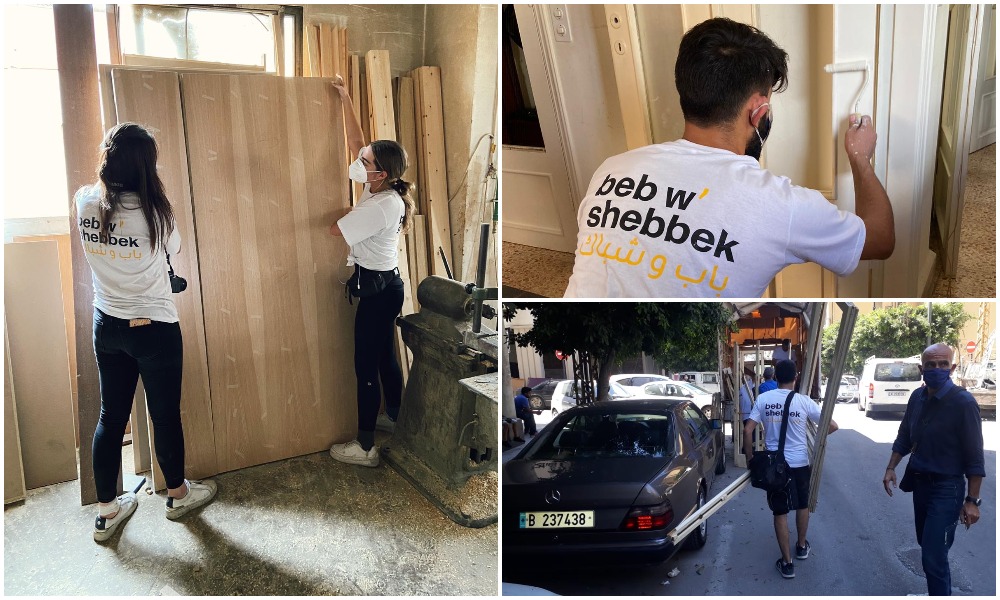
Beb w Shebbek is an organization dedicated to repairing or replacing blast-damaged doors and windows of 80,000 homes. (Supplied: Mariana Wehbe)
“Beb w Shebbek is exactly like other Lebanese organizations born after the explosion. We had to create this initiative to help others because the government is totally absent,” Gabriel added.
“Three weeks after the explosion, most people are still living with open windows and doors. Their homes are totally destroyed. They have nowhere else to go.”
After the end of the civil war in 1990, foreign aid emerged as a key pillar of Lebanon’s financial and economic stability.
Since the blast, donor countries have pledged close to $300 million in aid. Additionally, the UN is trying to raise more than $500 million for Lebanon.
But some of the slogans heard on the streets of Beirut since Aug. 4 oppose more international assistance to the country.
Many Lebanese not only have little faith in aid reaching the right recipients, they are convinced that the country’s political elites are the ultimate beneficiary of the economic model.
“Many Lebanese government officials and advisors are paid with the millions allocated by programs such as those managed by the UNDP (UN Development Programme),” said Gino Raidy, a Lebanese activist and blogger.
“There’s a lack of trust right now in some international aid organizations, including the UN. It’s not about just giving money, but finding long-term solutions that will put an end to the corruption, instead of inadvertently encouraging it like we’ve seen for decades.”
Activist Mouin Jaber told Arab News from Beirut: “We’re actually playing the role of the Lebanese government, which stayed silent and remained inactive during the first two weeks of the disaster.”
He drew attention to the eyebrows raised by the sight of Lebanese military officers handing out aid to citizens three weeks after the disaster.
“Right now, the Lebanese Army is distributing food boxes to people, with camera crews documenting the propaganda,” said Jaber.
“They’ve been extremely incompetent and inefficient in providing aid to their citizens. It’s a joke.”
Jaber and his friends got in touch with four youth organizations and NGOs formed during the October protests to deliver relief kits to people affected by the explosion.
These include Minteshreen, a youth-led group that has been distributing food boxes during the coronavirus pandemic; Baytna Baytak, an NGO providing alternative housing to patients suffering from COVID-19 who could not go back to their homes, and is now arranging accommodation for those who lost their homes in the blast; Muwaten Lebnene; and Embrace Lebanon, a mental-health clinic.
“We assembled a team of engineers to assess damage to homes, and provided people with temporary solutions until long-term plans for rebuilding can be finalized,” said Jaber. “This is all voluntary work. No one is being paid.”
Some volunteers have set up an informal base camp for better coordination of aid and relief operations being managed separately by dozens of local NGOs.
“Instead of sending relief to these big organizations, it would be better to send money to reconstruction companies that have bank accounts abroad so that they have full access to the money,” said Jaber.
“This would be better than sending to third-party intermediaries because you never know where the money will go when it arrives in Lebanon.”
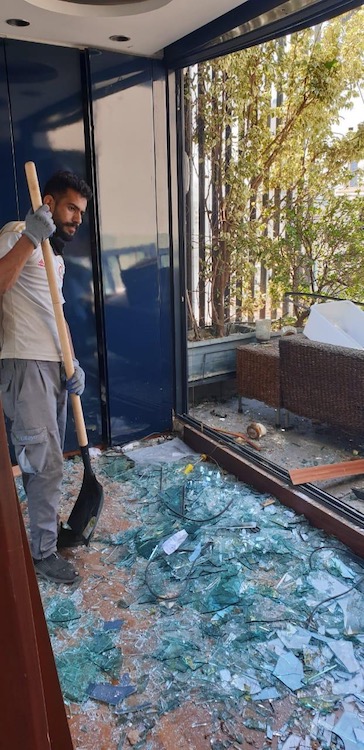
Beb w Shebbek is an organization dedicated to repairing or replacing blast-damaged doors and windows of 80,000 homes. (Supplied: Mariana Wehbe)
That said, fears expressed by some Lebanese on social media about NGOs encountering difficulty in getting aid into the country and relief supplies being mishandled by the government may have been overblown.
Nabih Jabr, under-secretary-general at the Lebanese Red Cross, said his teams received relief items and distributed them to those in need. “The problem was that we received too many in-kind donations too soon,” he told Arab News from Beirut.
“Some of them didn’t cater to the immediate needs of the affected population, and we rapidly ran out of space in nearby warehouses, so we took some of these items for processing in our warehouses all over the country,” he said.
“It always happens with in-kind donations that some end up sold in stores. People receive in-kind aid but need the cash, so some sell it to be able to get what they really need, and this is exactly why in-kind aid isn’t always the best aid.”
Jabr said in-kind donations can harm the local economy. “Small local businesses are already in trouble, and soon they’ll be in even more trouble if people don’t start buying again,” he added.
Jabr said the next step for the Lebanese Red Cross is handing out direct cash assistance. “This will start very soon,” he added. “This is the best and most efficient way to help people as long as there’s still a functioning local economy.”
----------------------
Twitter: @rebeccaaproctor


