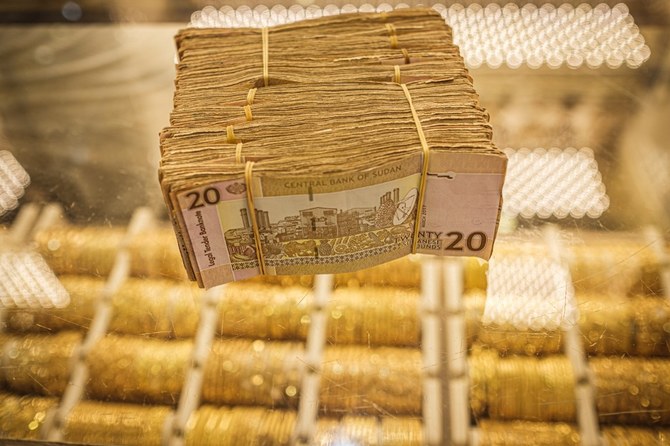
KHARTOUM: Sudan declared an economic state of emergency on Thursday after its currency fell sharply in recent weeks due to "systematic vandalism," officials said.
The transitional government, in charge of the country since the ouster of Omar Al-Bashir last year, will set up special courts in the next days to fight smuggling and other illicit activities undermining the economy, officials told a televised news conference.
The pound had fluctuated drastically in recent days, prompting major food suppliers to halt distribution of their products and pushing prices of food up between 50% and 100% at supermarkets and retailers, a Reuters witness said.
It comes at a time of record Nile River flooding that has left tens of thousands of people homeless. The government said it had allocated more than 150 million Sudanese pounds ($2.73 million) to help flood victims, the state news agency reported.
The government under Bashir had previously tried to crack down on the black-market traders by arresting some of them, but others remained persistent. The currency has been devalued four times since 2018.
Inflation in Sudan is second only to that of Venezuela, with the headline rate climbing to 143.78% in July from 136.36% in June.
Security forces would also step up controls at borders and airports to stop a smuggling of commodities such as gold, officials said.

Sudan declares state of economic emergency due to fall of currency
https://arab.news/gtdw2
Sudan declares state of economic emergency due to fall of currency
- It comes at a time of record Nile River flooding that has left tens of thousands of people homeless
- The currency has been devalued four times since 2018
Abbas reiterates opposition to displacement of Palestinians
- During Moscow talks, president calls for immediate halt to Israeli acts of terror
- Historically, Russia has supported and stood by the Palestinian people at political and diplomatic levels
MOSCOW: The Palestinian National Authority’s President Mahmoud Abbas has reiterated his opposition to all attempts to displace Palestinian people from their land.
Speaking with Russian President Vladimir Putin at the presidential palace in Moscow, Abbas was reported by the Kremlin’s official website as saying that “the Palestinian people are holding on to their land, and we categorically oppose attempts by the Americans and Israelis to expatriate Palestinians beyond Palestinian territory.”
He said the Palestinian people “will not abandon their land, whatever the cost.” Abbas stressed the need to fully implement US President Donald Trump’s peace plan, leading to the withdrawal of occupation forces and the launch of the reconstruction process.
He emphasized that the Palestinian Authority would assume a central role in administering the Gaza Strip, and that the enclave and the West Bank constituted two parts of a single territorial unit, with a unified and undifferentiated system of civilian institutions.
He stressed the need for an immediate halt to “Israeli settler colonialism and Israeli acts of terror in the West Bank, including Jerusalem, along with the release of withheld Palestinian funds and the cessation of all measures that undermined the Palestinian Authority and the two-state solution.”
He reaffirmed his commitment to continue the struggle for the realization of the Palestinian people’s right to self-determination and of their right to a fully sovereign, independent state based on the borders of June 4, 1967, with East Jerusalem as its capital, while living in security and peace with neighbors.
He told Putin: “What we need is peace, and we hope that with your help and support, we can achieve it — a peace built on the basis of international legal resolutions, decisions of the United Nations, and the principles established following the wars of 1967 and 1973.
“East Jerusalem remains the capital of Palestine, and we know that Russia has always supported — indeed, was the first to support — Palestine, maintaining a firm stance in support of our people.”
Abbas thanked his Russian counterpart for Moscow’s support and commended the bilateral “bonds of friendship” between both countries. He added: “We are friends of Russia and the Russian people. For over 50 years our nations have been bound by a strong friendship that has developed over the decades and continues on the correct path. Russia is a great friend and a nation upon which we rely in many spheres.
“Historically, Russia has supported and stood by the Palestinian people at political and diplomatic levels. Your economic and financial support is both significant in scale and crucial in importance.”
Abbas emphasized moving forward with the implementation of a comprehensive national reform program aimed at consolidating the rule of law, strengthening the principles of good governance, transparency, and accountability, and ensuring the separation of powers.
Putin affirmed Moscow’s “principled and consistent approach” to the Palestinian question.
He said: “We believe that only the establishment and full functioning of the Palestinian state can lead to a lasting settlement of the Middle East conflict.”


