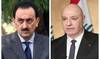
DAMASCUS: Syrian leader Bashar Assad said on Monday he wanted to expand business ties with Russia to help his country cope with new US sanctions on its already crippled economy that threaten to undermine military gains Damascus achieved with Moscow’s help.
Assad spoke during a meeting in Damascus with Russian Deputy Prime Minister Yuri Borisov and Foreign Minister Sergei Lavrov.
Lavrov told a news conference Syria needed international help to rebuild its economy.
Borisov said Russia was helping Syria to fix its power plants but said oil output could not resume as the fields were in areas outside government control.
Syria and Russia, whose military support since 2015 helped Damascus reverse gains by militants in an almost decade-long war, had said the two sides planned to boost trade ties and would review energy, mining and power projects.
The regime “was determined to continue to work with Russian allies to implement signed agreements and to ensure the success of Russian investments in Syria,” Assad said.
Borisov said Moscow had presented proposals in July to expand economic ties and expected an agreement would be sealed in December on his next visit to Damascus.
He said Moscow wanted to help Damascus break the blockade of US sanctions.
Syria has pinned hopes on Russia while Western diplomats say Russia’s military involvement in Syria has secured Moscow major regional influence.
“Russia turned the tide for Assad and with the regime now facing its gravest challenges, Moscow is in a better position than any other time to further squeeze Assad,” said one Western diplomat who follows Syria.
Although Assad has now regained most of the territory he had lost in the war, the economy is in tatters, leaving many Syrians in poverty as the currency has lost 80 percent of its value.
Russia has criticized the new US sanctions that took effect in June under the so-called Caesar Act.
Washington says the sanctions, which penalize foreign firms dealing with Syrian regime entities, aim to cut revenue for Assad’s government and push him back into UN-led talks to end the conflict.

Assad seeks Russian investment as US sanctions hammer economy
Short Url
https://arab.news/8ymtk
Assad seeks Russian investment as US sanctions hammer economy
- The visit by Sergey Lavrov comes amid a severe economic crisis in Syria and the coronavirus pandemic
- President Vladimir Putin has visited the war-torn country twice
Turkiye says Greece-Chevron activity off Crete unlawful
ANKARA: Turkiye said on Thursday it opposed Greece’s “unilateral activities” in hydrocarbon fields south of Crete with a consortium led by US oil major Chevron as a violation of international law and good neighborly relations.
The Chevron-led consortium signed exclusive lease agreements on Monday to look for natural gas off southern Greece, expanding the United States’ presence in the eastern Mediterranean.
“We oppose this unlawful activity, which is being attempted in violation of the 2019 Memorandum of Understanding on Maritime Jurisdiction between Libya and our country,” the Turkish Defense Ministry said at its weekly press briefing.
It said the activity, while not directly impacting Turkiye’s continental shelf in the region, also violated Libya’s maritime jurisdiction declared to the United Nations on May 27, 2025.
“We continue to provide the necessary support to the Libyan authorities to take action against these unilateral and unlawful activities by Greece.
The 2019 agreement signed by Turkiye and Libya set out maritime boundaries in the Mediterranean Sea and was rejected by Greece as it ignored the presence of the Greek island of Crete between the coasts of Turkiye and Libya.
The Chevron deal doubles the amount of Greek maritime acreage available for exploration and is the second in months involving a US energy major as the European Union seeks to phase out supplies from Russia and the US seeks to replace them.
Neighbours and NATO members Turkiye and Greece have been at odds over a range of issues for decades, primarily maritime boundaries and rights in the Aegean, an area widely believed to hold energy resources and with key implications for airspace and military activity.
A 2023 declaration on friendly relations prompted a thaw in rhetoric between the two countries, though issues have remained unresolved despite leaders voicing a desire to address them.
The Chevron-led consortium signed exclusive lease agreements on Monday to look for natural gas off southern Greece, expanding the United States’ presence in the eastern Mediterranean.
“We oppose this unlawful activity, which is being attempted in violation of the 2019 Memorandum of Understanding on Maritime Jurisdiction between Libya and our country,” the Turkish Defense Ministry said at its weekly press briefing.
It said the activity, while not directly impacting Turkiye’s continental shelf in the region, also violated Libya’s maritime jurisdiction declared to the United Nations on May 27, 2025.
“We continue to provide the necessary support to the Libyan authorities to take action against these unilateral and unlawful activities by Greece.
The 2019 agreement signed by Turkiye and Libya set out maritime boundaries in the Mediterranean Sea and was rejected by Greece as it ignored the presence of the Greek island of Crete between the coasts of Turkiye and Libya.
The Chevron deal doubles the amount of Greek maritime acreage available for exploration and is the second in months involving a US energy major as the European Union seeks to phase out supplies from Russia and the US seeks to replace them.
Neighbours and NATO members Turkiye and Greece have been at odds over a range of issues for decades, primarily maritime boundaries and rights in the Aegean, an area widely believed to hold energy resources and with key implications for airspace and military activity.
A 2023 declaration on friendly relations prompted a thaw in rhetoric between the two countries, though issues have remained unresolved despite leaders voicing a desire to address them.
© 2026 SAUDI RESEARCH & PUBLISHING COMPANY, All Rights Reserved And subject to Terms of Use Agreement.