Syria intercepts Israeli strike on air base: state media

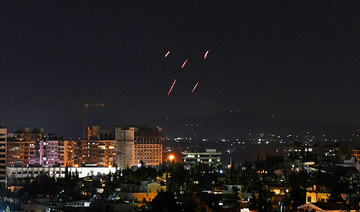
Syrian air defences respond to Israeli missiles. (File/AFP)
Short Url
Updated 03 September 2020
Follow

Syria intercepts Israeli strike on air base: state media

  • An aircraft belonging to Israel fired a number of missiles this evening
  • Wednesday’s attack was the second this week

DAMASCUS: Syrian air defenses on Wednesday intercepted missiles fired by an Israeli warplane at an air base in central Syria, state news agency SANA said, in the second such Israeli strike this week.
“An aircraft belonging to the Israeli enemy fired this evening a number of missiles... toward the T4 air base and our air defenses intercepted most of them,” SANA said citing a military source.
The Britain-based Syrian Observatory for Human Rights confirmed the attack on the air base in Homs province saying Israel was “likely” responsible.
Wednesday’s attack was the second this week, after Israeli strikes on Monday killed one civilian, three government troops and seven allied foreign fighters, according to the Observatory, a war monitor.
Monday’s strikes hit Syrian army positions south of Damascus as well as positions belonging to Iran-backed paramilitaries, including fighters of the Lebanese Hezbollah movement, in the southern province of Daraa, the Observatory said.
Israel has carried out hundreds of raids in Syria since the civil war broke out in 2011, targeting Iranian and Hezbollah forces as well as government troops.
The Israeli army rarely acknowledges individual strikes, but said that on Aug. 3 it had used fighter jets, attack helicopters and other warplanes to hit Syrian military targets in southern Syria.
Hezbollah’s leader Hassan Nasrallah warned on Sunday that the group would kill an Israeli soldier for each of its fighters slain by the Jewish state, after one of its combatants was killed in an Israeli strike in Syria on July 20.


Trial opens in Tunisia of NGO workers accused of aiding migrants

Updated 15 December 2025
Follow

Trial opens in Tunisia of NGO workers accused of aiding migrants

  • Aid workers accused of assisting irregular migration to Tunisia went on trial on Monday, as Amnesty International criticized what it called “the relentless criminalization of civil society”

TUNIS: Aid workers accused of assisting irregular migration to Tunisia went on trial on Monday, as Amnesty International criticized what it called “the relentless criminalization of civil society” in the country.
Six staff members of the Tunisian branch of the France Terre d’Asile aid group, along with 17 municipal workers from the eastern city of Sousse, face charges of sheltering migrants and facilitating their “illegal entry and residence.”
If convicted, they face up to 10 years in prison.
Migration is a sensitive issue in Tunisia, a key transit point for tens of thousands of people seeking to reach Europe each year.
A former head of Terre d’Asile Tunisie, Sherifa Riahi, is among the accused and has been detained for more than 19 months, according to her lawyer Abdellah Ben Meftah.
He told AFP that the accused had carried out their work as part of a project approved by the state and in “direct coordination” with the government.
Amnesty denounced what it described as a “bogus criminal trial” and called on Tunisian authorities to drop the charges.
“They are being prosecuted simply for their legitimate work providing vital assistance and protection to refugees, asylum seekers and migrants in precarious situations,” Sara Hashash, Amnesty’s deputy MENA chief, said in the statement.
The defendants were arrested in May 2024 along with about a dozen humanitarian workers, including anti-racism pioneer Saadia Mosbah, whose trial is set to start later this month.
In February 2023, President Kais Saied said “hordes of illegal migrants,” many from sub-Saharan Africa, posed a demographic threat to the Arab-majority country.
His speech triggered a series of racially motivated attacks as thousands of sub-Saharan African migrants in Tunisia were pushed out of their homes and jobs.
Thousands were repatriated or attempted to cross the Mediterranean, while others were expelled to the desert borders with Algeria and Libya, where at least a hundred died that summer.
This came as the European Union boosted efforts to curb arrivals on its southern shores, including a 255-million-euro ($290-million) deal with Tunis.