

Minister says over 60% of Karachi's Rs1.1 trillion transformation package from central budget

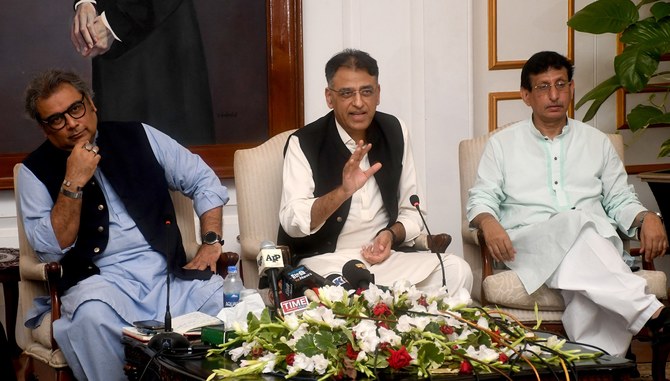
Planning and Development Minister Asad Umar is addressing a press conference alongside Maritime Affairs Minister Ali Haider Zaidi and Telecommunications Minister Syed Amin Ul Haque, at Governor House, Karachi, on Sept. 6, 2020. (PID)
Short Url
Updated 06 September 2020
Follow

Minister says over 60% of Karachi's Rs1.1 trillion transformation package from central budget

  • Social media post shared by Bilawal Bhutto Zardari claimed that most of the spending would come from Sindh government
  • Post-floods package aims at addressing problems with drinking water, drainage systems, roads and waste management

ISLAMABAD: Planning and Development Minister Asad Umar said on Sunday that 62 percent of Karachi's Rs1.1 trillion development package will come from the central budget, a day after opposition Pakistan People's Party (PPP) chairman Bilawal Bhutto Zardari alleged that the provincial government would bear the lion's share of the fund.

The package was announced by Prime Minister Imran Khan on Saturday as he visited the mega city a week after torrential rains and massive urban flooding devastated its infrastructure.

"The total funding for the list of projects shared yesterday and the responsibilities assigned amounted to a 62 percent share of the federal government and 38 percent of the Sindh government," Umar said during a press conference.

A social media post shared by Bilawal on Saturday claimed that most of the spending would come from the provincial government which is dominated by his party.

"In the clip, he is complaining that the Sindh government is putting forward Rs800 billion, whereas the federal government is only footing a cost of Rs300 billion," Umar said as he requested that stakeholders keep all political differences aside for the success of the city's development plan.

The plan aims at addressing within three years Karachi's problems with drinking water, damaged sewerage and drainage systems, circular railway, roads, and waste management. The plan would be implemented through the Provincial Implementation Coordination Committee (PCIC) consisting of representatives from the federal government, provincial government and the army.

Karachi, a city of over 15 million people has for years been facing various municipal problems, many of which have roots in its complicated governance system. Three parties are the main stakeholders in the capital of Sindh province.

In the city's division of power, the ruling Pakistan Tehreek-e-Insaf (PTI) has a majority from its constituencies in the provincial assembly. The assembly itself, however, is dominated by Pakistan People’s Party (PPP), which also rules the province. Muttahida Qaumi Movement-Pakistan (MQM-P), meanwhile, runs the Karachi city government.


Pakistan says military operation concluded in Balochistan, 216 militants killed 

Updated 8 sec ago
Follow

Pakistan says military operation concluded in Balochistan, 216 militants killed 

  • Separatist BLA militant group claimed responsibility for coordinated attacks across Balochistan last week 
  • Military says 36 civilians, 22 law enforcement and security forces personnel have been killed in attacks 

PESHAWAR: Pakistani forces have concluded a security operation in the southwestern Balochistan province and killed 216 militants after a series of coordinated attacks by separatist militants last week, the military’s media wing said on Thursday. 

Separatist militant group Baloch Liberation Army (BLA) claimed responsibility for a series of attacks in Balochistan last Friday and Saturday in multiple districts across the province, one of the deadliest flare-ups in the area in recent years. 

Pakistan military’s media wing, the Inter-Services Public Relations (ISPR), said security forces launched operations in Panjgur and Harnai district’s outskirts on Jan. 29 based on intelligence confirming the presence of “terrorist elements,” killing 41 militants. 

It said the military launched a broader series of intelligence-based operations in multiple areas of the province after that to dismantle “terrorist sleeper cells,” referring to it as “Operation Radd-ul-Fitna-1.”

“As a result of these well-coordinated engagements and subsequent clearance operations, 216 terrorists have been sent to hell, significantly degrading the leadership, command-and-control structures and operational capabilities of terrorist networks,” the ISPR said in a statement.

The military said 36 civilians, including women and children, were killed by militants while 22 security forces and law enforcement personnel also lost their lives. 

The ISPR said a substantial cache of foreign-origin weapons, ammunition, explosives and equipment were also recovered during the counteroffensive operations. 

“Preliminary analysis indicates systematic external facilitation and logistical support to these extremist proxies,” the statement said. 

The military said Pakistan’s armed forces remain steadfast in their resolve to combat “terrorism,” vowing that counterterror operations will continue until militants are completely eliminated. 

“Operation Radd-ul-Fitna-1 stands as a testament to Pakistan’s and particularly Balochistan’s proud peoples’ unwavering commitment to always prefer peace over violence, unity over division and development over violence,” the ISPR said. 

Pakistan’s government has accused India of being behind the militant attacks in Balochistan, charges that New Delhi has rejected as “baseless.”

Balochistan, Pakistan’s largest province by land area, has long faced a separatist insurgency that has intensified in recent years. Militants frequently target security forces, government officials, infrastructure projects, foreigners and non-local workers.

The province holds vast reserves of minerals and hydrocarbons and is central to the multibillion-dollar China-Pakistan Economic Corridor (CPEC), a flagship component of China’s Belt and Road Initiative.

Separatist groups such as the BLA accuse Islamabad of exploiting Balochistan’s natural resources while denying locals a fair share. Pakistan’s civilian and military leadership reject the claim and say they are investing in the province’s development.