ANKARA: Amid a diplomatic escalation of tension between Turkey and France over the East Mediterranean, the closure of French schools both in Ankara and Istanbul ranks high on the agenda of the Turkish government.
On Thursday, Turkey’s pro-government press Yeni Safak called for the closure of French schools Lycée Pierre Loti and Lycée Charles de Gaulle, in Istanbul and Ankara, respectively, claiming that the schools were “illegally” founded and unlawfully operating on Turkish territories. A significant part of the Turkish business elite, as well as many journalists and members of academia, are graduates from French schools in Turkey, the roots of which stretch back to Ottoman times.
For the past few years, Ankara has been exploring ways to open Turkish state-controlled schools in French territories based on the reciprocity principle.
However, in the context of the longstanding quarrel between French and Turkish leaders, education in a secular country like France remains a controversial and highly sensitive subject.
Last year, France insisted on training “local” imams to preach to its Muslim communities rather than letting Turkey send imams as a way to increase its soft power in the interests of Ankara.
“Turkish President Recep Tayyip Erdogan’s legacy is almost destroying Turkey’s secular education system,” Soner Cagaptay, director of the Turkish Research Program at the Washington Institute for Near East Policy, told Arab News.
According to Cagaptay, there are very few schools left that are sheltered from Erdogan’s ideological re-crafting of Turkey’s educational system.
“And these French schools are part of this minority. It is an unfortunate move. Even religious parents are avoiding sending their children to religious schools because at the end of the day, the issue is whether Turkey’s education system is preparing its citizens to be competitive in a 21st century economy,” he said.
Erdi Ozturk, a lecturer in International Relations and Politics at London Metropolitan University, said Turkey has lost its credibility to a significant extent due to its recent domestic and international moves.
“It still has some friends, but several European countries have turned their backs to Turkey, including France. From 2015-2019, there were many debates about spying activities and the influence of Turkey’s state apparatus over its nationals living in France. Imams and teachers who were appointed by Turkey have been allegedly used as a polarization tool over the Turkish diaspora,” he told Arab News.
Ozturk describes this as “transnational authoritarianism.”
“It is completely reasonable that countries go beyond their national boundaries to exert influence. But I think Turkey implemented this strategy in an unprofessional manner, thus triggering a reaction from France. Now with Macron loudly voicing his anti-Turkey discourse, the Erdogan regime has taken this opportunity to use counter-tools because the ruling government rejects multi-culturalism in its regime based on ethno-nationalism,” he said.
Experts think the recent re-conversion of the Hagia Sophia museum into a mosque marks a turning point and shows how capable the Turkish government is of turning its rhetoric into practice.
“After the controversial Hagia Sophia move, there is nothing that Erdogan can’t do. If the Erdogan regime proceeds with the closure of French schools, it will be not only a tool to consolidate its state identity, but it will further undermine Franco-Turkish relations,” Ozturk said.

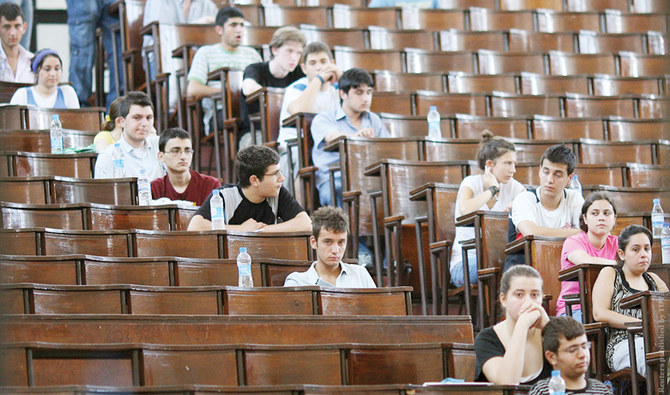
French schools in Turkey on shaky ground
https://arab.news/nbdrk
French schools in Turkey on shaky ground
- Last year, France insisted on training “local” imams to preach to its Muslim communities rather than letting Turkey send imams as a way to increase its soft power in the interests of Ankara
The Damascus book fair draws crowds, with censorship eased in post-Assad Syria
- The book fair was first held in Syria in 1985 and stopped for several years after the country’s civil war began in March 2011
DAMASCUS, Syria: Abdul-Razzaq Ahmad Saryoul began publishing books in Syria in 2003 but he used to abstain from participating in the annual International Damascus Book Fair because of tight measures by the country’s security agencies and bans on many books under Bashar Assad’s rule.
In the first post-Assad book fair to be held in Damascus, which wrapped up Monday, Saryoul was surprised when he was issued a permit the day he applied to take part without being asked what his books are about. The wide range of titles available made this year’s fair “unprecedented,” he said.
Another publisher, Salah Sorakji, was proud to offer Kurdish books in the Syrian capital for the first time in decades. During the Assad era, ethnic Kurds suffered from discrimination, including bans on their language.
The first book fair since Assad was unseated in December 2024 witnessed high turnout, with state media reporting that 250,000 people attended on the first day, Feb. 6, trekking out to fairgrounds where it was held about 10 miles (16 kilometers) from the city center. The fair’s director, Ahmad Naasan, said about 500 publishing companies from some 35 countries took part.
A debate over religious texts
While the new freedom of expression was widely welcomed, the introduction of some previously forbidden books by Islamist writers sparked anxiety among religious minorities.
Religious books were among the best selling at previous fairs in the majority Sunni Muslim country. This year, however, books of the Islamic scholar Ibn Taymiyya — who lived in Damascus seven centuries ago and whose teachings are followed by Sunni jihadi groups — were sold openly at the fair after being banned for decades.
The circulation of books spreading an extreme ideology raised alarms in Syria, where sectarian killings have left hundreds of Alawites and Druze dead over the past year in sectarian attacks by pro-government Sunni fighters.
Assad, a member of the Alawite religious minority, officially espoused a secular ideology. The Assad dynasty launched brutal crackdowns on the Muslim Brotherhood and other Islamist groups during the family’s five- decade rule.
The only known book to be banned this year — “Have You Heard the Talk of the Rafida?” — included audio addresses by Abu Musab Al-Zarqawi, the leader of Al-Qaeda in Iraq who was killed in a US strike in 2006. Iraq reportedly asked Syrian authorities to remove it because it incites hatred against Shiite Muslims.
A bearded man wearing a military uniform who identified himself by his nom de guerre Abu Obeida, bought a copy of Ibn Taymiyyah’s famous book “Al-Aqida Alwasitiyeh” or “The Fundamental Principles of Islam.”
“Before liberation this book was banned in Syria,” Abu Obeida told The Associated Press, standing at a stand selling religious books. ”Anyone who had such a book used to be taken to jail.”
“Now it is available, thanks be to God,” he said,adding that in the past people read “what the state wanted them to.”
A new era
The book fair was first held in Syria in 1985 and stopped for several years after the country’s civil war began in March 2011.
Hala Bishbishi, the director of the Egypt-based Al-Hala publishing house, was surprised by the number of people who showed up, although she added that the Damascus book fair cannot yet be compared to those held in oil-rich Gulf countries.
“With the circumstances that Syria passed through, this fair is excellent,” the woman said. Shuttle buses between the fair and central Damascus boosted visitor numbers, she added.
Atef Namous, a Syrian publisher who had been living abroad for 45 years, said he was participating for the first time because any book can be sold at the fair now, even those imported form Western countries.
The exhibition this year comes weeks after intense clashes between government forces and Kurdish fighters in the northeast. A ceasefire deal was reached and the government in Damascus has sought to reassure Kurds that they are equal citizens in the new political order.
Interim President Ahamd Al-Sharaa issued a decree last month giving Kurds rights unseen in decades, including restoring citizenship to Kurds who had been stripped of it under the Assad dynasty, making Kurdish one of Syria’s official languages as well as recognizing the Kurds most important holiday, the spring celebration of Newroz.
“We are very happy with this positive step toward Kurds, who for more than 60 years have been deprived of practicing the Kurdish culture,” said Sorakji, the Kurdish publisher about being allowed to show books in Kurdish for the first time in many years.
Selling history, literature and philosophy books at his stand, Sorakji said most of the people buying were Kurds, but there were also Arabs who want to know more about their compatriots.
“We are all Syrians but what caused all the differences was the (Assad) regime,” he said.
Another owner of a publishing company, Mayada Kayali, said that the most important thing to offer to the younger generations who “have emerged from war, injustice and oppression is knowledge — knowledge that is accessible to them, without placing restrictions on their ideas or their opinions.”


