



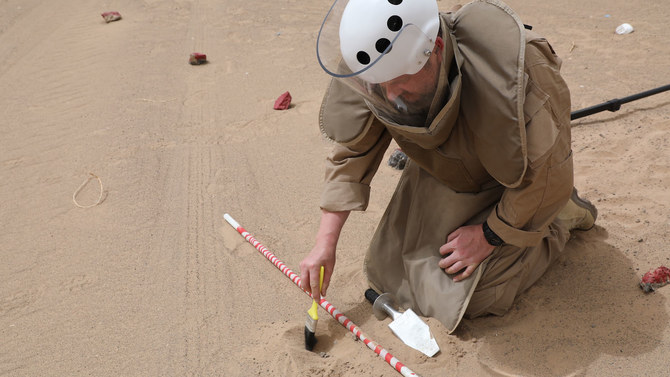

AL-MUKALLA: The Saudi Project for Landmine Clearance (Masam) in Yemen has cleared mines from across the country to allow displaced people to return home, according to the project director.
Osama Al-Gosaibi said that the Iran-backed Houthis had put down tens of thousands of mines in Yemen since taking over Sanaa in late 2014.
He added that the project’s demining engineers were working as hard as they could to clean land before civilians were hit. “We are racing against time,” Al-Gosaibi told Arab News.
Masam, which was established in mid-2018 by the King Salman Humanitarian Aid and Relief Center (KSRelief), aims to clear Yemen of landmines and unexploded ordnances. It trains local demining engineers, equips them with state-of-the-art machines and also helps landmine victims.
In June, KSRelief extended Masam’s contract for one year at a cost of $30 million.

Al-Gosaibi said the project has 32 demining teams. They have tackled more than 180,000 landmines, anti-personnel and anti-tank mines as well as other explosive devices since 2018. Their activity has covered an area exceeding 13 million square meters in the provinces of Marib, Jawf, Shabwa, Taiz, Lahj, Dhale, Hodeidah and Saada.
Compared to other countries such as Lebanon, where Al-Gosaibi and his teams have also worked, a demining mission in Yemen is more dangerous and arduous. It has cost Masam the lives of 21 engineers.
“The Houthi militia has extensively and indiscriminately planted mines in all areas,” he said. “We retrieve mines from purely civilian areas. We remove them from schools, houses, farms, roads, children's playgrounds and animal pastures.”
Figures collected by Masam and the US-based Armed Conflict Location and Event Data Project show that the Houthis planted around a million landmines in contested areas and even in areas under their control.
“As much as we are keen to secure and clear the largest amount of mined areas, the militias are still laying mines in the areas under their control.”
Local and international right groups say that hundreds of Yemeni civilians have been killed over the last five years.
Masam said that the latest confirmed victims of Houthi landmines were two people who were killed on Monday in a landmine explosion in the central province of Al-Bayda.
Local media outlets recently reported that entire families were killed in Jawf when vehicles drove over landmines laid by Houthis.
“Landmine victims are in their thousands, mainly children and women, and this bloodshed will stop when Yemen is entirely secured from landmines. And this is our chief objective,” Al-Gosaibi said.
Most landmines retrieved by Masam teams are locally made, while others originate from Iran.
Al-Gosaibi accused the Houthis of targeting civilians by planting landmines disguised as rocks and children’s toys in villages, farmlands, schools, roads and parks.

Thousands of Yemenis who fled fighting in their home villages have been able to return thanks to the project’s efforts, however. “By securing these areas, we helped thousands of displaced people to safely return to their homes, farms and schools,” Al-Gosaibi said.
Yemeni demining officials have hailed the role of Masam in helping the country get rid of landmines and supplying local demining teams with knowledge and equipment.
“Masam is a great project that came at the right time,” Maj. Gen. Ameen Saleh Al-Aqeli, the director of the Yemen Executive Mine Action Center (YEMAC), told Arab News. “It achieved great work at record time. The number of landmine victims would have been much higher if Masam did not come to Yemen. It has saved the lives of many Yemenis.”
YEMAC has received support from the Saudi government and other international donors that have helped it stand on its feet during the war.
Al-Aqeli attributed the high number of civilian casualties to the intensity of landmines planted by the Houthis and people’s lack of awareness, as many displaced Yemenis had hastily returned to liberated areas before demining teams were able to finish their missions.
“Due to poverty and hunger many people do not heed to our warnings against returning to their houses. So they cause a disaster to themselves and the others when they return.”


