

Waterborne diseases, dengue surge in Karachi after urban flooding

People wade through a flooded residential area following heavy monsoon rains triggered floods in Pakistan's port city of Karachi on Aug. 31, 2020. (AFP/File)
Short Url
Updated 04 September 2020
Follow

Waterborne diseases, dengue surge in Karachi after urban flooding

  • Doctors say they have witnessed a sharp increase in cases of diarrhea, vomiting and gastroenteritis
  • Sindh health minister informs the provincial administration has launched its preventive campaign against dengue, malaria

KARACHI: Health experts and medical practitioners in Pakistan’s densely populated southern port city warned on Thursday that diseases like dengue and malaria could spread in the country's commercial capital if immediate precautionary measures were not taken by relevant authorities.

Ponds of rainwater contaminated with black sewage can be seen in different parts of Karachi after it recently witnessed massive urban flooding.

Doctors maintain they have already seen a significant increase in waterborne diseases in the city. 

“If steps are not taken, you may see a dengue or malaria epidemic,” Dr. Muneer Sadiq, a Karachi-based health expert, told Arab News, adding that the number of patients complaining of diarrhea and vomiting had suddenly increased. “I have examined today 12 patients of diarrhea. This is despite the fact that we usually get an average of one such patient on a daily basis under normal circumstances.” 

Dr. Omar Sultan, a consultant physician at the Jinnah Postgraduate Medical Center, said that other waterborne diseases had surged as well, though the real threat was the spread of dengue. 

“Different waterborne diseases have increased in the city,” he informed. “If the situation persists without large scale disinfection drives, end of September and beginning of October could see a high number of dengue patients.” 

According to the Ministry of National Health Services, some 90,400 dengue cases and 169 related deaths were reported across Pakistan between 2015 and 2019. Last year alone witnessed a massive jump from 3,204 cases in 2018 to 45,120 cases in 2019. 

Sindh witnessed a record number of 16,925 dengue cases last year. According to a report by the provincial health department that is based on 15 years of statistics, the province has recorded 49,322 cases of dengue and 275 related deaths between 2005 and 2020. The data also signify that last year was the worst with 16,925 cases and 46 deaths. 

During the ongoing year, the province has reported 733 dengue cases in the first eight months. About 92 percent of them—or 677—were recorded in Karachi. During the last three days, at least 10 more dengue cases have been reported in the city. 
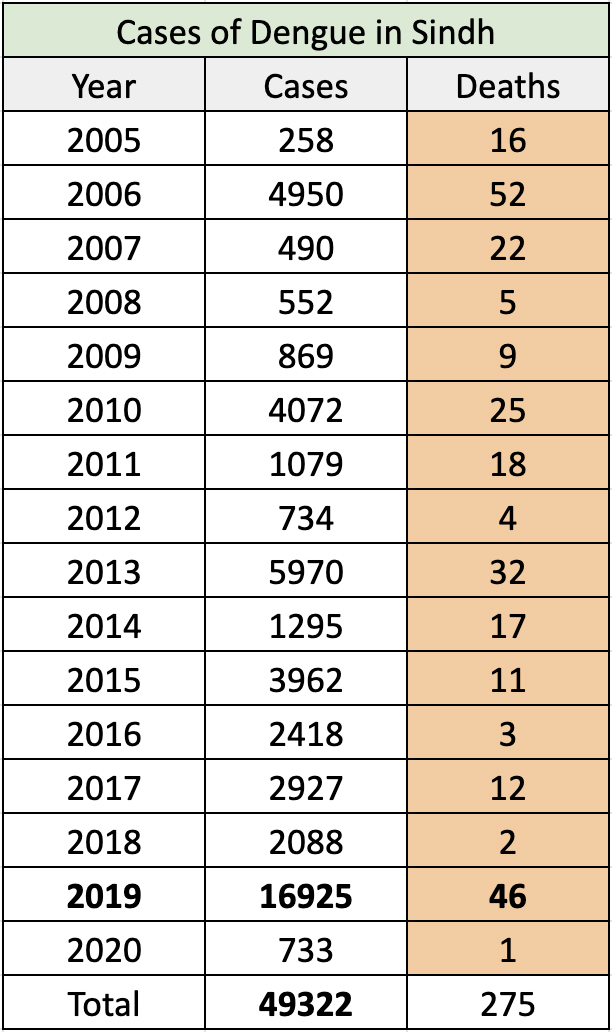
Source: Sindh Health Department

The Sindh health department spokesperson, Meeran Yousuf, told Arab News that an increase in waterborne diseases, especially dengue and malaria, was anticipated by health authorities that were trying to prevent that from happening. 

“The health department is spraying disinfectants to get rid of larvae whereas the process of putting up banners to create greater awareness about the disease across the province is also underway,” she added. 

In a video message shared with Arab News, the provincial health and population welfare minister, Dr. Azra Fazal Pechuho, said that dengue and malaria could spread at a rapid pace due to stagnant water that gathered in different areas after the recent monsoon rains. 

“I request you to drain water from your houses. Even a cup full of water can be enough for dengue mosquitoes to breed,” she said while addressing people through social media. 

“We have conducted meetings and are using sprays to kill mosquito larvae,” she said, adding that "health department teams immediately rush to neighborhoods where dengue cases are reported to spray disinfectants.”


Cross-border clash breaks out between Pakistan and Afghanistan amid rising tensions

Updated 55 min 2 sec ago
Follow

Cross-border clash breaks out between Pakistan and Afghanistan amid rising tensions

  • Border residents say exchange of fire in the Chaman border sector lasted nearly two hours
  • Both governments issue competing statements blaming the other for initiating the violence

ISLAMABAD: Pakistan and Afghanistan witnessed yet another border clash, according to officials in both countries who spoke in the early hours of Saturday, with each side accusing the other of launching “unprovoked” attacks.

Fighting erupted in Pakistan’s southwestern Chaman border sector, with an AFP report saying that residents on the Afghan side of the frontier reported the exchange of fire began at around 10:30 p.m. (1800 GMT) and continued for roughly two hours.

The incident underscored how tensions remain high between the neighbors, who have seen deadly clashes in recent months despite several rounds of negotiations mediated by Qatar and Türkiye that resulted in a tenuous truce in October.

“There has been unprovoked firing by Afghan Taliban elements in the Chaman Sector which is a reckless act that undermines border stability and regional peace,” said a Pakistani security official on condition of anonymity.

“Pakistani troops responded with precision, reinforcing that any violation of our territorial integrity will be met with immediate and decisive action,” he continued.

The official described Pakistan’s response as “proportionate and calibrated” that showed “professionalism even in the face of aggression.”

“The Chaman Sector exchange once again highlights the need for Kabul to rein in undisciplined border elements whose actions are destabilizing Afghanistan’s own international standing,” he added.

Relations between Pakistan and Afghanistan have grown increasingly bitter since the Taliban seized power in Kabul following the withdrawal of international forces in August 2021.

Islamabad accuses the Taliban administration of sheltering anti-Pakistan militant groups such as the Baloch Liberation Army (BLA) and Tehreek-e-Taliban Pakistan (TTP), which have carried out deadly attacks in its western provinces bordering Afghanistan, targeting civilians and security forces.

The Taliban deny the charge, saying Pakistan’s internal security challenges are its own responsibility.

The Pakistani security official said his country remained “committed to peaceful coexistence, but peace cannot be one-sided.”

“Attempts to pressure Pakistan through kinetic adventurism have repeatedly failed and will continue to fail,” he said. “The Chaman response has reaffirmed that message unmistakably.”

He added that Pakistan’s security forces were fully vigilant and that responsibility for any escalation “would solely rest with those who initiated unprovoked fire.”

Mosharraf Zaidi, spokesman for Pakistan’s prime minister, also commented on the clashes in a social media post, saying the Afghan Taliban had “resorted to unprovoked firing along the border.”

“An immediate, befitting and intense response has been given by our armed forces,” he wrote.

Afghan authorities, however, blamed Pakistan for the hostilities.

“Unfortunately, tonight, the Pakistani side started attacking Afghanistan in Kandahar, Spin Boldak district, and the forces of the Islamic Emirate were forced to respond,” Taliban spokesman Zabihullah Mujahid said on X.

Border clashes that began in October have killed dozens of people on both sides.

The latest incident comes amid reports of back-channel discussions between the two governments, although neither has publicly acknowledged such talks.
