

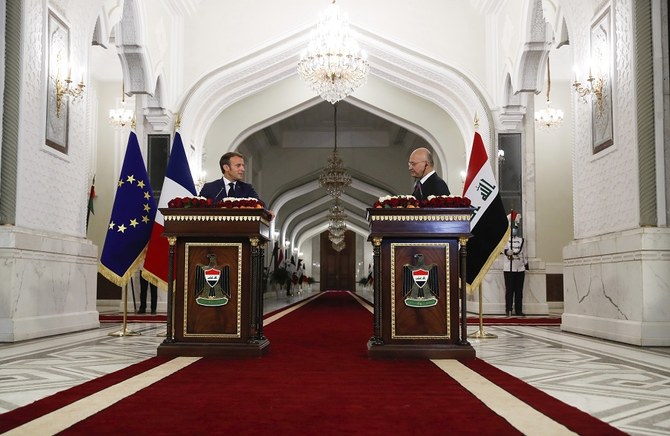

BADGHAD: French President Emmanuel Macron met Iraqi leaders on Wednesday on his first visit to Baghdad where he stressed the war-scarred country must assert its “sovereignty” despite being caught up in US-Iran tensions.
Coming straight from a two-day trip to crisis-hit Lebanon, Macron is the most prominent world leader to visit Iraq since Prime Minister Mustafa Al-Kadhimi came to power in May.
The trip aims to “launch an initiative alongside the UN to support a process of sovereignty,” Macron earlier said.
He voiced his support for his Iraqi counterpart Barham Saleh to help fight Daesh group sleeper cells and resist foreign interference.
“Iraq has been going through a challenging time for several years, with war and terrorism” as well as “multiple foreign interventions,” Macron said. “You have a transition to lead. France will be by your side so the international community can help.”
But there were few details on the much-vaunted “sovereignty” initiative. Iraqi officials said they were not expecting new financial or military aid.
President Saleh said he looked forward to a longer visit by Macron in 2021, and Kadhimi said he hoped France and Europe as a whole could help “restore stability” to the rocky region.
“We do not want to be an arena for confrontations but a zone of stability and moderation,” the premier said, adding that France and Iraq would sign energy agreements in the future and deepen military cooperation.
Macron said Iraqis, who had “suffered so much,” deserved options besides domination by regional powers or extremists.
Macron said the fight against Daesh is not over, even if there are retreats from some territory.
“The fight against Daesh, which France is fully invested in as part of international coalition, will continue,” he said.
The second challenge is “foreign interference from multiple points, some which has lasted for many years and some that is more recent,” Macron said. He added that France fully supports a project to “consolidate the (Iraqi) state” in the economic, military, educational and cultural sectors, describing it as a “project for Iraqi sovereignty.” He did not elaborate.
“I come to Baghdad, which I am happy to visit for the first time, to show our support for Iraq in a time of challenges,” Macron tweeted after arrival. He said there are “numerous challenges to guarantee Iraq’s sovereignty in all dimensions, economic and security-wise, internally and in the region.”
“Our collective security and regional stability depend on this. Our soldiers are fighting side by side to ensure the definitive defeat of the jihadis,” Macron added in his tweet.
Unlike most foreign visitors, the French president will not stop over in Irbil, capital of Iraq’s autonomous Kurdish region, but will instead meet Kurdish President Nechirvan Barzani in Baghdad.
Macron was also likely to discuss the fate of 11 French nationals who were condemned to death last year by Iraqi courts for joining Daesh.
The president’s focus on sovereignty was also an indirect message to Turkey, one Iraqi official said, after Ankara launched a cross-border assault on Kurdish rebels in the north.
Tensions are high between France and Turkey over the conflict in Libya and a dispute over offshore gas rights in the Eastern Mediterranean.
Karim Bitar, a political science professor in France and Lebanon, said the French leader was focusing on Lebanon and Iraq as he believes Paris could play a mediating role if regional tensions escalate further.
“Macron is definitely trying to make a push for a France-facing Middle East,” Bitar said.
French Defense Minister Florence Parly held talks in Baghdad, pledging continued support for Iraq’s fight against remnants of the Daesh group.
Parly held talks with her counterpart Jumaa Inad and President Saleh, and was due to travel to the autonomous Kurdish region in northern Iraq. She said France was hoping to resume its training and arming of Iraqi security forces “as soon as possible.”
Parly said she and Inad also discussed boosting Iraq’s surveillance methods, “by land and in its airspace,” to squeeze IS sleeper cells still operating in desert areas.
“We are convinced that the fight against Daesh is not over,” she said. “We are by your side.”


