

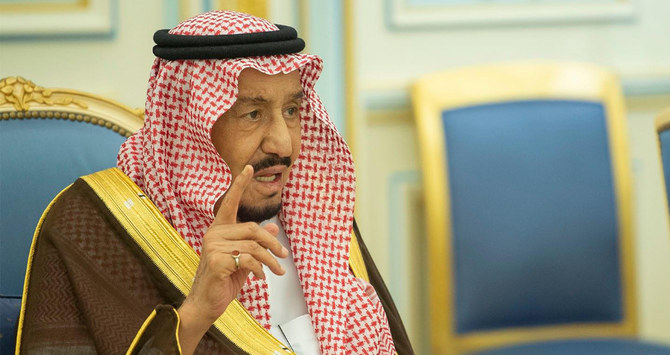
King Salman’s sacking of top Saudi officials proves ‘no one is above law’

The monarch on Monday issued a royal decree ordering the dismissal of Saudi Commander of the Joint Forces in Yemen Lt. Gen. Fahad bin Turki bin Abdul Aziz. (SPA)
Short Url
Updated 01 September 2020
Follow

King Salman’s sacking of top Saudi officials proves ‘no one is above law’

  • Saudi lawyers laud monarch’s royal decree, tough stance against corruption in Kingdom

JEDDAH: Saudi lawyers on Tuesday lauded King Salman’s sacking of two high-ranking officials as part of an anti-corruption drive that proved “no one was above the law.”

The monarch on Monday issued a royal decree ordering the dismissal of Saudi Commander of the Joint Forces in Yemen Lt. Gen. Fahad bin Turki bin Abdul Aziz and Jouf Deputy Gov. Prince Abdul Aziz bin Fahad bin Turki bin Abdul Aziz Al-Saud and the launch of a corruption probe.

He also placed under investigation a number of officers, civil officials, and others based on a referral from Crown Prince Mohammed bin Salman to the Control and Anti-Corruption Authority (Nazaha) to look into what the decree described as “suspicious financial dealings monitored at the Ministry of Defense.”

According to the king’s decree, Nazaha “disclosed financial corruption” at the ministry linked to the military chief and the prince.

Saudi lawyer Abdullah Al-Khatib told Arab News that Nazaha would complete legal procedures against the accused.

“One of the authority’s main objectives is to provide direct communication channels with the public to receive their reports related to corrupt behaviors, verify their validity and take the necessary actions in this regard, following the approach of our wise leadership to achieve justice in society and eliminate corruption in all its forms,” he said.

Legal consultant, Majed Garoub, said: “This action is a clearer confirmation to a recent decision where governors of the Red Sea coastal cities of Umluj and Al-Wajh, the head of border security, and other local commanders, as well as officials from the Ministry of Interior have been sacked over corruption at tourism projects; most of them were referred to by their names and job titles.

“Everyone should know that only attempting to be involved in a corrupt action is a crime by itself and is punishable by law. This is to confirm that whoever plans, plots, conceals, and initiates the crime, his punishment is no less than those who commit the full crime of financial corruption, including bribery, mediation, and abuse of influence,” he added.

Garoub pointed out that the king’s decree had targeted high-ranking officials and members of the Saudi royal family, sending out a clear message that no one in the Kingdom was above the law.

“The interest of the Kingdom of Saudi Arabia and its wealth is for the public interest, the country and the citizens, and not for the corrupt to benefit from them unlawfully.

“This is to uproot corruption from Saudi thought, culture, and conscience, and to remind everyone who thinks that they can safely continue in their corruption that social status and governmental position can no longer prevail over the law,” he said.

Another lawyer, Njood Al-Qassim, noted that corruption covered crimes including bribery and trading in influence, abuse of power, illicit enrichment, manipulation, embezzlement, squandering or abuse of public money, money laundering, accounting and commercial fraud, forgery, and currency counterfeiting.

“Therefore, the national integrity and anti-corruption strategy has focused on verifying and investigating all those found guilty and those related to these violations, completing the statutory procedures, taking the necessary measures in this regard, and raising results to the higher responsible authorities.

“No one is above the law according to the policy and vision of the Kingdom of Saudi Arabia,” she said.


Experimental farm in Al-Lith looks into future of Saudi Arabian agriculture

Updated 02 February 2026
Follow

Experimental farm in Al-Lith looks into future of Saudi Arabian agriculture

  • Research initiative reflects strategic transformation

JEDDAH: An experimental farm in Saudi Arabia’s Al-Lith Governorate is one of the research initiatives reflecting the strategic transformation taking place in the Kingdom’s agricultural sector.

The farm uses highly efficient, sustainable production models that combine scientific research with commercial application, contributing to strengthening the country’s food security system and the sustainability of water resources.

Located in the Ghumaiqa Center on an area of about 10 hectares, the cutting-edge farm is a testing platform for modern agricultural technologies that tackle the challenge of water scarcity.

The farm includes developed open fields and modern greenhouses, supported by smart irrigation encompassing drip and sprinkler irrigation alongside surface and subsurface technologies.

All the systems operate via smart controls that enable the monitoring of water consumption and ensure improved efficiency, thereby achieving a balance between agricultural production and water conservation.

The farm also uses treated and diluted low-salinity seawater.

It aims to diversify agricultural water sources, reduce reliance on freshwater, and open new horizons for agriculture in coastal and semi-arid environments.

A view of the experimental farm in Al-Lith. (SPA)

The project represents a promising investment opportunity in the field of smart agriculture, enabling the development of commercially scalable production models, particularly for high-value vegetables and fruits, while reducing operational costs associated with water and energy, enhancing the economic feasibility of future agricultural projects.

In addition, the project contributes to transferring and localizing agricultural expertise, supporting local food supply chains, and creating an attractive environment for agricultural investment.

This aligns with Sustainable Development Goals and enhances the efficiency of the private sector in adopting innovative agricultural solutions.

Yahya bin Abdulrahman Al-Mahabi, the director of the Ministry of Environment, Water and Agriculture office in Al-Lith Governorate, told the Saudi Press Agency that the project represented the future of agriculture in the Kingdom.

He explained that the vision was based on investing in technology, enhancing the return on water per unit, and integrating scientific research with investment opportunities.

Al-Mahabi spoke of the experimental farm as a modern, scalable and replicable model applicable in several regions of the Kingdom, particularly in coastal environments.

Al-Mahabi highlighted the Ministry of Environment, Water and Agriculture’s commitment to supporting distinctive projects that contributed to achieving food security while developing rural areas and enhancing agricultural production efficiency, in line with the objectives of the Kingdom’s Vision 2030.