ISLAMABAD: On the invitation of the government of Afghanistan, Pakistani Foreign Secretary Sohail Mahmood visited Kabul for key talks under the second review meeting of the Afghanistan-Pakistan Action Plan for Peace and Solidarity (APAPPS), the Pakistani foreign office said in a statement.
The Afghan side was led by Deputy Foreign Minister Mirwais Nab.
APAPPS was established in 2018 to provide a comprehensive and structured framework for institutional engagement in diverse areas of bilateral cooperation between Pakistan and Afghanistan.
The framework comprises five working groups focused on Politico-Diplomatic, Military-to-Military Cooperation, Intelligence Cooperation, Economic Cooperation, and Refugee Issues. The first review meeting was held in Islamabad on 10 June 2019.
“During the meeting, the entire spectrum of bilateral relations was reviewed,” the Pakistani foreign office said in a statement. “Highlighting the importance of Pakistan-Afghanistan relations, the Foreign Secretary underlined that these historic and fraternal ties were reinforced by a shared desire for regional peace, stability and prosperity.”
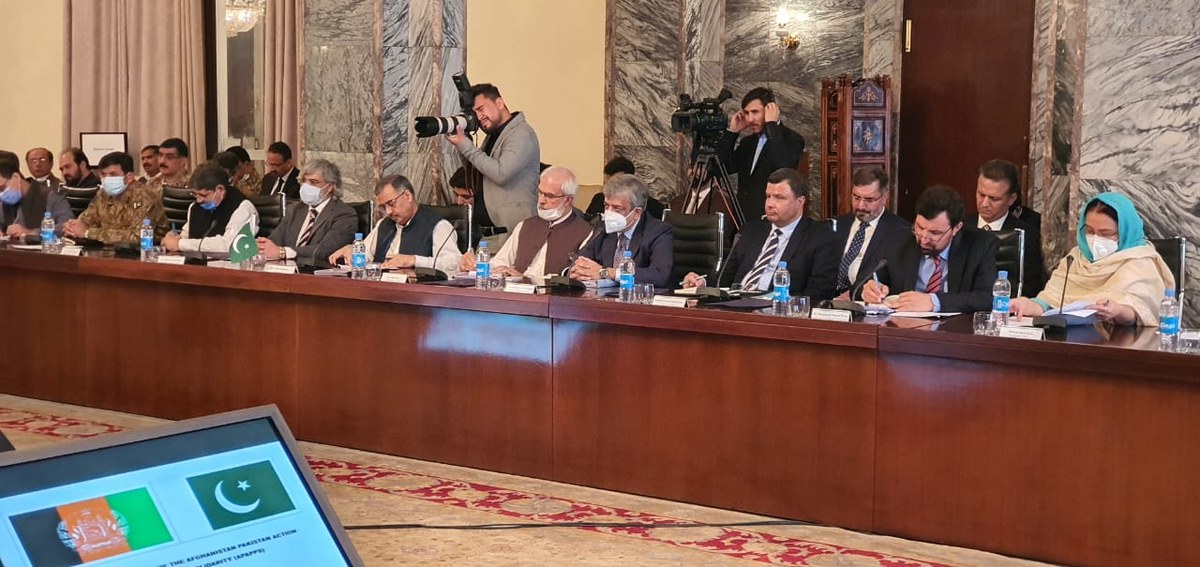
Senior Pakistani and Afghanistan officials meet in Kabul for second review meeting of the Afghanistan-Pakistan Action Plan for Peace and Solidarity on August 31, 2020. (Photo by Pakistan Embassy in Kabul)
Pakistani and Afghan officials are meeting at a time when efforts are underway to kickstart crucial intra-Afghan talks, a date for which has yet to be finalized, which will enable Afghans to decide their future political roadmap.
It also follows a visit by Afghan Taliban political representatives to Islamabad last week, following which Foreign Minister Shah Mahmood Qureshi said that they had agreed on “a peaceful settlement of the conflict.”
The Pakistan foreign office said the relationship with Afghanistan was further strengthened through regular exchanges at the highest level and through myriad bilateral mechanisms, particularly APAPPS, the statement said.
“Despite the challenges posed by Covid-19, the Foreign Secretary said, Pakistan had opened the border crossings with Afghanistan to facilitate bilateral and transit trade as well as pedestrian movement,” the statement said.
The Foreign Secretary reiterated Pakistan’s abiding commitment to a peaceful, stable, united, sovereign and prosperous Afghanistan. He reaffirmed Pakistan’s steadfast support for the Afghan peace process and reiterated that there was no military solution to the conflict in Afghanistan. An inclusive, broad-based and comprehensive political settlement was the only way forward, he said.
“Pakistan looked forward to the earliest commencement of Intra-Afghan negotiations,” the statement said, referring to upcoming talks between the Kabul government and Taliban insurgents.
“The Afghan stakeholders must seize this historic opportunity, work together constructively, and secure an Afghan-owned and Afghan-led negotiated solution for durable peace and stability in Afghanistan and the region,” the statement said. “Noting that the coming phase would be challenging, the Foreign Secretary cautioned against the role of ‘spoilers’ and stressed that perseverance and unflinching commitment would be indispensable for a successful outcome.”
The five Working Groups held in-depth discussions on key tracks of the relationship. In the Politico-Diplomatic Working Group, the Pakistan side focused on strengthening bilateral relations through regular high-level exchanges, increased institutional engagement, utilization of existing mechanisms including APTECA and JEC, enhanced economic partnership, and intensified people-to-people exchanges.
Under the Economic Working Group, Pakistan reaffirmed its commitment to expand bilateral trade through facilitation and liberalization measures and expressed its readiness to commence negotiations on a new Afghanistan-Pakistan Transit Trade Agreement (APTTA).
The Refugee Working Group discussed all aspects pertaining to the Afghan refugees in Pakistan. The Pakistan side reiterated that the peace and reconciliation process offered a unique opportunity to address the return of Afghan refugees to their homeland with dignity and honor. A time-bound, well-resourced roadmap was important in this regard.
Under the Military-to-Military and Intelligence Cooperation Working Groups, detailed discussions were held on all relevant matters, with emphasis on regular exchanges and closer collaboration.
The two sides reiterated their commitment to optimally utilize APAPPS to deliberate on all key issues, effectively address common challenges, and pursue new opportunities. It was agreed to enhance the frequency of APPAPS review meetings and increase mutual interaction among the various Working Groups. It was decided that the next, third, review meeting will be held in Pakistan, the dates for which will be worked out through diplomatic channels.
Prior to the review meeting, the Foreign Secretary and the delegation members called on Acting Foreign Minister Hanif Atmar. The Foreign Secretary conveyed greetings on behalf of the leadership and people of Pakistan. He also conveyed sympathies and condolences over the loss of precious lives due to COVID-19 and the human and material losses caused by heavy rains and flash floods in Parwan province. During the meeting, ways and means were discussed to enhance Pakistan-Afghanistan bilateral cooperation and strengthen endeavours in support of the Afghan peace process.