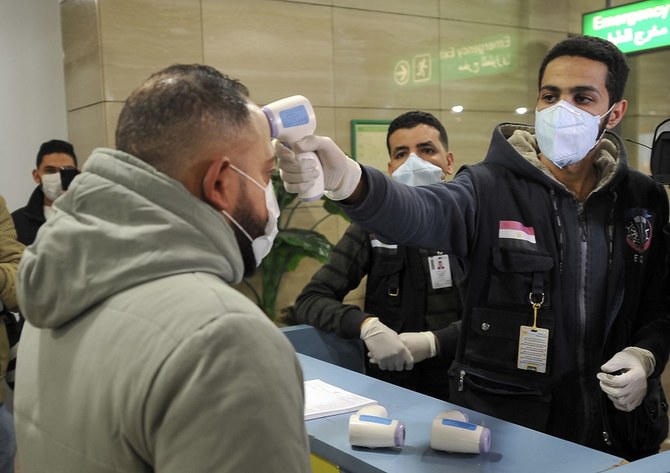
DUBAI: Egypt will require all passengers arriving the country’s airports to present a negative Polymerase Chain Reaction (PCR) test for coronavirus starting September 1.
The PCR test requirement, which also covers Egyptian nationals, must be conducted a maximum of 72 hours prior to the scheduled flight, instead of a previous 48 hours, according to a circular issued by the civil aviation ministry, local daily Al-Ahram Online reported.
Children of all nationalities under the age of six are exempted from the decision, the report added.
Cairo authorities required all travelers arriving in the country to present negative PCR result after noting ‘increasing infections in some countries.’ Foreign visitors are now only allowed entry into the three coastal governorates: South Sinai, Red Sea and Matrouh.
Egypt started a gradual resumption of international flights in July, after suspending them in March due to the coronavirus outbreak in the country.
A total of 126,000 tourists visited the country since international flights were resumed.

Egypt requires negative COVID-19 tests for airport travelers
https://arab.news/yvbjd
Egypt requires negative COVID-19 tests for airport travelers
Sudan’s war robs 8 million children of 500 days’ education
- British NGO Save the Children says many teachers are leaving their jobs due to unpaid salaries
PORT SUDAN: Almost three years of war in Sudan have left more than 8 million children out of education for nearly 500 days, the NGO Save the Children said on Thursday, highlighting one of the world’s longest school closures.
“More than 8 million children — nearly half of the 17 million of school age — have gone approximately 484 days without setting foot in a classroom,” the children’s rights organization said in a statement.
Sudan has been ravaged by a power struggle between the army and the Rapid Support Forces since April 2023.
This is “one of the longest school closures in the world,” the British NGO said.“Many schools are closed, others have been damaged by the conflict, or are being used as shelters” for the more than 7 million displaced people across the country, it added. North Darfur in western Sudan is the country’s hardest-hit state: Only 3 percent of its more than 1,100 schools are still functioning.
In October, the RSF seized the city of El-Fasher, the capital of North Darfur, and the last of Darfur’s five capitals to remain outside their control.
West Darfur, West Kordofan, and South Darfur follow with 27 percent, 15 percent, and 13 percent of their schools operating, respectively, according to the statement.
The NGO added that many teachers in Sudanese schools were leaving their jobs due to unpaid salaries.
“We risk condemning an entire generation to a future defined by conflict,” without urgent investment, said the NGO’s chief executive, Inger Ashing.
The conflict, which has claimed tens of thousands of lives, has triggered the “world’s worst humanitarian crisis,” according to the UN.
On Sunday, UN Human Rights commissioner Volker Turk condemned the increasing number of attacks against “essential civilian infrastructure” in Sudan, including hospitals, markets, and schools.
He also expressed alarm at “the arming of civilians and the recruitment of children.”
The UN has repeatedly expressed concern about the “lost generation” in Sudan.
Even as war rages in the southern Kordofan region, Prime Minister Kamil Idris has announced that the government will return to Khartoum after operating from the Red Sea city of Port Sudan, some 700 km away, for nearly three years.
Main roads have been cleared, and cranes now punctuate the skyline of a capital scarred by the war. Since then, officials have toured reconstruction sites daily, promising a swift return to normal life.
Government headquarters, including the general secretariat and Cabinet offices, have been refurbished. But many ministries remain abandoned, their walls pockmarked by bullets.
More than a third of Khartoum’s 9 million residents fled when the RSF seized the city in 2023.
Over a million have returned since the army retook the city.
A jungle of weeds fills the courtyard of the Finance Ministry in central Khartoum, where the government says it plans a gradual return after nearly three years of war.
Abandoned cars, shattered glass, and broken furniture lie beneath vines climbing the red-brick facades, built in the British colonial style that shaped the city’s early 20th-century layout.
“The grounds haven’t been cleared of mines,” a guard warns at the ruined complex, located in an area still classified as “red” or highly dangerous by the UN Mine Action Service, or UNMAS.
The central bank is a blackened shell, its windows blown out. Its management announced this week that operations in Khartoum State would resume, according to the official news agency SUNA.
At a ruined crossroads nearby, a tea seller has reclaimed her usual spot beneath a large tree.
Halima Ishaq, 52, fled south when the fighting began in April 2023 and came back just two weeks ago.
“Business is not good. The neighborhood is still empty,” the mother of five said,
Near the city’s ministries, workers clear debris from a gutted bank.
“Everything must be finished in four months,” said the site manager.
Optimism is also on display at the Grand Hotel, which once hosted Queen Elizabeth II.
Management hopes to welcome guests again by mid-February.


