

Pakistan’s minister for defense production meets Arab envoys

Federal Minister for Defense Production Zobaida Jalal meets Saudi Ambassador to Pakistan Nawaf bin Saeed Al-Malki at her office in Islamabad on Aug. 27, 2020. (PID)
Short Url
Updated 27 August 2020
Follow

Pakistan’s minister for defense production meets Arab envoys

  • Tells the Saudi ambassador that her country attaches great significance to its relations with the Kingdom
  • Zobaida Jalal also points out that the defense industries of Pakistan and Egypt could undertake joint ventures

ISLAMABAD: Federal Minister for Defense Production Zobaida Jalal held separate meetings with two Arab envoys on Thursday, praising her country’s strong diplomatic bonds with the two states in the Middle East and North Africa. 

According to an official handout circulated in Islamabad, the minister met the Saudi ambassador to Pakistan Nawaf bin Saeed Al-Malki at her office and told him that Pakistan attached great significance to its relations with the Kingdom. 

She noted that the Saudi-Pak religious, cultural and fraternal ties had a remarkable history, adding that people of both countries had tremendous regard for each other. 

Jalal said that the two allies had commonality of views on all regional and international issues and should continue to nurture their relationship further.

In response, the Saudi ambassador “expressed his good wishes for the government and people of Pakistan” and said that there was “a feeling of oneness” between them that signified the closeness and depth of their relationship. 

The minister also met the Egyptian ambassador to Pakistan Tarek Dahrough later in the day and said that his country held an important position in the region as well as in the Muslim world. 
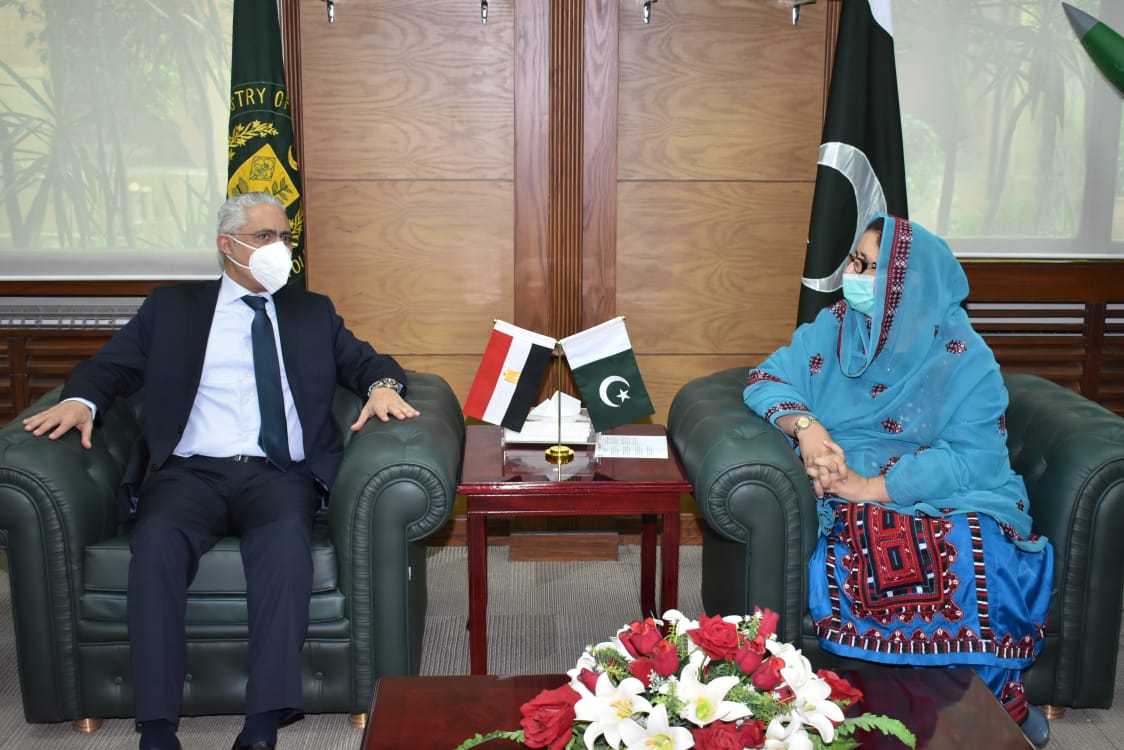


Federal Minister for Defense Production Zobaida Jalal met Egyptian Ambassador to Pakistan Tarek Dahrough at her office in Islamabad on Aug. 27, 2020. (PID)

Jalal added that there was a great scope and scale of cooperation between Pakistan and Egypt, pointing out that the defense industries of the two countries could work together to enhance their production capabilities. 

“The visiting dignitary acknowledged the existing scope and scale of cooperation and committed to undertake joint ventures in the respective domains,” the statement added. 

Expressing her gratitude on Egypt’s “principled” stance on Kashmir, the minister said that her country appreciated Cairo’s support and hoped that the two countries would continue to help each other on a reciprocal basis in the future as well. 


Pakistan reroutes kinnow exports to Gulf, Asia after Afghan closure – commerce ministry

Updated 5 sec ago
Follow

Pakistan reroutes kinnow exports to Gulf, Asia after Afghan closure – commerce ministry

  • Border shutdown with Afghanistan since late 2025 disrupted a key overland route for Pakistan’s citrus exports
  • Kinnow shipments earned about $40 million during peak season despite loss of a major regional market

KARACHI: Pakistan has rerouted kinnow orange exports to the Gulf and Southeast Asia after the closure of the Afghan market disrupted one of the country’s largest traditional destinations for the citrus crop, the commerce ministry said on Monday, underscoring a push to diversify export markets amid regional security tensions.

The shift follows Pakistan’s closure of major border crossings with Afghanistan in late 2025 after deadly clashes and a sharp rise in militant attacks that Islamabad says originated from Afghan territory. Pakistan has linked the restrictions to concerns over cross-border militancy, saying trade routes would remain constrained until Kabul takes credible steps to curb militant activity, a charge Afghan authorities deny.

Before the shutdown, bilateral trade between Pakistan and Afghanistan exceeded $1.6 billion annually, with overland routes playing a crucial role in the export of perishables such as kinnow, a Pakistani variety of mandarin orange. Exporters have warned that prolonged border disruptions particularly hurt citrus shipments during the winter harvest, forcing consignments to seek longer and costlier alternative routes.

Despite the disruption, the Ministry of Commerce said exporters successfully redirected shipments to other destinations.

“Priority was given to expanding access to markets in the Middle East, Southeast Asia, and other non-traditional destinations, while ensuring compliance with international quality and phytosanitary standards,” the ministry of commerce said in a statement on Monday.

According to official export figures cited by the ministry, Pakistan earned approximately $40 million from kinnow exports within 45 days, covering December and the first half of January, as shipments maintained momentum despite the loss of the Afghan market.

The ministry said it coordinated closely with the Trade Development Authority of Pakistan (TDAP), overseas trade missions and logistics partners to facilitate rerouting, documentation and market outreach, helping exporters avoid losses during the peak citrus export window.

Officials said the diversification drive helped sustain foreign-exchange inflows and protect growers, packers and exporters across the citrus value chain, while reinforcing Pakistan’s reputation as a reliable supplier in Gulf and Asian markets.

The performance, the ministry added, is being viewed as a positive signal for broader agricultural exports as Pakistan seeks to reduce dependence on a limited number of regional trade routes amid persistent geopolitical and security risks.