CAIRO: The British ambassador to Lebanon said Wednesday that the behavior of some parties, including that of Hezbollah, undermines peace in Lebanon.
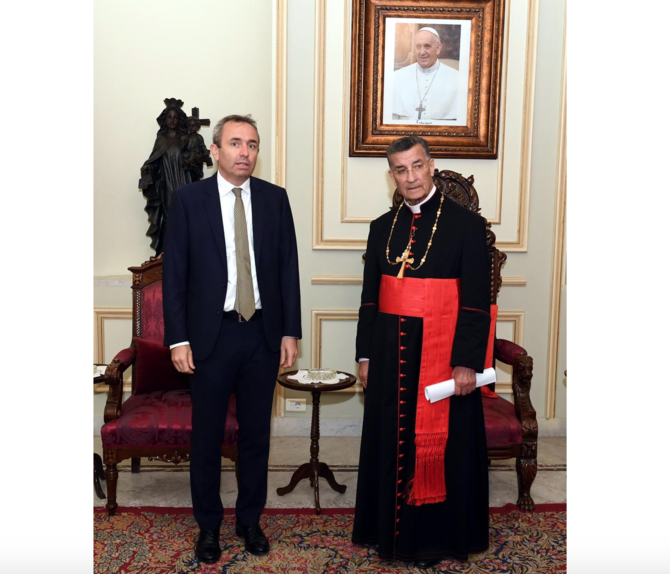
The remarks by Chris Rampling came during his meeting with Mar Bishara Boutros Al-Rai, the Lebanese patriarch of the Maronite Catholic church.
Rampling said he discussed the political solution proposed by Al-Rai for Lebanon, which aims to maintain the country’s characteristics of pluralism, openness, and democracy.
“I discussed with his eminence the neutrality initiative that he launched and its content, which it is clear that some parties, including Hezbollah, did not support, and this undermines the stability of Lebanon.”
The ambassador also described his meeting with the Al-Rai as “very important.”
“We talked about the Beirut bombing, and I expressed my condolences to his eminence and the Lebanese people,” he was quoted by Lebanon’s state news agency as saying.
“We talked about the difficult economic situation, the difficulties that Lebanon and the Lebanese are facing, the necessity for reforms at this delicate stage.”


UK envoy blames Hezbollah behavior for undermining peace in Lebanon
https://arab.news/9nsta
UK envoy blames Hezbollah behavior for undermining peace in Lebanon


Syria Kurds impose curfew in northeast cities before govt deal begins
- The government’s push to extend its authority across the country was a blow to the Kurds.
QAMISHLI, Syria: Syrian Kurdish security forces on Sunday announced a curfew early next week in two cities in the country’s northeast, ahead of the implementation of a recent deal struck with the Islamist-led government in Damascus.
Damascus and Kurdish forces reached a comprehensive agreement on Friday to gradually integrate the Kurds’ military and civilian institutions into the state, after the Kurds ceded territory to advancing government forces in recent weeks.
Mazloum Abdi, head of the Kurdish-led Syrian Democratic Forces, has said the deal would be implemented on the ground from Monday, with both sides to pull forces back from frontline positions in parts of the northeast, and from the town of Kobani in the north.
He said a “limited internal security force” would enter parts of Hasakah and Qamishli but that “no military forces will enter any Kurdish city or town.”
Kurdish security forces announced a curfew in the northeastern city of Hasakah from 6:00 am (0300 GMT) to 6:00 p.m. on Monday, and in the northeast’s main Kurdish city of Qamishli on Tuesday, during the same hours.
It said the move was “to maintain security, stability and the safety of residents.”
A source from the Kurds’ security forces said a government security delegation visited its headquarters in Qamishli on Sunday.
The text of Friday’s deal maintains an ongoing ceasefire and introduces a “gradual integration” of the Kurdish forces and administrative institutions.
It appeared to include some of the Kurds’ demands, such as establishing brigades of fighters from the Kurdish-led Syrian Democratic Forces (SDF) in Kurdish-majority areas.
The government’s push to extend its authority across the country was a blow to the Kurds.
They had sought to preserve the de facto autonomy they exercised after seizing swathes of north and northeast Syria in battles against the Daesh terrorist group during Syria’s civil war, backed by a US-led coalition.
- ‘Protects us’ -
In Qamishli on Sunday, thousands of Kurdish men, women and children filled the streets in a show of solidarity, waving Kurdish flags and holding up pictures of fighters who were killed, an AFP correspondent said.
Student Barine Hamza, 18, said “we have come out for Kurdish unity.”
“We are afraid of being betrayed because we do not trust this government,” she said.
Housewife Nourshana Mohammed, 40, said that “the presence of the SDF is important for us. It protects us Kurds and saved us” from IS.
Information Minister Hamza Mustafa told state media on Friday that the agreement included the handover of some oil fields, the Qamishli airport and border crossings to the government within 10 days.
He said SDF fighters would be integrated on an individual basis into several brigades being formed under the army’s command.
The United States, which has drawn close to Syria’s new Islamist authorities, recently said the purpose of its alliance with the Kurdish forces was largely over.
Also on Sunday, the head of internal security in Aleppo province, Mohammed Abdul Ghani, told reporters he met with Kurdish forces in Kobani to discuss security matters there “and begin the deployment of interior ministry forces,” without announcing a timeframe.
He said technical details still needed to be settled, but that the response from the Kurdish side was “positive.”
Located in Aleppo province more than 200 kilometers (125 miles) from other Kurdish-held areas in Syria’s northeast, Kobani is hemmed in by the Turkish border to the north and Syrian government forces on other sides.
Kurdish forces liberated Kobani from a lengthy siege by IS in 2015 and it took on symbolic value as their first major victory against the jihadists.
On Saturday, NGOs and a Turkish MP said Turkish authorities had blocked a convoy carrying aid to Kobani from across the border.


