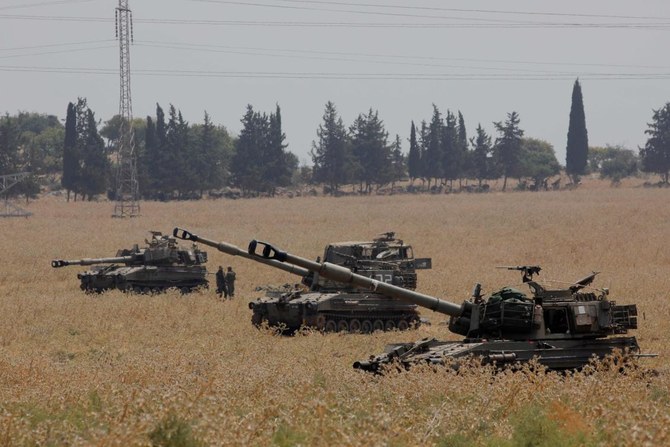
MANARA: Israel said Wednesday it had launched air strikes against Hezbollah observation posts in Lebanon after shots were fired from across the border toward its troops the previous evening.
The border flare-up came hours after Lebanon rejected an Israeli call to reform the UN peacekeeping force which patrols the border ahead of a UN Security Council vote to renew its mandate.
The Israeli army had said earlier that a “security incident” was unfolding near Manara, a kibbutz near the UN-demarcated border between the two countries, and urged residents to take shelter.
“During operational activity in northern Israel last night, shots were fired from Lebanon toward (Israeli) troops,” the military said on Twitter.
“We responded with fire, & our aircraft struck Hezbollah observation posts near the border. This is a severe event & we remain ready to combat any threat to our borders.”
Lebanon’s state-run National News Agency reported Israeli gunfire and flares in the Mays Al-Jabal area across the border from Manara.
The Israeli army said “troops deployed dozens of illumination rounds and smoke shells and responded with fire.”
Afterwards “attack helicopters and aircraft struck observation posts belonging to the Hezbollah terror organization in the border area.”
It reported no Israeli casualties.
Manara was quiet on Wednesday morning, an AFP journalist reported. The army told residents they could come into the open and resume work in the fields.
Israel and Lebanon are still technically at war, and the United Nations force, UNIFIL, is tasked with monitoring their cease-fire.
Lebanon had hours earlier rejected an Israeli call to reform UNIFIL ahead of a UN Security Council vote to renew its mandate.
The incident also comes after Hezbollah announced at the weekend it had brought down an Israeli drone flying over the border.
The Iran-backed Shiite militant group vowed in September last year to down Israeli drones flying over Lebanon, following an incident a month earlier when two drones packed with explosives targeted its stronghold in south Beirut.
Set up in 1978, UNIFIL was beefed up after a month-long war in 2006 between Israel and Hezbollah.
The 10,500-strong force, in coordination with the Lebanese army, is tasked with monitoring a cease-fire and Israeli pullout from a demilitarised zone on the border.
Israel accuses the force, whose latest mandate expires at the end of August, of not being active enough against Hezbollah.
It accuses the militants of stockpiling weapons at the border, and has been pushing for the UN force to be allowed to inspect private property.
But Lebanon’s caretaker foreign minister Charbel Wahbe informed the five veto-wielding permanent members of the Security Council on Tuesday that his government wanted the force to stay on “without modifying its mandate or its numbers.”
Hezbollah wields considerable political influence in Lebanon and its allies dominate the caretaker government.
Israel has carried out dozens of air strikes on Hezbollah targets in neighboring Syria where the group is fighting alongside the government of President Bashar Assad.
It has also struck Iranian targets in Syria in what it says is a campaign to prevent Tehran providing Hezbollah with the technology to replace its arsenal of rockets with ballistic missiles capable of penetrating Israel’s Iron Dome air defense shield.


![]()

Israel strikes Hezbollah after gunfire on Lebanon border
Short Url
https://arab.news/je6jd
Israel strikes Hezbollah after gunfire on Lebanon border
- The Israeli army said the srike was launched after shots were fired from Lebanon toward its troops


Latest updates


© 2026 SAUDI RESEARCH & PUBLISHING COMPANY, All Rights Reserved And subject to Terms of Use Agreement.