

Egypt’s Al-Azhar and Coptic Church send two aid planes to Lebanon

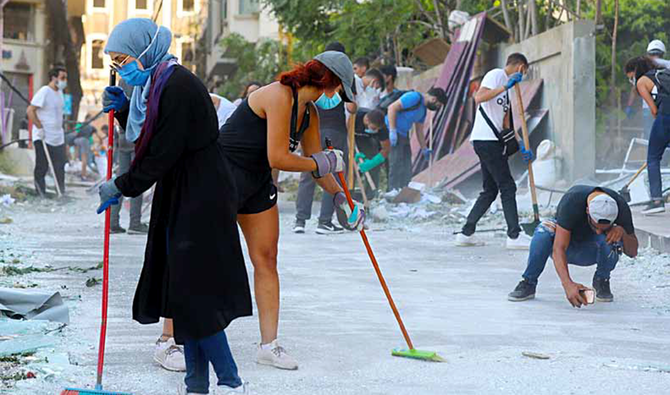
Lebanese join clean-up teams in Beirut as aid planes from Egypt carrying food and medical supplies rush to support the country, devastated by the port blast. (Reuters)
Short Url
Updated 23 August 2020
Follow

Egypt’s Al-Azhar and Coptic Church send two aid planes to Lebanon

  • The church sent its relief shipment through the Middle East Council of Churches in Lebanon

CAIRO: Egypt’s two largest religious institutions have sent aid planes to Lebanon after its capital was ravaged by a massive explosion of ammonium nitrate.

Al-Azhar and the Coptic Orthodox Church loaded the aircraft with medicine, aid and other supplies to help the Lebanese, who are still coping with the aftermath of the Aug. 4 blast.

The aid planes are a continuation of an air bridge announced by Egypt earlier this month to provide urgent assistance for the crisis in Beirut.

The church sent its relief shipment through the Middle East Council of Churches in Lebanon. It included 12 tons of food and medical supplies, including 11,000 washable masks to reduce the severity of the spread of coronavirus, and a ton of medicine and equipment.

Father Gabi Hashem is the director of the Theological Affairs and Ecumenical Affairs Department at the Middle East Council of Churches. He represented the body when receiving the air bridge shipments and said there were not enough words to thank the Egyptian government and people.

He also said that the Coptic Church was the largest church in the Council and had an important role in it.

“Today these shipments express the depth of the relationship that binds the Egyptian and Lebanese people,” Hashem added. “On behalf of the council I thank President (Abdel Fattah) El-Sisi and Pope Tawadros, the elder father of the Middle East Council of Churches. The churches in the Council are continuously praying in order to revive hope and to rebuild the Middle East on humanitarian and spiritual foundations.”

Egyptian Ambassador to Lebanon Yasser Alawi said the supplies came with state directives to provide all forms of support to the people of Lebanon. He stressed that his country would not abandon its neighbor until it had overcome its ordeal.

Egypt’s Lebanon air bridge has four phases. The first included medical aid, the second included medical and food aid, the third had Egyptian doctors to support the work of medical personnel in Lebanon while the fourth phase will contribute to reconstruction efforts. This last phase will involve sending the tools and materials needed to restore the facilities that were destroyed by the explosion.

During his recent visit to Lebanon, Egyptian Foreign Minister Sameh Shoukry inspected the country’s field hospital in Beirut which has six main clinics.

Shoukry welcomed the hospital’s contribution to aid the injured and those affected by the blast.

The hospital is an hour away from the site of the explosion at the Port of Beirut.


What to know about Gaza’s Rafah border crossing

Updated 7 sec ago
Follow

What to know about Gaza’s Rafah border crossing

  • The Rafah crossing into Egypt — often called Gaza’s “lifeline” — was the only border access for the territory that does not pass through Israel

CAIRO, Egypt: Pedestrians are set to begin passing through the Rafah border crossing between the Gaza Strip and Egypt on Monday, after it was largely shut for close to two years since Israeli forces seized the Palestinian side.
The reopening, demanded by the United Nations and aid groups, is a key part of the second phase of US President Donald Trump’s truce plan for the Palestinian territory.
AFP looks at what to know about this crucial crossing:

- Vital access point -

COGAT, the Israeli defense ministry body coordinating Palestinian civilian affairs, has said it will only be open for the passage of “residents in both directions.”
AFP images showed ambulances lined up on the Egyptian side of the border, preparing to receive medical evacuees, who are expected to be the first groups allowed out.
The Rafah crossing into Egypt — often called Gaza’s “lifeline” — was the only border access for the territory that does not pass through Israel.
It now lies in an area held by Israeli forces following their withdrawal behind the so-called “Yellow Line” under the terms of the US-brokered ceasefire.
For a long time, the crossing was the main exit point for Palestinians from Gaza who were authorized to leave the narrow strip of land, under Israeli blockade since 2007.
From 2005 to 2007, it was the first Palestinian border terminal controlled by the Palestinian Authority, and later became a symbol of Hamas control over the Gaza Strip after the militant group seized power.

- Under Israeli control -

On May 7, 2024, the Israeli army took control of the Palestinian side, claiming that the crossing was being “used for terrorist purposes.”
Many access points have since been mostly closed, including those used by the United Nations.
Rafah briefly reopened for medical evacuations during a short ceasefire between Israel and Hamas in January of last year.
Israel has said it will “conduct security clearance of individuals” permitted in and out of Gaza, which is meant to be administered by a 15-member Palestinian technocratic body.
The National Committee for the Administration of Gaza is also waiting to enter the territory, after Israel’s approval.
No agreement has yet been reached on the number of Palestinians permitted through, sources said, noting that Egypt plans to admit “all Palestinians whom Israel authorizes to leave.”
Palestinians intending to return to Gaza will be allowed limited luggage, no metal or electronic items and limited amounts of medication, according to the Palestinian embassy in Cairo.

- EU-Palestinian mission -

COGAT said “an initial pilot phase” began Sunday, “in coordination with the European Union Border Assistance Mission (EUBAM), Egypt, and all relevant stakeholders.”
“The actual passage of residents in both directions will begin upon completion” of preliminary preparations, it added.
The Palestinian side of the crossing is expected to be administered by EUBAM and a delegation from the Palestinian Authority.
The EU had set up a civilian mission in 2005 to help monitor the Rafah crossing, but it was suspended two years later after the Islamist militant group Hamas took control of Gaza.
The European mission aims to provide a neutral, third-party presence at the key crossing and involves police from Italy, Spain and France. It was briefly redeployed in January of last year but suspended again in March.
Both the EUBAM and the Palestinian Authority delegation have arrived at the crossing, sources at the border told AFP.

- Aid entry -

Trump’s plan, which underpins the ceasefire agreement between Israel and Hamas, stipulates the reopening of the Rafah crossing and the entry of 600 aid trucks per day.
But Israeli authorities have stalled on the matter and life-saving aid remains inadequate, according to aid groups.
International aid is generally routed from Egypt, through the Rafah checkpoint, before trucks are directed to the nearby Israeli crossing of Kerem Shalom — which currently processes three-quarters of aid entering Gaza.
Drivers disembark their vehicles, which go through strict Israeli inspection before being unloaded and reloaded onto other vehicles authorized to enter Gaza.
Two aid sources on the Egyptian side told AFP on Thursday that Israel has continued to obstruct aid delivery, returning “dozens” of trucks without unloading them.
Other access points have operated in the past, but Israeli authorities have not communicated on whether they will reopen.