SYDNEY: The white supremacist who killed 51 Muslim worshippers last year, a massacre that prompted a global campaign to stamp out online hate, arrived in Christchurch on Sunday ahead of sentencing hearings.
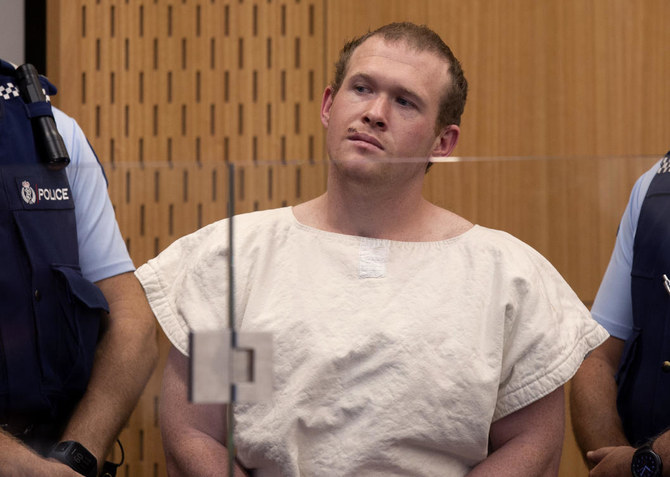
Brenton Tarrant disembarked a New Zealand air force plane at Christchurch Airport on Sunday afternoon, wearing a protective vest and helmet and escorted by armed officers, before being directed into the back of a white van, television footage showed.
He has pleaded guilty to 51 charges of murder, 40 charges of attempted murder and one charge of committing a terrorist act.
Tarrant was transported to Christchurch, the city where the shootings occurred, from Auckland Prison at Paremoremo, the New Zealand Herald reported.
A court in Christchurch will begin multi-day sentencing hearings on Monday, where survivors of the attack and family members of those killed will deliver victim impact statements.
Tarrant, an Australian, will be sentenced after being allowed to make a statement.
Murder convictions carry a mandatory sentence of life in prison. The judge can impose a life term without the possibility of release, a sentence that has never been used in New Zealand.
A police spokeswoman declined to comment on Tarrant’s movements, referring Reuters to the country’s Department of Corrections. A spokeswoman there declined to comment, citing “the interests of public safety and operational security.”

New Zealand mosque shooter arrives in Christchurch for sentencing
https://arab.news/p648u
New Zealand mosque shooter arrives in Christchurch for sentencing
- He has pleaded guilty to 51 charges of murder, 40 charges of attempted murder and one charge of committing a terrorist act
- A court in Christchurch will begin multi-day sentencing hearings on Monday
Modi ally proposes social media ban for India’s teens as global debate grows
- India is the world’s second-biggest smartphone market with 750 million devices and a billion Internet users
- South Asian nation is a key growth market for social media apps and does not set a minimum age for access
NEW DELHI: An ally of Indian Prime Minister Narendra Modi has proposed a bill to ban social media for children, as the world’s biggest market for Meta and YouTube joins a global debate on the impact of social media on young people’s health and safety.
“Not only are our children becoming addicted to social media, but India is also one of the world’s largest producers of data for foreign platforms,” lawmaker L.S.K. Devarayalu said on Friday.
“Based on this data, these companies are creating advanced AI systems, effectively turning Indian users into unpaid data providers, while the strategic and economic benefits are reaped elsewhere,” he said.
Australia last month became the first country to ban social media for children under 16, blocking access in a move welcomed by many parents and child advocates but criticized by major technology companies and free-speech advocates. France’s National Assembly this week backed legislation to ban children under 15 from social media, while Britain, Denmark and Greece are studying the issue.
Facebook operator Meta, YouTube-parent Alphabet and X did not respond on Saturday to emails seeking comment on the Indian legislation. Meta has said it backs laws for parental oversight but that “governments considering bans should be careful not to push teens toward less safe, unregulated sites.”
India’s IT ministry did not respond to a request for comment.
India, the world’s second-biggest smartphone market with 750 million devices and a billion Internet users, is a key growth market for social media apps and does not set a minimum age for access.
Devarayalu’s 15-page Social Media (Age Restrictions and Online Safety) Bill, which is not public but was seen by Reuters, says no one under 16 “shall be permitted to create, maintain, or hold” a social media account and those found to have one should have them disabled.
“We are asking that the entire onus of ensuring users’ age be placed on the social media platforms,” Devarayalu said.
The government’s chief economic adviser attracted attention on Thursday by saying India should draft policies on age-based access limits to tackle “digital addiction.”
Devarayalu’s legislation is a private member’s bill — not proposed to parliament by a federal minister — but such bills often trigger debates in parliament and influence lawmaking.
He is from the Telugu Desam Party, which governs the southern state Andhra Pradesh and is vital to Modi’s coalition government.


