

A secret Pakistani ingredient makes all the difference in Indian food

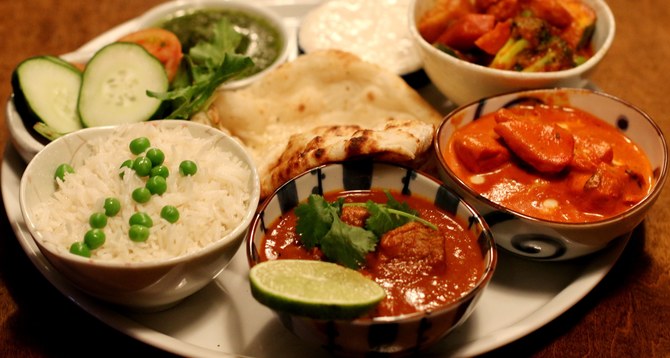
This undated photo shows a traditional Indian thaali (platter) with an assortment of dishes. Many Indians use Shan Foods spice mixes without knowing the Pakistani origin of the brand. Shan Foods is sold in 65 different countries across the world, including neighboring India. (Photo courtesy: indian-by-nature.com)
Short Url
Updated 22 August 2020
Follow

A secret Pakistani ingredient makes all the difference in Indian food

  • Pakistani company Shan Foods sells spice mixes in 65 countries, including India
  • It brings authentic taste in the food, Indian cooks say, as they encourage culinary exchanges with Pakistan

NEW DELHI: Ranjana Kumar’s mutton and chicken korma curries are the talk of the town in the Indian capital of New Delhi. But even she did not know that a secret ingredient she has been using for over a decade — Shan Foods spice mixes — comes from Pakistan.
The Shan Foods company sells spice mixes in 65 countries, including India, a nation with whom Pakistan shares decades of enmity, dominated by their territorial dispute over Kashmir. They have fought three wars since their independence from Britain in 1947.
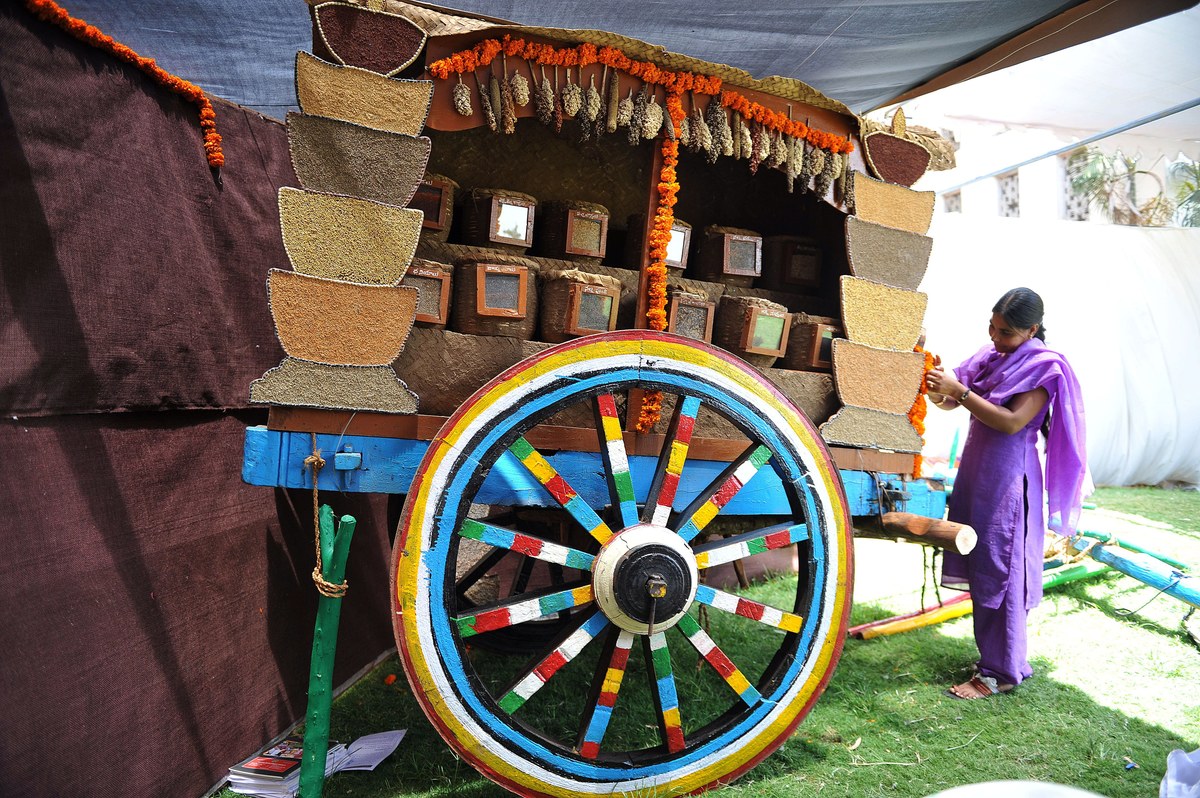


An Indian woman arranges a display of seeds and spices on a bullock cart at an exhibition fair in Hyderabad, India on May 22, 2011.( AFP/File photo)

“I wasn’t aware it’s a Pakistani brand,” Kumar told Arab News, saying her family loved dishes cooked in Shan spices and she always kept extra stock of the mixes at home. “How does it matter whether it is Pakistani or Indian? The taste is good.”
“Both the neighbors share the same taste and culture and I feel both countries should have access to their products,” the mother of two added.
Kumar’s family is a supporter of India’s nationalist Bhartiya Janata Party (BJP) under whose rule already brittle ties with Pakistan have deteriorated further in recent years.
Even so, Kumar said, there was no harm in using Pakistani products.
“Both India and Pakistan share the same history, same past, and the same taste, What’s wrong if we get Pakistani products in our kitchen or house?” she said. “This should be promoted so that both countries could understand each other better.”


A screengrab from Shan Foods' commercial shows the company's Bombay Biryani spice mix. (Photo courtesy of Shan Foods via AN)

One Delhi shop owner said he didn’t like selling Pakistani brands but customers came asking for Shan spices.
“I don’t like to keep the brand, but customers demand it. That’s why I keep it,” Naresh Sankhla said at his grocery store. “I reluctantly sell this brand from the enemy country, but there is demand for it. I must be selling around 150 packets of Shan (spices) every month.”
Others say despite the brand’s popularity, they put India first.
“I have stopped distributing the Shan brand last year, after Pakistan’s involvement in the Pulwama tragedy,” Delhi-based distributor Gaurav Gupta told Arab News, referring to last year’s attack in a town in the Indian part of Kashmir in which 50 Indian paramilitary soldiers were killed. New Delhi has blamed Pakistan-based groups for the assault. The Pakistan government denies any official complicity.



A man is choosing a Shan masala mix at a grocery store in this screengrab from a Shan Foods commercial. (Photo courtesy of Shan Foods via AN)

Despite his official words, however, quick market research shows that Gupta’s company remains one of the main sellers of Shan’s products.
Rafat Shahab who runs a catering company, lamented this attitude, saying culinary exchanges needed to be encouraged despite political differences.
“I used the Shan brand a lot whenever I got orders for parties or special occasions. It brings authentic taste in the food,” she said, “It’s unfortunate that we don’t have that kind of relationship with Pakistan. Politics should not come in the way of people’s contacts and culinary exchanges.”


Pakistan cuts interest rate despite IMF caution, citing space to support growth

Updated 9 sec ago
Follow

Pakistan cuts interest rate despite IMF caution, citing space to support growth

  • Central bank lowers policy rate by 50 bps after four consecutive holds
  • Business groups say cut is too small to ease cost pressures on industry

KARACHI: Pakistan’s central bank on Monday cut its key policy interest rate by 50 basis points to 10.5 percent, resuming monetary easing after four consecutive meetings, in a move that surprised markets and came despite International Monetary Fund guidance to maintain an “appropriately tight” policy stance to anchor inflation expectations.

The decision by the State Bank of Pakistan (SBP) follows a year-long stabilization effort under an IMF Extended Fund Facility, during which authorities relied on tight monetary and fiscal policies to rein in inflation, rebuild foreign exchange reserves and stabilize the balance of payments after the country narrowly avoided default in 2023.

Most analysts had expected the central bank to hold rates steady. In a survey conducted by Karachi-based brokerage Arif Habib Limited ahead of the decision, 72 percent of respondents predicted no change, citing fading base effects in inflation and emerging external pressures, while only 28 percent anticipated a cut.

“The Monetary Policy Committee (MPC) has decided to decrease the policy rate,” the SBP said in a statement following the meeting of its rate-setting body in Karachi.

“While ensuring the ongoing price stability, the MPC noted the available space to reduce the policy rate to support sustainable economic growth.” 

Pakistan’s consumer inflation eased to 6.1 percent in November from 6.2 percent in October, remaining within the SBP’s medium-term target range of 5–7 percent, according to official data.

“The Committee noted that inflation on average remained within the target range of 5–7 percent during July–November FY26, though core inflation is proving to be relatively sticky,” the MPC said, adding that economic activity was gaining traction despite a challenging global environment for exports.

The central bank said food, energy and core inflation had broadly converged in recent months, while inflation expectations remained anchored due to a “prudent monetary policy stance” and fiscal discipline. However, it warned that inflation could rise above the target range toward the end of the current fiscal year due to low base effects, before easing again in FY27.

The MPC also cited labor market pressures to justify the rate cut, pointing to the Labour Force Survey 2024–25, which showed an increase in unemployment compared with 2020–21, despite faster employment growth.

Pakistan’s foreign exchange reserves have climbed above $15.8 billion following the release of a $1.2 billion IMF tranche after a successful program review, the central bank said, while consumer confidence has improved and fiscal balances recorded surpluses in the first quarter of FY26.

“The real policy rate remains adequately positive to stabilize inflation within the target range of 5–7 percent over the medium term and contribute toward sustainable economic growth,” the MPC said.

It projected real GDP growth in FY26 to remain in the upper half of its earlier forecast range of 3.25–4.25 percent. The government has since revised its growth target to 3.9 percent, down from 4.2 percent, citing damage estimated at $1.3 billion from monsoon floods.

On the external front, the central bank said Pakistan’s current account deficit of $0.7 billion during July–October FY26 was in line with expectations, though exports remained under pressure due to a sharp decline in food shipments, particularly rice.

Exports fell 6.4 percent to $12.8 billion in the first four months of the fiscal year, while imports rose 13.3 percent to $28.3 billion, widening the trade deficit by 37 percent to $15.5 billion, according to the Pakistan Bureau of Statistics.

“Going forward, global headwinds, especially from evolving trade dynamics, are likely to constrain exports, though lower global oil prices may contain import growth,” the MPC said, adding that foreign exchange reserves were projected to rise to $17.8 billion by June 2026 with the realization of planned official inflows.

“SURPRISING MOVE“

Analysts described the rate cut as unexpected but measured.

“The 50 basis points cut is a surprising move signaling greater emphasis on supporting growth despite lingering inflation and external account risks,” Muhammad Waqas Ghani, head of research at JS Global Capital Limited, told Arab News.

“Importantly, the quantum of the cut is modest, suggesting a cautious approach, the SBP is signaling flexibility while remaining mindful of inflation risks and external account vulnerabilities,” he added.

Business groups, however, expressed disappointment, saying the reduction would do little to ease financing costs.

“Such a token adjustment falls far short of what is urgently required to revive Pakistan’s fragile economy and restore business confidence,” Karachi Chamber of Commerce and Industry President Muhammad Rehan Hanif said in a statement.

He said borrowing costs in Pakistan remained among the highest in the region despite easing inflation.

“Regional economies such as China, India, Bangladesh, Vietnam, Indonesia and Sri Lanka maintain single-digit interest rates, enabling their industries to access affordable financing, expand capacity, and remain competitive in global markets,” Hanif said.

Pakistan’s industries continue to face high energy tariffs, fuel costs, taxation, logistics expenses and regulatory pressures, he added, warning that a prolonged high-interest-rate environment would discourage investment and suppress economic activity.