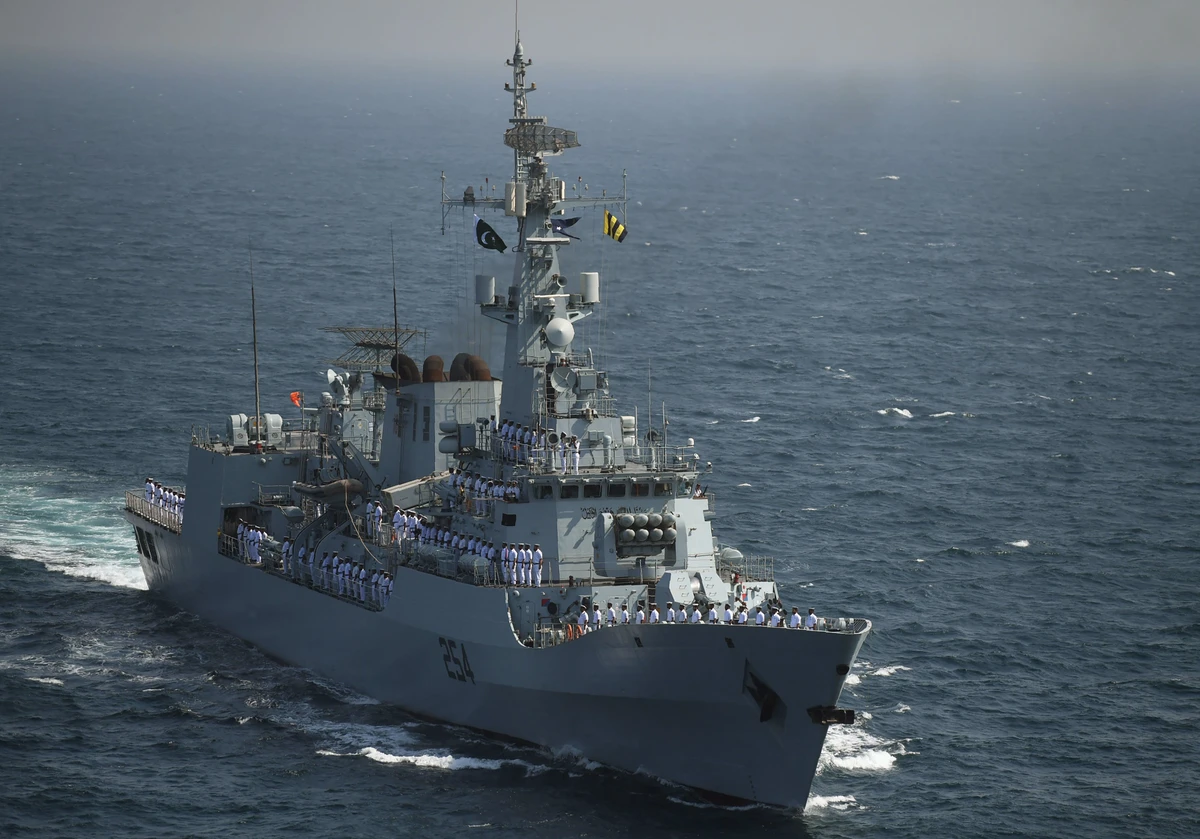
- Senior navy official says second ship could be delivered by Turkey in 2022, project not aimed at ‘arm’s race’ with India
- Pakistan also manufacturing two ships locally under technology-transfer agreement with Istanbul
ISLAMABAD: Pakistan is aiming to get the first of four MILGEM class corvette ships from Turkey by the end of next year, a Pakistan navy official has said, while the manufacturing of two boats in Pakistan under a technology-transfer agreement with Istanbul has also started.
The MILGEM project is a Turkish warship program that aims to develop multipurpose corvettes and frigates that can be deployed in a range of missions, including reconnaissance, surveillance, early warning, anti-submarine warfare, surface-to-surface and surface-to-air warfare, and amphibious operations.
On June 4, the keel laying ceremony of the first MILGEM class corvette for the Pakistan navy was held at Istanbul Naval Shipyard. Laying the keel is the formal recognition of the start of a ship’s construction and is often marked with a ceremony.
Pakistan signed a contract for four corvettes for the Pakistan navy with the Turkish state-owned defense firm ASFAT in July 2018.
“The contract entails construction of two corvettes at Turkey while two at Karachi Shipyard & Engineering Works (KS&EW),” the Pakistan Navy said in a statement. “Construction of corvettes in Pakistan is aimed to provide impetus to local ship building industry and further enhance KS&EW capabilities.”
Speaking on condition of anonymity as he was not authorized to speak to the media on the subject, a senior Pakistan navy official said Pakistan hoped to get its first MILGEM corvette by the end of 2021 “as usually it took two years to completely manufacture a corvette.”
In October 2019, Turkish President Recep Tayyip Erdogan along with Pakistan Navy Chief Admiral Zafar Mahmood Abbasi had cut the metal plate of the first MILGEM class corvette during a ceremony in Istanbul, the official said. In June this year, the keel laying ceremony took place in Turkey “which is second stage of its manufacturing.”
“We hope to get a second boat from Turkey in 2022,” the official added.
“The manufacturing of two boats in Pakistan has also started this year but it is in the first stage as its steel cutting ceremony was held on June 9,” the official said. “We hope to complete the first boat in Pakistan within two years.”
He said under the contract, Turkish firm ASFAT would share with Pakistan all the technology required to build the boats locally.
“The advantage of this transfer of technology contract is that it will enhance our shipbuilding industry capability and we can make more such boats in the future,” the official added.
MILGEM vessels are 99 meters long with a displacement capacity of 24,00 tons and can move at a speed of 29 nautical miles.
“Corvettes is a medium-sized boat which is bigger than normal patrolling boats and smaller than a warship but it can be used for any military purpose,” the navy official said. “It has capabilities to be used in any warfare missions. In the current era it is even better than big warships as it is the era of smart technology, which can be effective at forward basis and even easy to maintain.”
When questioned if Pakistan was acquiring the corvettes to use against arch-rival India, the official said: “We are not part of any arms race. They [the ships] are to strengthen Pakistan navy’s overall capability,” the official said.
“When all four MILGEM class corvettes, which is their Turkish name, will be handed over to Pakistan navy then we will call them Jinnah class corvettes,” the official said. “The first boat will be called Jinnah while the other three will have different names but their parent class will remain Jinnah.”
Responding to a question on a comparison of the Pakistan navy with the Indian navy, the official said the capability to defend sea borders was more important than the size of the navy.
“Pakistan Navy has modern equipment which has been acquired from different countries like China, France and others,” he said. “We have MoUs with different companies to modernize our equipment.”
“This acquisition of modern technology warships along with transfer of technology is very significant not only for our defense needs but also to enhance our indigenous manufacturing capabilities,” defense analyst retired vice Admiral Khan Hasham bin Saddique told Arab News.
“Ever since its independence Pakistan is faced with substantial threat due to hostile neighbor,” he added, referring to India. “Therefore, we need to update our defense technology and security equipment. Modern security calculus required full spectrum capabilities from no war to right upto the conventional war and even nuclear war. Empowering Pakistan navy is part of gaining full spectrum capability to effectively respond to any threat.”
Saddique also said Pakistan was not in an “arm’s race” with India as Indian defense spending was almost eight times Pakistan.
“We cannot have that matching capabilities. neither do we need it,” he said. “We are getting modern and smart technology to maintain minimum deterrence so that war is not imposed on us.”
According to a Pakistan navy statement, the MILGEM class corvettes will be state-of-the-art surface platform-equipped with modern surface, subsurface and anti-air weapons, sensors and combat management system.
“These ships will be among the most technologically advanced platforms of Pakistan navy and will significantly contribute in maintaining peace, stability and balance of power in Indian Ocean Region,” the statement said.