

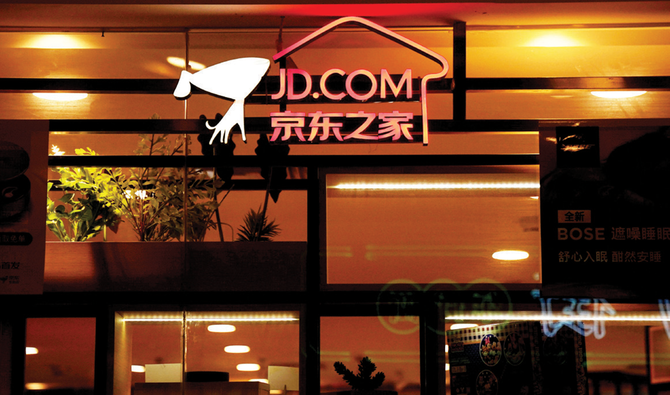
JD.com posts upbeat results as shoppers’ habits shift

Retail sales in China fell during July, but the move by consumers online helped JD.com, which saw total net revenue jump by more than 33 percent. (Reuters)
Short Url
Updated 19 August 2020
Follow

JD.com posts upbeat results as shoppers’ habits shift

  • JD.com’s US-listed shares rose by 5 percent in trading before the bell

SHANGHAI: China’s JD.com Inc. beat analysts’ estimates for quarterly sales on Monday, as the firm benefited from a shift in shopping habits of domestic consumers who have largely moved to online ever since the outset of the pandemic.

US-listed shares of the e-commerce company rose by 5 percent in trading before the bell.

The results coincide with growing tensions between Beijing and Washington. Several Chinese companies are putting off plans for US listings amid tensions between the world’s top two economies, while those listed in New York are seeking to return to exchanges closer to home. In June, JD raised about $3.87 billion in its Hong Kong secondary listing.

JD executives did not offer any comments on US-China tensions on a conference call on Monday.

China, which has under a 1,000 active COVID-19 cases currently, has largely emerged out of lockdowns, but demand is still picking up in many sectors.

Retail sales in the world’s second-largest economy slipped in July as consumers failed to shake off wariness about the coronavirus, while the factory sector’s recovery struggled to pick up pace.

The company’s net product revenue, which includes online retail sales, rose 33.5 percent to 178.19 billion yuan in the second quarter. Net income attributable to shareholders rose to 16.45 billion yuan from 618.8 million yuan a year earlier.

The company’s total net revenue rose 33.8 percent to 201.1 billion yuan ($28.98 billion) in the quarter ended June 30. Analysts on average had expected revenue of 190.95 billion yuan, according to IBES data from Refinitiv.


Argentina eyes deeper Saudi ties as multilateral trade landscape shifts, says minister  

Updated 9 sec ago
Follow

Argentina eyes deeper Saudi ties as multilateral trade landscape shifts, says minister  

ALULA: Shifting global trade patterns are creating new opportunities for bilateral cooperation between Argentina and Saudi Arabia, particularly in the energy sector, said Federico Sturzenegger, Argentina’s minister of deregulation and state transformation. 

Speaking to Arab News on the sidelines of the AlUla Conference for Emerging Market Economies, Sturzenegger expanded on his goals at the event, Argentina’s growing economic relationship with the Kingdom, and the country’s position as a third-party player amid geopolitical tensions. 

He said the forum provides a strong platform for collaboration because of the diversity of participants gathered in AlUla. Sturzenegger pointed to Argentina’s bilateral relationship with Saudi Arabia as an example of the type of cooperation the conference can facilitate, particularly in energy: 

“Definitely we could see some of the knowledge, experience, capital, know-how of this country to exploit those resources. It’s always an opportunity to talk and learn about those things and see how things are going in each country,” the minister told Arab News. 

Elaborating on the sector, he added: “I mean energy definitely, I mean this country is absolutely top tier, it’s a leader in the world. It has the engineers, it has the knowledge, it has the capital; Argentina is a potentially relevant hub in the world in this, in a very isolated place, and a very safe place from a geopolitical point of view.” 

After speaking on Paper Session 1: Resetting Global Trade — which also featured Faisal Alibrahim, Saudi minister of economy and planning; Eyob Tekalign, governor of the Ethiopian National Bank; and Pol Antras, professor of economics at Harvard University — Sturzenegger outlined the effects of geopolitical tensions on trade agreements and the role of third-party countries. 

He referred to a major trade deal recently signed between the US and Argentina as an example of how fragmentation in multilateralism has paradoxically created alternative avenues for cooperation, especially as such agreements historically took decades to finalize. 

Building on that example, he raised the question of whether the rupture of multilateralism might in some cases lead to more trade rather than less — a view that Antras challenged during the session. 

Geopolitical positioning remained a central theme in his remarks, particularly when discussing the importance of third-party countries during periods of tension. 

“Until three years ago we had this kind of multilateralism; it was very well established, everything was contained within that framework. Of course, the US had a prominent role in that framework. Now things are a little bit more uncertain, and that has led to the proliferation of many bilateral agreements,” he said. 

Despite that shift, Sturzenegger said the new environment is creating room for agreements that previously struggled to advance. 

“I’m seeing some opportunities for trade which perhaps were not explored before,” the minister added. 

He also referred to an increase in trade in Africa, emphasizing that there are different opportunities throughout the world that were previously unexplored under the contained sphere of earlier multilateralism. 

On Saudi-Argentine ties, he maintained an optimistic outlook, again emphasizing energy as a priority. 

“I know that Saudi companies have been visiting Argentina this year, and again, as I mentioned, you have the expertise, you have the know-how, it’s a business that you know, you have the global network of trade, so just adding an additional source of supply makes that network even more powerful, profitable, and resilient,” the minister said. 

As the Emerging Market Economies Conference wraps up its first day, it is evident that while discussions on implementation and the strengthening of long-term economic planning are at the forefront, relationships with the Kingdom continue to develop and support bilateral ties.