Oman’s sultan names new foreign minister

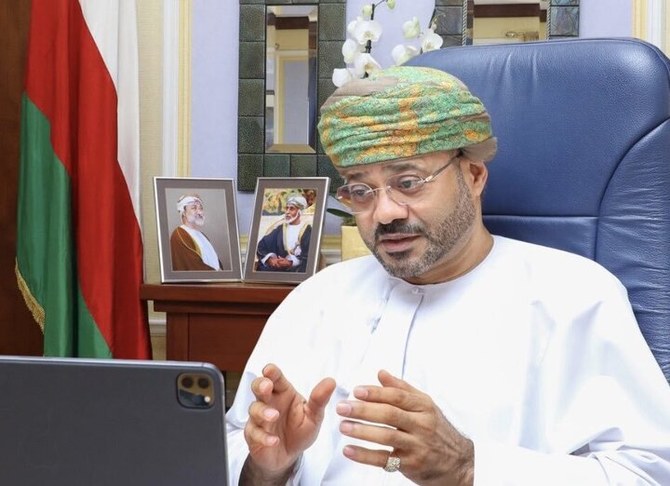
Badr Albusaidi, 60, was named as Oman's foreign minister. (Twitter)
Short Url
Updated 19 August 2020
Follow

Oman’s sultan names new foreign minister

  • Badr Albusaidi, 60, was named foreign minister of Oman
  • He replaces the long-serving Yusuf bin Alawi bin Abdullah

MUSCAT: Oman’s Sultan Haitham on Tuesday appointed a new top diplomat, replacing the long-serving Yusuf bin Alawi bin Abdullah in a government reshuffle.
Sultan Haitham, since his accession in January, has vowed to maintain Oman’s policy of neutrality and non-interference.
Badr Albusaidi, 60, was named foreign minister, a title held by the late Sultan Qaboos himself but with Alawi responsible for foreign affairs for the past two decades.
Albusaidi has been in the diplomatic service since the 1980s and held a number of posts, including foreign ministry secretary-general.
Sultan bin Salem bin Saeed Al-Habsi was appointed finance minister, a post also held by the sultan, and new faces were named to other key ministries, state media said.
Haitham bin Tariq was sworn in after modern Oman’s founding father, Sultan Qaboos, died at the age of 79.
Yusuf bin Alawi played a key role in maintaining Oman’s neutrality and as a regional mediator.
On Monday, he spoke with Israeli Foreign Minister Gabi Ashkenazi on the phone to stress Oman’s support of “a comprehensive, just and lasting peace,” Oman’s foreign ministry said on Twitter.
It was the first public contact between Oman and Israel since US President Donald Trump’s announcement last week that the Jewish state and the UAE, Oman’s neighbor, have agreed to normalize ties.
In October 2018, Israel’s Prime Minister Benjamin Netanyahu held surprise talks with Qaboos in Muscat, which does not officially recognize the Jewish state but maintains good ties with both Washington and Tehran.


International law at ‘breaking point’ amid ‘epidemic’ of conflicts: Survey

Updated 4 sec ago
Follow

International law at ‘breaking point’ amid ‘epidemic’ of conflicts: Survey

  • Gaza war highlighted as one of the most concerning areas; atrocities in Sudan also noted
  • ‘Well over’ 100,000 civilians have been killed in past 18 months amid ‘rampant impunity’

LONDON: A new survey of 23 conflicts worldwide has said more than 100,000 civilians have been killed in the past 18 months, with adherence to international humanitarian law reaching “a critical breaking point.”

The “War Watch” survey highlighted the war in Gaza as one of the most concerning areas in an “epidemic” of violence, while also noting concerning levels of atrocities in Sudan.

Taken under the auspices of the Geneva Academy of International Humanitarian Law and Human Rights, the survey covers July 2024 to the end of 2025.

Lead author Stuart Casey-Maslen said: “Atrocity crimes are being repeated because past ones were tolerated. Our actions — or inaction — will determine whether international humanitarian law vanishes altogether.”

In Gaza, local authorities say 18,592 children and 12,400 women have been killed since Israel invaded the Palestinian enclave in October 2023. 

The report said Gaza’s overall population had declined by “about 254,000 people, a 10.6 percent decline compared with pre-conflict estimates,” making it one of the most deadly conflicts in the world. It noted that despite a ceasefire being agreed late last year, civilian casualties have continued.

In Sudan, after the fall of the city of El-Fasher to the Rapid Support Forces last October, widespread reports of survivors “being gang-raped by RSF fighters” — including in the presence of relatives — were recorded in numerous instances.

The survey said: “We do not know how many civilians have been killed in the conduct of hostilities during armed conflicts in 2024 and 2025, but we do know that the number is well over 100,000 in each of the two years.”

It added that “serious violations of international humanitarian law (IHL) were wrought … on a huge scale and with rampant impunity.” 

The report said IHL and the laws of armed conflict, established after the Second World War to protect civilians, must be upheld by every state under the Geneva Conventions “in all circumstances.”

It added: “Addressing widespread impunity for serious violations of international law should be treated as a policy priority.”

The report suggested several policy ideas to reduce the number of people suffering, including arms export bans for countries “where there is a clear risk that the arms or ammunition to be delivered will be used to commit or facilitate serious violations” of IHL.

It also proposed limiting the use of drones and artificial intelligence targeting in civilian areas, as well as unguided gravity bombs or inaccurate long-range artillery.

In addition, it called for “systematic prosecution of war crimes,” saying more political and financial support need to be given to the International Criminal Court by members of the international community.