

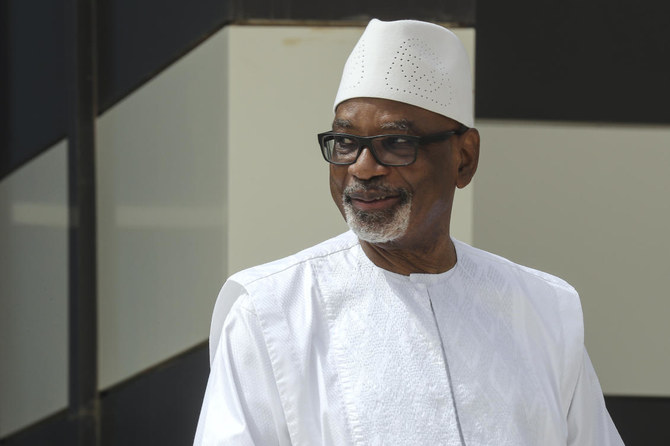

BAMAKO, Mali: Soldiers detained Mali’s president and prime minister Tuesday after surrounding a residence and firing into the air in an apparent coup attempt after several months of demonstrations calling for President Ibrahim Boubacar Keita’s ouster.
The soldiers moved freely through the streets of Bamako, making it increasingly clear that they were in control of the capital city. There was no immediate comment from the troops, who hailed from the same military barracks in Kati where an earlier coup originated more than eight years ago.
United Nations head Antonio Guterres demanded “the immediate and unconditional release” of Mali’s president and members of his government Tuesday after they were seized by rebel soldiers.
“The secretary-general strongly condemns these actions and calls for the immediate restoration of constitutional order and rule of law in Mali,” a spokesman for Guterres said in a statement.
The dramatic escalation capped off a day of political chaos in Mali, where the UN and former colonizer France have spent more than seven years trying to stabilize the country since a 2012 coup allowed an extremist insurgency to take hold in the West African nation.
The unrest kicked off earlier in the day in the garrison town of Kati, where the previous coup had originated under similar circumstances eight years earlier. The soldiers took weapons from the armory at the barracks, and then detained senior military officers.
Anti-government protesters cheered the soldiers’ actions, some setting fire to a building that belongs to Mali’s justice minister.
Prime Minister Boubou Cisse, who was believed to be sheltering with Keita, urged the soldiers to put down their arms and put the interests of the nation first.
“There is no problem whose solution cannot be found through dialogue,” he said in a communique.
Earlier in the day, government workers fled their offices as armed men began detaining people including the country’s finance minister Abdoulaye Daffe.
“Officials are being arrested — it’s total confusion,” said an officer at Mali’s Ministry of Internal Security.
Mali’s president, who was democratically elected and has broad support from France and other Western allies, was believed to be sheltering with the prime minister at the private residence in Bamako’s Sebenikoro neighborhood.
As the day wore on, Malians tuned in to state broadcaster ORTM, where the 2012 coup leader announced he was now in charge. The channel only carried classroom lessons and cartoons among other pre-recorded programming.
The regional bloc known as ECOWAS that has been mediating Mali’s current political crisis urged the soldiers to return immediately to their barracks in Kati, which is only 15 kilometers (less than 10 miles) from the presidential palace in the capital.
France echoed those concerns, with Foreign Minister Jean-Yves Le Drian condemned the soldiers’ actions as did the State Department’s special envoy for the Sahel region.
“The US is opposed to all unconstitutional changes of government whether in the streets or by security forces,” tweeted J. Peter Pham.
The developments Tuesday bore a troubling resemblance to the events leading up to the 2012 military coup, which ultimately unleashed years of chaos in Mali when the ensuing power vacuum allowed extremists to seize control of northern towns. Ultimately a French-led military operation ousted the extremists but they merely regrouped and then expanded their reach during Keita’s presidency.
On March 21, 2012, a similar mutiny erupted at the Kati military camp as rank-and-file soldiers began rioting and then broke into the camp’s armory. After grabbing weapons they later headed for the seat of government, led by then Capt. Amadou Haya Sanogo.
Sanogo was later forced to hand over power to a civilian transitional government that then organized elections. Keita emerged from a field of more than two dozen candidates to win that 2013 vote with more than 77 percent of the vote. His popularity, though, has plummeted since his 2018 re-election.
Regional mediators have urged Keita to share power in a unity government but those overtures were swiftly rejected by opposition leaders who said they would not stop short of Keita’s ouster.
The current president has faced growing criticism of how his government has handled the relentless insurgency engulfing the country once praised as a model of democracy in the region. The military faced a wave of particularly deadly attacks in the north last year, prompting the government to close its most vulnerable outposts as part of a reorganization aimed at stemming the losses.


