Algeria turns to Islamic finance to prop up economy

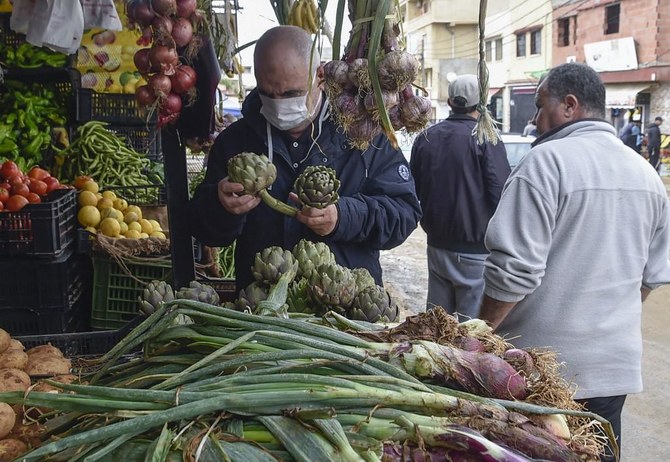
In Algeria, Africa’s largest nation and home to 43 million people, most transactions are done in cash circulating outside the formal banking sector, said professor Mohamed Boudjelal, an expert on Islamic finance. (File/AFP)
Updated 16 August 2020
Follow

Algeria turns to Islamic finance to prop up economy

  • Falling oil prices and the coronavirus pandemic have battered the North African country
  • IMF forecast that Algeria’s economy will shrink 5.2 percent this year

ALGIERS: Algeria has launched Islamic finance products in a bid to attract money from the informal market, but bankers warn it will take more to fix the country’s struggling economy.
Falling oil prices and the coronavirus pandemic have battered the North African country, triggering alarm bells among officials and experts.
The International Monetary Fund (IMF) forecast that Algeria’s economy will shrink 5.2 percent this year.
Prime Minister Abdelaziz Djerad has warned of an “unprecedented economic situation,” and experts have estimated unemployment at nearing 15 percent.
In Algeria, Africa’s largest nation and home to 43 million people, most transactions are done in cash circulating outside the formal banking sector, said professor Mohamed Boudjelal, an expert on Islamic finance.
Many Algerians “turn their nose up” at conventional banking, Boudjelal said.
Some Muslims believe that the traditional banking system is incompatible with their faith.
Islamic finance — the provision of financial services in accordance with religious laws — is a fast growing sector that has been adopted in many Muslim countries.
The industry is based on shared profit and loss, while earning interest is banned as “usury.”
Funds are also blocked from investing in companies associated with tobacco, alcohol, pork or gambling.
Algeria is hoping the new products could woo new investors into the market, following the success of Islamic finance products over the past decade in other countries, notably in the Gulf and Malaysia.
The country’s neighbors have already rolled out similar schemes.
In Tunisia, Islamic finance has operated in the private sector since the 1980s, although the sector remains modest, while in Morocco it began in 2017, though it has recorded net losses it says are due to initial start-up costs.
But Algeria hopes to tap into the significant revenues of the informal market, estimated to be as much as $30-35 billion, according to Abderahmane Benkhalfa, a former minister of finance and ex-head of the banking association.
“It is not only necessary to draw these resources, but to inject them into banks in order to bolster the economy,” Benkhalfa said.
Earlier this month, state-run National Bank of Algeria offered nine Islamic financial services, receiving a certificate from Muslim clerics ensuring they were compatible with Islamic law.
Only two other private banks, subsidiaries of the Bahrain-based Baraka Bank and Al Salam Bank, offer Islamic finance services in Algeria.
However, Algeria’s other banks — all state-run — are now expected to follow suit by the end of the year.
Most foreign banks are also planning to sell Islamic finance products too.
But Benkhalfa, who is also a member of a panel of African experts tasked by the African Union to mobilize international funds to help the continent combat coronavirus, warned that Islamic finance is not a “miracle solution.”
Only a small slice of cash in the informal economy circulates because of people’s religious beliefs.
The solution, Benkhalfa argues, are to make steps to modernize the traditional banking system — to make it more responsive — and develop in parallel with Islamic finance.
Economist Abderrahmane Mebtoul was even more cautious in his assessment.
It is only viable if inflation can be brought under control and if households have faith in the government’s management of the economy, Mebtoul said.
According to several studies, Islamic finance products are often more expensive that those provided by the traditional banking sector.
By the end of the year Algeria’s state banks are expected to propose several Islamic finance products, including “murabaha,” “ijara” and “musharakah.”
Murabaha, or cost-plus financing, is among the most popular products, and is used to finance a variety of consumer purchases from cars to houses.
It involves the bank buying on behalf of a client a property or another product, which it sells back to the client at a certain profit that replaces an interest rate.
Ijara is a way of buying a house through a lease and subsequent ownership, rather than through a mortgage.
Musharakah is seen as a way of enabling a buyer to avoid taking an interest-bearing loan, though some Islamic scholars say it is too similar to the charging of interest.
Algerian authorities are also considering issuing Islamic bonds.


Accelerating growth boosts investor confidence

Updated 06 December 2025
Follow

Accelerating growth boosts investor confidence

  • Startups attract fresh capital to scale AI, health tech, and infrastructure

RIYADH: Startups across the Middle East and North Africa are accelerating growth through strategic funding rounds, partnerships, and technological innovation. 

From agriculture tech and AI-led cybersecurity to digital health and home renovation, this week’s developments reflect the region’s expanding startup ecosystem and investor confidence across key verticals.  

Saudi agritech startup Nabt has raised $3.4 million in a seed extension round, bringing its total funding to $5 million.  

The round was led by SHG Group, with participation from Merak Capital and several angel investors, signaling strong investor confidence in the company’s long-term growth strategy.  

The funding announcement took place during a signing ceremony at the Sunbola program event under the Ministry of Environment, Water, and Agriculture.  

Founded to build both physical and digital infrastructure for the fresh-produce sector, Nabt connects farmers directly with commercial buyers through fulfillment centers that handle sorting, cold storage, and last-mile logistics.  

The company recently launched the Nabt Online Auction to support large-scale produce trading across the Kingdom, and Nabt Intel, which provides real-time pricing and market-demand data. 

CEO Abdullah Al-Otaibi said: “In just two years, Nabt has proven that building transparent and efficient infrastructure for fresh produce is not only possible but essential.”  

The new capital will support expansion into additional Saudi cities and further develop Nabt’s infrastructure and services to boost food security and farmer profitability across the country.   

COGNNA raises $9.2m 

COGNNA, a Saudi cybersecurity company founded in 2022, has closed a $9.2 million series A round led by Impact46 and co-led by BNVT Capital, with participation from Vision Ventures and Tali Ventures.  

The company offers AI-driven security operations tailored for enterprises and SMEs through its Agentic SOC platform.  

Combining AI automation with human oversight, COGNNA’s platform helps organizations simplify compliance and proactively defend against cyber threats. 

Chief Technology Officer Ziyad Al-Sheri stated: “Through our AI-led platform, we are building an Agentic SOC that doesn’t just respond to threats — it anticipates them.”  

The funding will be used to accelerate global expansion, enhance R&D in AI automation, and scale operational teams and infrastructure to meet growing demand. 

The company plans to allocate capital across product development, marketing, hiring, and international operations.  

Funch raises $500k 

Funch, a Dubai-based AI-native lunch subscription startup, has secured $500,000 in a pre-seed round led by Angelspark, with participation from investors including Mostafa Kandil, Mahesh Murthy, and Tushar F.  

Founded in 2025 by Ahmad Joehnny and Ghada Zanaty, the platform offers flexible, credit-based lunch subscriptions for 19 Emirati dirhams per day with no delivery fees. 

Founded in 2025 by Ahmad Joehnny and Ghada Zanaty, Funch offers flexible, credit-based lunch subscriptions with no delivery fees. (Supplied)

Funch replaces traditional meal plans with a system where users can pause, skip, or cancel orders while using credits only when meals are delivered.

“Our model is built around pre-planned orders, enabling us to operate with higher efficiency, reduce waste, and cut emissions with fewer trips,” said co-founder and chief operating officer Ghada Zanaty.  

The company leverages AI to forecast demand, optimize routes, rotate menus, and streamline logistics, and will use the funding to scale across Dubai and develop its AI systems further. 

Paymob teams up with Robusta 

Egyptian fintech Paymob and software development firm Robusta Technology Group have announced a strategic partnership to accelerate digital transformation across Egypt and the wider region.  

The collaboration will integrate Paymob’s digital payments infrastructure with Robusta’s AI-driven product development and analytics capabilities.  

The joint initiative aims to deliver intelligent digital experiences for SMEs and enterprises, supporting Egypt’s Vision 2030 goals. 

Both companies plan to expand regionally and develop future offerings combining automation, analytics, and seamless payment systems to improve operational efficiency for merchants and startups.  

Reno raises $4m

UAE-based renovation technology platform Reno has raised $4 million in a mix of equity and debt funding.  

The round included investments from Sanabil 500, Hub71, and Plus VC, as well as Zero 100 VC, FlyerOne Ventures,  and Sandstorm VC. AngelSpark and Swiss Founders Fund also invested.

Founded in 2024 by Marc Michel, Amr Hosny, and Farah Karabeg, Reno offers a tech-enabled, end-to-end solution for interior design and renovation services in both residential and commercial sectors.  

Reno aims to streamline the renovation process through a unified digital platform, allowing customers to manage projects from planning through execution.  

The company plans to use the new capital to expand across the GCC region, enhance its technological infrastructure, and further develop its customer experience. 

Glenwood PE and Mubadala invest in Korean desalination firm NanoH2O

Glenwood Private Equity and Abu Dhabi’s Mubadala Investment Company, along with co-investors, have completed a co-investment in NanoH2O, a Seoul-based reverse osmosis membrane manufacturer previously operating as LG Water Solutions under LG Chem.  

All closing conditions and regulatory approvals for the investment have been fulfilled.  

NanoH2O, which became an independent entity in 2024, supplies desalination and brackish water treatment solutions to municipal and industrial clients worldwide. More than 95 percent of its revenue is generated outside South Korea. 

“We have strong conviction in NanoH2O’s technology leadership and long-term growth potential,” said Mohamed Al-Badr, head of Asia at Mubadala.  

The firm aims to support NanoH2O’s global expansion, particularly in the MENA region, amid growing concerns over water security and decarbonization.