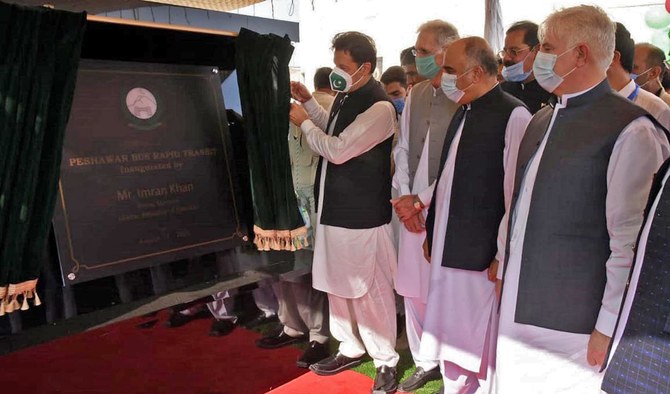
PESHAWAR: Prime Minister Imran Khan on Thursday inaugurated Peshawar’s long-awaited Bus Rapid Transit (BRT) project, calling it the best metro bus service available in Pakistan.
“I had serious reservations about the project initially,” he said, “but it is one of the best models of transportation system in the country. I congratulate you all and [former chief minister of Khyber Pakhtunkhwa province] Pervez Khattak who used to say we would realize the significance of the project after its completion.”
Launched in October 2017 at an estimated cost of Rs. 49 billion, the 27-kilometer-long BRT corridor had to be completed within a span of six months. However, the project got delayed and missed at least four deadlines in 2018 and 2019.
Addressing the media in Peshawar on Wednesday, Chief Minister Mahmood Khan acknowledged that the earlier inauguration dates announced by his predecessor were mistakes.
However, Alamgir Bangash, who works with the government-owned TransPeshawar Company, told Arab News that the project got delayed since its design had to undergo some changes which also increased its cost to a staggering Rs. 66 billion.
Praising the project, the prime minister said that it connected the city’s main arteries and went as far away as the Torkham border that separates the Afghan and Pakistani territories.
The introduction of hybrid diesel buses, he continued, would effectively tackle the traffic congestion and reduce air pollution in Peshawar.
The TransPeshawar Company has already acquired a fleet of 200 hybrid air-conditioned buses to cover the BRT corridor, Bangash informed.
“We are still doing some infrastructure and beautification work on three stations,” he said. “But this will not hamper the service that has started today.”
The political rivals of the ruling party criticized the BRT, however, and claimed that it was not a viable project for Peshawar.
“The BRT project was flawed from the outset and it was also surrounded by corruption allegations,” said Sardar Hussain Babak, a senior leader of the Awami National Party, while talking to Arab News. “Even now we don’t know if the project has been completed or it is a premature inauguration.”
“I suggest the PTI must probe the corruption allegations related to this if it is truly striving to uproot financial irregularities from the country,” he added.


Pakistani PM inaugurates BRT rapid bus service in Peshawar
https://arab.news/46wa2
Pakistani PM inaugurates BRT rapid bus service in Peshawar

- Launched in 2017, the project had to be completed in six months but missed several deadlines
- Opposition figures say all corruption allegations surrounding the project must be probed

Pakistan urges Hajj pilgrims to complete Saudi biometrics till Sunday
- Saudi Arabia has allocated Pakistan a quota of 179,210 pilgrims for this year’s Hajj
- Saudi biometric verification is mandatory for issuance of Hajj visas, ministry says
ISLAMABAD: The Pakistani religious affairs ministry has urged aspiring Hajj pilgrims to complete mandatory Saudi biometric verification for Hajj visas by Sunday, Pakistani state media reported, with preparations for the 2026 pilgrimage gathering pace following stricter oversight of the Hajj process.
Saudi Arabia has allocated Pakistan a quota of 179,210 pilgrims for Hajj 2026, with the majority of seats reserved under the government scheme and the remainder allocated to private tour operators.
Regulations for private Hajj operators have been tightened and their quota reduced following widespread complaints last year, when tens of thousands of pilgrims were unable to travel under the private Hajj scheme.
The Pakistani religious affairs ministry said last month that Saudi biometric verification is mandatory for the issuance of Hajj visas and pilgrims should complete it at home using the ‘Saudi Visa Bio’ app.
“Hajj visas will not be issued without biometrics, however pilgrims over 80 years of age are exempted from biometrics,” the Radio Pakistan broadcaster reported, citing the religious affairs ministry.
Pakistan has been steadily implementing digital and procedural requirements for pilgrims ahead of Hajj 2026, including mandatory training sessions, biometric checks and greater use of mobile applications, as part of efforts to reduce mismanagement.
Pilgrims who were unable to complete biometric verification through the mobile application should visit designated Saudi Tasheer centers before Feb. 8, according to the religious affairs ministry.
Details of the centers are available on Pakistan’s official Hajj mobile application. Tasheer centers will remain open from 9am to 5pm today and on Sunday to facilitate Hajj pilgrims, it added.


