Director of groundbreaking new women-led Pakistani series hopes men will watch too

A poster of 'Churails', a new groundbreaking Pakistani TV show directed by London-based Asim Abbasi and to be premiered on August 11, 2020. (Courtesy: Social Media)
Short Url
Updated 11 August 2020
Follow

Director of groundbreaking new women-led Pakistani series hopes men will watch too

  • Asim Abbasi says his “job is done” if the series 'Churail' helps men become empathetic toward women’s issues
  • Says he titled the series Churail to subvert the meaning of a word that was long been used to label women negatively

KARACHI: The British-Pakistani director of a new groundbreaking Pakistani TV show that aims to put the spotlight on stereotypes about Pakistani women said he hopes men too will watch the show and develop a more empathetic attitude towards women’s problems.



Actress Sarwat Gilani feeding a horse during filming of the new TV series 'Churails' in Karachi in 2019. (Photo courtesy: Zee5 Global)

The ten-episode 'Churails', which is the Urdu word for witches, releases on Tuesday on the Zee5 app. It stars top actresses Sarwat Gilani, Yasra Rizvi, Nimra Bucha and Mehr Bano as four women who start a detective agency to expose cheating husbands behind the facade of a burqa boutique.
“After watching it, even on a marginal rate, [if] they [men] become empathetic towards what a woman goes through and understands them better, I think my job is done,” London-based Asim Abbasi said in an interview with Arab News. 
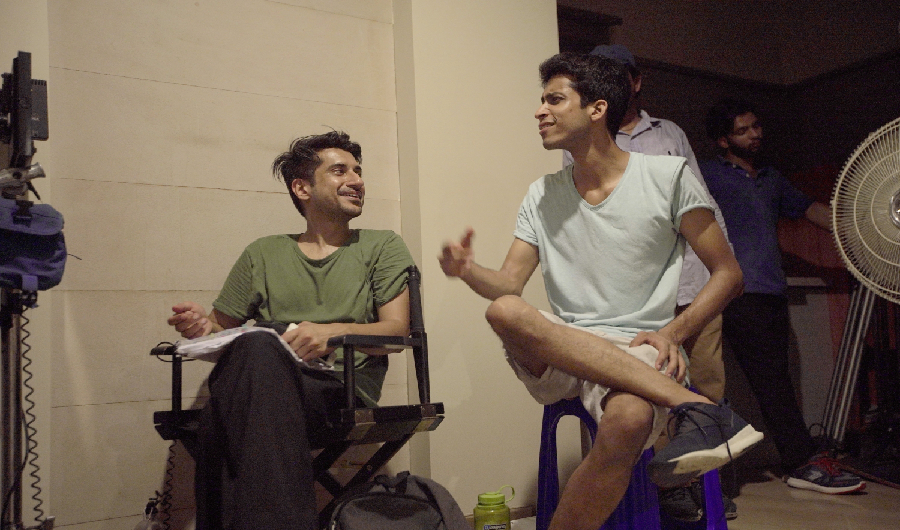


Director Asim Abbasi seen behind the scenes of the TV series 'Churails' in Karachi in 2019. (Photo courtesy: Zee5 Global)

Abbasi said he had titled the series Churail to subvert the meaning of a word that has long been used to label women 'negatively'. In his show, Churail is a woman who opposes oppression and is liberated emotionally, physically and sexually, he said. 
“I have put forward the issue of the status of a woman in a patriarchal society without giving moral judgement on it,” he said. “Churails is not just about how a woman should stand up for her rights but also how she is downplayed in our society through acts of child marriages, domestic violence, abusive attitude, and judgement on her physical appearances.”



Actress Sarwat Gilani during filming of the new TV series 'Churails' in Karachi in 2019. (Photo courtesy: Zee5 Global)

“Mainstream media all over the world generally portrays a woman in a very suppressive and deprived state, who needs a man as her savior and a guiding force,” said leading lady Gilani, who plays the role of family woman Sarah who finds out her husband is cheating on her, which leads her to meeting the three other women with whom she sets up the detective agency. 
“But in Churails all these women uplifting and supporting each other in fighting their battle," she added. 



Sarwat Gilani poses during a cut scene of the new TV seres 'Churails' shot in Karachi in 2019. (Photo courtesy: Zee5 Global)

Yasra Rizvi, who portrays the role of event planner Jugnu Chaudhry, said her character was “breaking all the stereotypical portrayals of women in our media.”
Mehar Bano, who portrays Zubaida, a young girl from a poor family who wants to be a boxer, said she took boxing training to play the role. In the play, her father beats her after he learns that she wants to box. 
“At that point, the Churails squad rescued her and then inspired by their mission, she also became their part,” Bano said.
Nimra Bucha, who plays a self-determined woman from a middle class background, described her character as such: “Batool has had enough to bear from men and the society and now leads her own life on her terms and conditions.”

Pakistan PM approves framework for National Energy Plan aimed at cutting power costs

Updated 4 sec ago
Follow

Pakistan PM approves framework for National Energy Plan aimed at cutting power costs

  • Electricity costs in Pakistan have been a major concern for both industries and domestic consumers
  • PM Shehbaz Sharif instructs authorities to expedite privatization of power distribution companies

ISLAMABAD: Prime Minister Shehbaz Sharif on Wednesday approved the framework for a National Energy Plan aimed at ensuring low electricity costs for industries and facilitating domestic consumers, Pakistani state broadcaster reported. 

The development took place during a meeting of the Cabinet Committee on Energy in Islamabad presided over by Sharif. The Pakistani prime minister directed all ministries and provincial governments to present a “workable and coordinated” strategy under the proposed plan.

Electricity costs in Pakistan have been a major concern for both industries and domestic consumers. Industrial users often face high tariffs that increase production cost while residential consumers struggle with rising bills that impact household budgets. 

“Prime Minister Shehbaz Sharif has given in-principle approval for the formulation of a comprehensive National Energy Plan in consultation with relevant ministries and provincial governments,” Radio Pakistan said in a report.

“He emphasized that the government’s top priorities include ensuring electricity supply to industries at the lowest possible cost and providing facilitation for domestic consumers.”

Sharif also approved the establishment of a dedicated secretariat for the National Energy Plan and gave approval to the framework guidelines for auctioning wheeling charges, it added.

Wheeling charges are fees paid for using another company’s power grid to transmit electricity from a generator to a consumer, covering the cost of transporting electricity over someone else’s network.

The report said Sharif instructed authorities to include the recommendations of the climate change, finance, industries and petroleum ministries into the plan. 

Sharif also gave instructions to expedite the privatization of power distribution companies (DISCOs) and urged competitive tariffs for industries to boost production capacity.

Fluctuations in fuel prices, inefficiencies in the power sector, and reliance on imported energy have contributed to high electricity costs in Pakistan in recent years, making energy affordability and stability a key focus for government policies and reforms.

Pakistan has pushed energy sector reforms to tackle long-standing issues like circular debt, power theft, and transmission losses, which have caused blackouts and high electricity costs. 

In February, Pakistan developed a new energy policy that it says will help the country attract $5 billion in investment through public-private partnerships.