


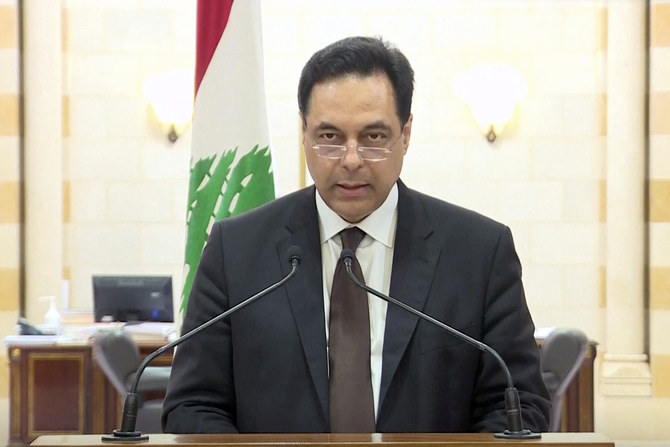

BEIRUT: Lebanon’s government resigned on Monday less than a week after a massive blast in Beirut, with the prime minister telling the nation in a televised address that the scale of the tragedy was “too great to describe.”
The explosion of more than 2,700 tons of ammonium nitrate at a warehouse in the Port of Beirut has killed at least 160, injured thousands and displaced hundreds of thousands of people in the capital.
Prime Minister Hassan Diab, who took office last December, was already under pressure for the lack of progress in resolving the country’s dire financial and economic situation. Last week’s huge explosion intensified accusations of corruption, incompetence, negligence against the political elite.
Read more: Analysis: Lebanon government steps down. So what?
In his address on Monday evening Diab spoke of “a system of corruption” that was rooted in the state.
“Rather, corruption is greater than the state, and it is not possible to confront this system or get rid of corruption.”
He said that the blast was “one of the examples of corruption in Beirut” and that the scale of the tragedy was “too great to describe.”
But he also appeared to shift the blame for his government’s inability to resolve the many challenges facing the country, saying that others were responsible for the lack of progress and reform.
“Between us and change, a very thick wall is protected by a class that resists with all dirty methods in order to control the state. We fought fiercely and with honor, but this battle has no equivalence.”
Communications continued throughout Sunday night by President Michel Aoun, Hezbollah and the Amal Movement to discourage some ministers from submitting their resignations after the resignation of Information Minister Manal Abdel Samad on Saturday.
On Sunday, Diab linked the government's resignation to the approval of a bill to shorten parliament’s term and call for early elections. It was a response to an announcement from Parliament Speaker Nabih Berri for parliament to convene on Thursday to hold the government accountable for the port disaster.
The blast was one of the examples of corruption in Beirut ... the scale of the tragedy is too great to describe.
Hassan Diab, Prime minister of Lebanon
Diab called Aoun on Monday and requested that the Council of Ministers’ session that was scheduled at the Presidential Palace be transferred to government headquarters, giving the impression that all efforts had failed to prevent the government from collapsing.
Samad, as well as Environment Minister Damianos Kattar, did not attend the session. Lebanon’s Justice Minister Marie Claude Najm attended the session and announced her resignation before it began.
She said: “Given the tragedy that afflicted the nation and the pain of the Lebanese, and what we witnessed in terms of street unrest and reactions that came confirming that Lebanon entered the stage of intensive care and has become requiring assertive stances to preserve community peace and avoid losing more lives and property, I submit my resignation from the government.”
Some ministers had their resignations on standby upon entering the Cabinet session, stressing that they would resign if the government did not collectively quit.
Iran has also pressured Lebanon.
Iranian Embassy spokesman, Abbas Al-Mousawi, said in a press conference from Tehran: “The explosion should not be used as a pretext for political goals, and the cause of the explosion must be carefully investigated. The US should also lift the sanctions imposed on Lebanon.”
The leader of the Lebanese Forces party, Samir Geagea, feared that any new government would be similar to the previous one. He added: “The aim is to go to the core of the problem, that is, parliament.”
Diab was assigned to lead the government on Dec. 19, 2019, following street protests that toppled the government of his predecessor Saad Hariri.
His government won the confidence vote of parliament on Feb. 11 with the support of Hezbollah, the Free Patriotic Movement and the Amal Movement. The Lebanese Forces, Future Movement and Progressive Socialist parties did not take part in the vote.
His administration, which called itself a government of specialists, was given three months to achieve the reforms required to negotiate an IMF rescue deal to stave off the economy’s collapse.
But criticism of the government's performance soared after the horrific explosion at the Port of Beirut, sparking outrage on the streets.
Public Works Minister Michel Najjar said upon leaving the last Cabinet session that he had “learned about the issue of storing ammonium nitrate in the port 24 hours before the explosion.”
Najm suggested referring the port explosion to the Judicial Council, which is the highest Lebanese judicial body. Its rulings are final.
The opposition has insisted on an international investigation into the blast due to a “lack of confidence in the local judiciary,” a demand rejected by the president.
Attorney General Judge Ghassan Oweidat on Monday continued his supervision of the investigations. There have been 19 arrests so far, including two former and current directors of customs and the director of the port.
Oweidat transferred those arrested on charges of negligence and causing harm to the Military Court to block any release, as the period of preventive detention usually does not exceed four days.
He instructed the Information Branch of the Internal Security Forces to go to Cyprus to hear the testimony of the owner of the vessel that was transporting the ammonium nitrate to Mozambique but unloaded its cargo seven years ago in the Port of Beirut.
Opinion
This section contains relevant reference points, placed in (Opinion field)
The investigations are focusing on the pre-explosion phase, specifically between 2013 and 2020, when the ammonium nitrate was stored in Ward No.12 inside the port, and the circumstances of the explosion.
On Monday, Lebanese Army Command announced: “The rescue teams of the army, in cooperation with the Civil Defense teams, the fire brigade, and the Russian and French search and rescue teams, were able to retrieve five bodies of the victims of the blast, and the search for the remaining missing will continue.”
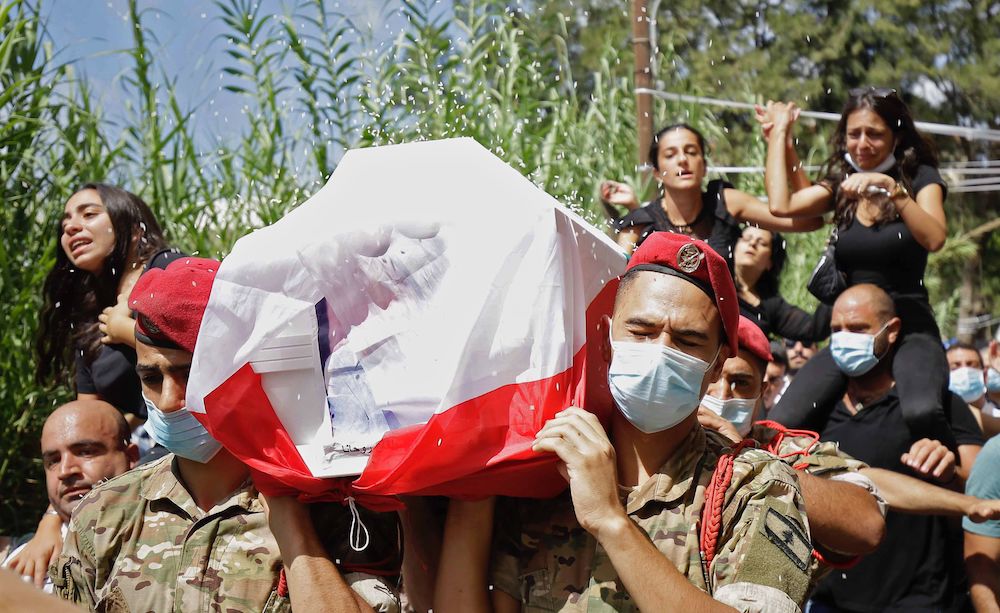
The funeral in Batroun of Lebanese army corporal Estephan Rouhana, who was killed in the Beirut explosion. (AFP)


