TAIPEI: A senior member of US President Donald Trump’s administration landed in Taiwan Sunday for Washington’s highest level visit since switching diplomatic recognition to China in 1979, a trip Beijing has condemned.
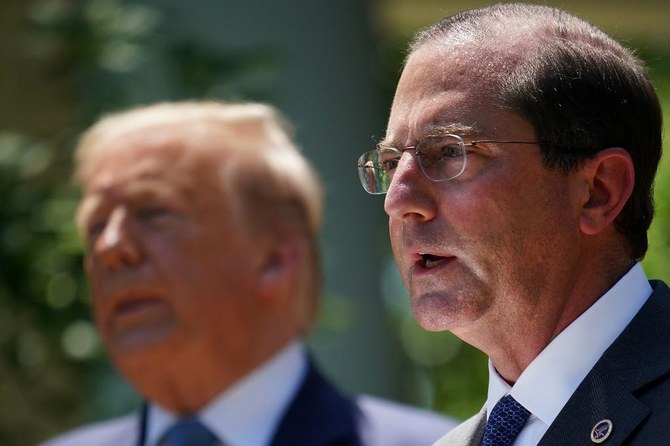
During the three-day visit Health Secretary Alex Azar will meet President Tsai Ing-wen, who advocates Taiwan being recognized as a sovereign nation and is loathed by China’s leaders.
Azar is the most senior US cabinet member to visit Taiwan in decades and his visit comes as relations between the world’s two biggest economic powers plunge to historic lows.
In recent days, Trump has ordered sweeping restrictions on popular Chinese apps TikTok and WeChat and the US Treasury Department slapped sanctions on Hong Kong’s leader over a tough law that curbs dissent.
Washington has billed the Taiwan trip as an opportunity to learn from the island’s fight against the coronavirus and to celebrate its progressive values.
“This trip is a recognition of Taiwan’s success in combating COVID-19 and a testament to the shared beliefs that open and democratic societies are best equipped to combating disease threats like COVID-19,” a health and human services department official told reporters ahead of the visit.
But Beijing balks at any recognition of self-ruled Taiwan, which it claims as its own territory and vows to one day seize, by force if necessary.
It has described Azar’s visit as a threat to “peace and stability,” while China’s defense minister warned against Washington making any “dangerous moves.”
As well as meeting Tsai, Azar will hold talks with his counterpart Chen Shih-chung and Foreign Minister Joseph Wu.
He will also meet coronavirus experts and give a speech to public health students as well as alumni of a training program with the US Centers for Disease Control and Prevention.
Taiwan has become a poster child for defeating the coronavirus thanks to a well-honed track and tracing program as well as firm border controls.
Despite its proximity and economic links to China it has recorded fewer than 500 infections and seven deaths.
In contrast the US has recorded the most deaths in the world with more than 160,000 fatalities.
As public disapproval has grown for his handling of the epidemic, Trump has pivoted from his previous focus on striking a trade deal with China to blaming the country for the coronavirus crisis.
The two countries have clashed on a range of issues, from trade to espionage allegations and Beijing’s human rights record such as the mass incarceration of Uighur Muslims and the political crackdown in Hong Kong.
Washington remains the leading arms supplier to Taiwan but has historically been cautious in holding official contacts with it.
Under Trump, relations with Taiwan have warmed dramatically and he has approved a number of major military sales, including F-16 fighter jets.
The last cabinet minister to visit Taiwan was in 2014 when the then head of the Environmental Protection Agency led a delegation.


![]()

US begins highest level Taiwan visit in decades
Short Url
https://arab.news/yz96t
US begins highest level Taiwan visit in decades
- During the three-day visit Health Secretary Alex Azar will meet President Tsai Ing-wen
- Under President Donald Trump, US relations with Taiwan have warmed dramatically


Latest updates


Recommended


© 2026 SAUDI RESEARCH & PUBLISHING COMPANY, All Rights Reserved And subject to Terms of Use Agreement.