Turkey’s tumbling lira tests Erdogan’s rate resolve

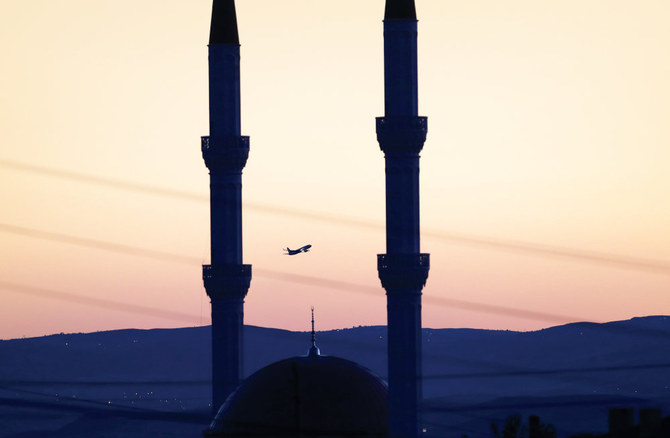
Investors, analysts and sources close to Turkey’s central bank say that the most direct solution to the lira’s costly slide, in the form of a rate hike, would only happen as a last resort. (AFP)
Updated 07 August 2020
Follow

Turkey’s tumbling lira tests Erdogan’s rate resolve

  • Erdogan believes high rates cause inflation and sacked his previous central bank chief for not following his instructions

ISTANBUL: Turkish central bank head Murat Uysal has stuck to the rate-cutting script since President Recep Tayyip Erdogan hired him to lift Turkey out of a recession and currency crisis.

A year later with the COVID-19 pandemic now crushing the lira, some traders and analysts say they think Uysal will instead hike rates to head off a deeper crisis.

Erdogan, whose 17 years in power have been marked by cheap credit and booming growth, has repeated the unorthodox view that high rates cause inflation and sacked Uysal’s predecessor for not following his instructions.

The central bank did not immediately comment on expectations of higher rates or on political pressure. Uysal said last week that policy was in line with the central bank’s inflation forecasts and he has said in the past it has policy independence.

Investors, analysts and sources close to Turkey’s central bank say that the most direct solution to the lira’s costly slide, in the form of a rate hike, would only happen as a last resort.

Erdogan’s office was not available to comment, while a spokesman for the Treasury did not immediately respond.

After the central bank slashed rates to 8.25 percent from 24 percent in less than a year, such a quick policy turn-around would likely need the government’s tacit approval, analysts say.

Nevertheless, money market traders have been adding to bets in recent days that Uysal, who halted an aggressive year-long easing cycle in June, has little choice but to tighten policy soon to avoid a second currency crisis in as many years.

HIGHLIGHTS

Lira hits historic low vs dollar as volatility returns.

After aggressive easing, traders bet on policy reversal.

Previous central bank head sacked for ignoring Erdogan.

The lira hit a historic low on Thursday and is down nearly 20 percent versus the dollar so far this year, despite the greenback’s own weak performance.

While the central bank’s policy rate is 8.25 percent, the November money market pricing for three-month lending is at 10.75 percent, implying 250 basis points of tightening by year-end.

Some fear that in a worst-case scenario, interventions to stabilize the lira lose steam as the central bank’s reserves run thin, prompting further depreciation, inflation and a ballooning current account deficit.

“We have a lot of ingredients here to have a full blown crisis,” said Nikolay Markov, senior economist at Pictet Asset Management. “The hope is to have a more proactive policy response from the central bank.”

Turkish annual inflation is high at near 12 percent, leaving real rates deeply negative for depositors in lira, a factor which has hastened the currency’s slide.

Economists polled by Reuters before the latest lira selloff expected more rate cuts once things cooled down.

But after two weeks of volatility, Goldman Sachs now expects 175 points of hikes by year end. Pictet’s Markov said that Turkey boasts the biggest gap among major emerging markets between the current policy rate and where it should be based on inflation and other factors.

Ankara is running out of alternatives to monetary policy.

The central bank’s gross FX reserves have dwindled to $51 billion from $81 billion this year, official figures show.

Data and the calculations of traders show the drop is in part due to the central bank and state banks selling some $110 billion in dollars since last year, including an acceleration in recent weeks, to stabilize the lira.

Ankara’s appeals for funding from the US Federal Reserve and other central banks have only yielded a deal with Qatar.

Rate hikes are only an option if more foreign funding cannot be found, a senior Turkish banker said, adding: “We do not anticipate a rate rise unless there is no other option.”


Reforms target sustained growth in Saudi real estate sector, says Al-Hogail

Updated 26 January 2026
Follow

Reforms target sustained growth in Saudi real estate sector, says Al-Hogail

RIYADH: The Real Estate Future Forum opened its doors for its first day at the Four Seasons Riyadh, with prominent global and local figures coming together to engage with one of the Kingdom’s most prospering sectors.

With new regulations, laws, and investments underway, 2026 is expected to be a year of momentous progress for the real estate sector in the Kingdom.

The forum opened with a video highlighting the sector’s progress in the Kingdom, during which an emphasis was placed on the forum’s ability to create global reach, representation, as well as agreements worth a cumulative $50 billion

With the Kingdom now opening up real estate ownership to foreigners, this year’s Real Estate Future Forum is placing a great deal of importance on this new milestone and its desired outcomes and impact on the market. 

Aside from this year’s forum’s unique discussions surrounding those developments, it will also be the first of its kind to launch the Real Estate Excellence Award and announce its finalist during the three-day summit.

Minister of Municipalities and Housing and Chairman of the Real Estate General Authority Majed Al-Hogail took to stage to address the diverse audience on the real estate market’s achievements thus far and its milestones to come.

Of those important milestones, he underscored “real estate balance” as a key pillar of the sector’s decisions to implement regulatory tools “with the aim of constant growth which can maintain the vitality of this sector.” He pointed to examples of those regulatory measures, such as the White Land Tax.

On 2025’s progress, the minister highlighted the jump in Saudi family home ownership, which went from 47 percent in 2016 to 66 percent in 2025, keeping the Kingdom’s Vision 2030 goal of 70 percent by the end of the decade on track.

He said the opening of the real estate market to foreigners is an indicator of the sector’s maturity under the leadership of Crown Prince Mohammed bin Salman. He said his ministry plans to build over 300,000 housing units in Riyadh over the next three years.

Speaking to Arab News,  Al-Hogail elaborated on these achievements, stating: “Today, demand, especially local demand, has grown significantly. The mortgage market has reached record levels, exceeding SR900 billion ($240 billion) in mortgage financing, we are now seeing SRC (Saudi Real Estate Refinance Co.) injecting both local and foreign liquidity on a large scale, reaching more than SR54 billion”

Al-Hogail described Makkah and Madinah as unique and special points in the Kingdom’s real estate market as he spoke of the sector’s attractiveness.

 “Today, the Kingdom of Saudi Arabia has become, in international investment indices, one that takes a good share of the Middle East, and based on this, many real estate investment portfolios have begun to come in,” he said. 

Al-Ahsa Gov. Prince Saud bin Talal bin Badr Al-Saud told Arab News the Kingdom’s ability to balance both heritage sites with real estate is one of its strengths.

He said: “Actually the real estate market supports the whole infrastructure … the whole ecosystem goes back together in the foundation of the real estate; if we have the right infrastructure we can leverage more on tourism plus we can leverage more on the quality of life … we’re looking at 2030, this is the vision … to have the right infrastructure the time for more investors to come in real estate, entertainment, plus tourism and culture.”