
BEIRUT: Lebanon could face a repair bill of up to $15 billion in the aftermath of a cataclysmic chemical blast at Beirut port, according to a top government adviser.
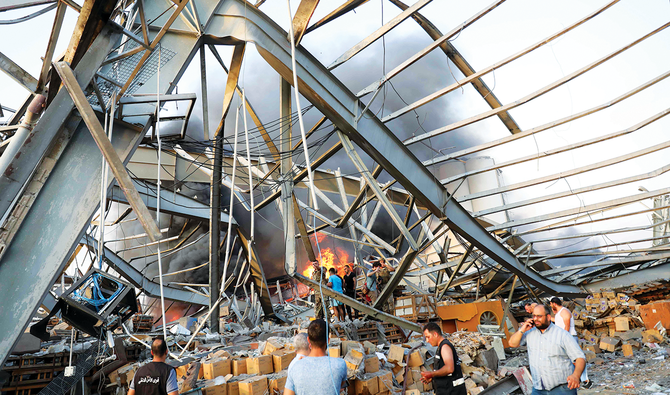
The explosion, which was felt as far away as Cyprus, killed at least 100 people, wounded thousands and left an additional 300,000 Beirut residents homeless.
It is thought to have been caused by nearly three tons of ammonium nitrate, a common agricultural fertilizer, that was confiscated in 2013 and improperly stored in warehouses. But after months of economic misery, the collapse of the currency and mounting civil unrest, it is being seen as the consequence of years of neglect, financial mismanagement and corruption as across the country.
Opinion
This section contains relevant reference points, placed in (Opinion field)
Charbel Cordahi, an economist and financial adviser to the president, estimated the cost of damages from the explosion, including compensation, at around $15 billion.
“Up to 70 percent of Lebanon’s trade channels through the port of Beirut,” he told Arab News.
“Airports and other ports in the country can facilitate only 30-40 percent of this trade, and opening the borders with Syria can facilitate another 20 percent. This means that at least $5 billion of imports will not find their way to the country, and another $2 billion of exports will stay on ground in the coming eight months. This represents a loss of around $4 billion, or 15 percent of gross domestic product,” he said.
He added that without an international aid program, “Lebanon cannot face this disaster.”
The explosion caps months of misery for the Lebanese, nearly half of whom now live below the poverty line. Popular anger directed at the government and political classes has swelled as a wider economic crisis has been made worse by the impact of the coronavirus pandemic.
Efforts to assess the damage at Beirut port, the country’s main trade gateway, are already underway. The second priority will be to restore food security and ensure the country does not run out of wheat after grain silos were destroyed, while also making sure residents who have lost their homes are rehoused as quickly as possible. Maintaining medical supplies and mitigating the environmental impact will also be a priority for city chiefs.
Many residents of the city are unable to return to their homes, even if their buildings remain visibly intact, because of the potential structural damage caused by the 4.5 Richter-scale blast.
“We need other countries to help us reconstruct Beirut,” Gen. Mohammed Kheir, secretary general of the Higher Relief Council, told Arab News. “We would be grateful if each country rebuilt a street or neighborhood in Beirut, like they did following the 2006 Israeli aggression. That would be the best way.”
He also appealed for emergency prefab homes for families for whom the government may not be able to provide housing.
Beirut Gov. Marwan Abboud, who estimated the primary damage at $3-$5 billion, appealed to the international community and the Lebanese diaspora to help.
Health officials had told Arab News that the country was running low on medical equipment, especially items needed for major surgery, and hoped that aid from abroad would fill the gap.
It is still too early to assess the full environmental impact of the blast, but environmental expert Mostapha Raad said a potentially bigger catastrophe may have been averted when the wind carried away a toxic cloud filled with nitric acid away from land and toward open sea.
“We were afraid the ammonium nitrate residue would lead to cooling off the weather and causing acidic rain, but according to tests on air samples, the result was green and the cloud disappeared over the sea,” he said.