ISLAMABAD: The government of Pakistan has exercised its executive authority by formally laying claim to the disputed Himalayan territory of Jammu and Kashmir in a new political map, experts said on Wednesday, adding that the move was in line with the country’s decades-old position on Kashmir since it had always maintained that the region was illegally occupied by India.
Prime Minister Imran Khan unveiled Pakistan’s new map on Tuesday, showing the entire area of Jammu and Kashmir and Gilgit-Baltistan as its territory. The decision was made in response to a similar step taken by India which released its own political map in October last year depicting Azad Kashmir and Gilgit-Baltistan, both territories governed by Pakistan, as being part of India.
The Muslim majority Himalayan valley of Kashmir remains disputed between the two South Asian neighbors since 1947. Both claim it in full but rule only parts of it. Both countries have also fought at least two full-scale wars over the territory, making the world community describe the region as a potential nuclear flashpoint.
Last year, India revoked the special status of the disputed Himalayan region’s autonomy.
“By issuing this map, Pakistan has exercised its executive authority to document its position regarding its territorial dispute with India,” Ahmer Bilal Soofi, a top Pakistani expert of international law, told Arab News.
He said that Pakistan’s action was well within the framework of international law and in keeping with the relevant United Nations resolutions promising plebiscite in the region.
“Pakistan has also reiterated its stance [through the map] that India’s illegal annexation of occupied Kashmir through last year’s presidential decree is not recognized by it,” he said, adding that territorial claims over disputed regions could be exercised through legislation, executive action and judicial pronouncements.
“Pakistan’s decision to use the executive authority in this case may also be followed by its legislative action,” he said.
Soofi said the new map would help Pakistan contest its case over Kashmir at international forums, including the UN.
“Maps are not without sanctity and significance in international law and global litigation over territorial disputes,” he said.
Pakistan’s foreign office said the new map was “essential for firmly rejecting the political map issued by India” last year, adding that New Delhi had made “false territorial claims on Azad Jammu and Kashmir and Gilgit-Baltistan.”
“The political map emphatically reasserts Pakistan’s stated position [on Kashmir],” Aisha Farooqui, the foreign office spokesperson, told Arab News.
“Pakistan’s consistent stance on Jammu and Kashmir, anchored in the United Nations Security Council resolutions stipulating that the accession of the state will be through a UN-supervised plebiscite, is further reinforced as the map reaffirms this position,” she said.
The country’s largest opposition party in parliament, the Pakistan Muslim League-Nawaz (PML-N), also endorsed the new map while urging the government to utilize all international avenues to get the dispute resolved peacefully.
“The government should clarify if it will be using the same map at international forums like the UN, or is it just for domestic consumption,” Muhammad Zubair, former governor of Sindh province and a senior PML-N leader, told Arab News.
He said that Pakistan should circulate the new map among all the embassies and international forums to tell the world about its position on the disputed territory. “The new map will be useless if it is only for optics,” Zubair said. “Let’s see how the government proceeds ahead with it.”
Dr. Zafar Nawaz Jaspal, an Islamabad-based academic and expert in international relations, termed Pakistan’s decision to unveil the new map a “wise move.”
“This is a complete map of Pakistan showing our rightful claim over the disputed Kashmir region,” he said, “though it only seems to be for domestic consumption at the moment.”


![]()
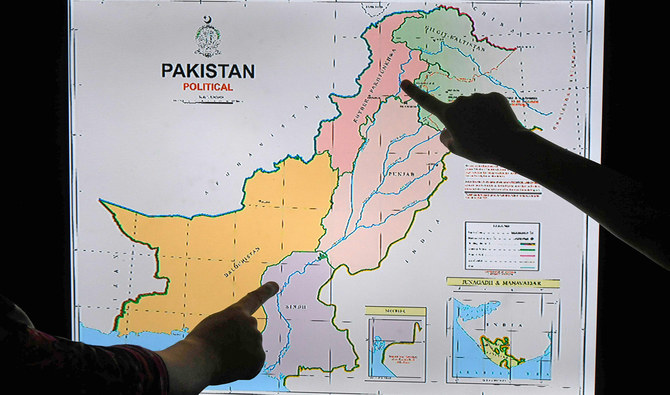
Pakistan’s new 'political map' projects decades-old position on Kashmir, experts say

Short Url
https://arab.news/b7rv8
Pakistan’s new 'political map' projects decades-old position on Kashmir, experts say
- Maps are not without significance in international law and global litigation over territorial disputes, top legal expert says
- Opposition urges government to circulate map among all embassies and international forums to convey official position on disputed territory
Latest updates


© 2026 SAUDI RESEARCH & PUBLISHING COMPANY, All Rights Reserved And subject to Terms of Use Agreement.