

New 'political map' hardens Pakistani position with India over disputed Kashmir region

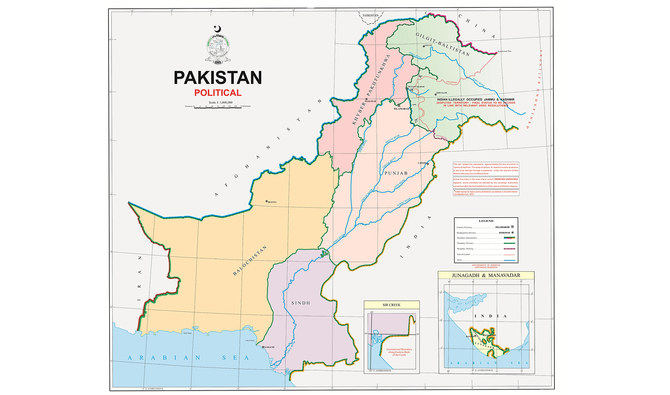
A new map approved by Pakistani Prime Minister Imran Khan shows areas in the Himalayan Kashmir valley disputed with India to be a part of Pakistan. August 4, 2020. (Photo courtesy: Pakistan Prime Minister's Office)
Short Url
Updated 05 August 2020
Follow

New 'political map' hardens Pakistani position with India over disputed Kashmir region

  • Pakistan PM says new map approved by his cabinet and endorsed by Kashmiri and Pakistani opposition leaders
  • Indian news agency quotes ministry of foreign affairs as saying new map had no “legal validity nor international credibility”

ISLAMABAD: Pakistani prime minister Imran Khan said on Tuesday his cabinet had approved a new ‘political map’ which should be considered the official map of the country both inside Pakistan and internationally.
An image of the map was shared with Pakistani media by the PM’s office in Pakistan and showed areas in the Himalayan Kashmir valley disputed with India as a part of Pakistan with these words printed across the relevant parts of the map: “Indian illegally occupied Jammu and Kashmir. (Disputed territory — Final status to be decided in line with relevant UNSC [United Nations Security Council] resolutions.)”
A dotted line that previously marked the disputed areas has been removed from the new map.
The UN Security Council adopted several resolutions in 1948 and in the 1950s on the dispute between India and Pakistan over the region, including one which says a plebiscite should be held to determine the future of mostly Muslim Kashmir. Another resolution also calls upon both sides to “refrain from making any statements and from doing or causing to be done or permitting any acts which might aggravate the situation.”
But Pakistan’s move to release the new map signals a hardening of Islamabad’s position over a decades-long border row that has strained ties between the South Asian neighbors.
“This is a historic day in Pakistan,” PM Khan said in a televised address. “Today we are bringing a new political map of Pakistan before the world.”
“From today, in all of Pakistan, our official map of Pakistan will be this, which has been passed by the cabinet of Pakistan.” he said. “From now, in schools, colleges, internationally, this is the map that will appear.”


The PM said his cabinet, leaders of Kashmir as well as opposition parties in Pakistan had all endorsed the map.
In an address following the PM’s, Pakistani foreign minister Shah Mahmood Qureshi said the dotted line in the old map that indicated a ‘disputed territory’ has been done away with. He said Siachen, which always belonged to Pakistan, had also been included in the new map.
The Siachen Glacier in the Karakorum range is known as the highest militarized zone in the world. Thousands of Indian and Pakistani troops contest an area at altitudes above 20,000 feet where they must deal with altitude sickness, high winds, frostbite and temperatures as low as minus 60 degrees Celsius.
Qureshi claimed that the “Kashmiri leadership” had endorsed the new map, without naming anyone.
“This map sends a message to India, it sends a message to the unarmed youth of Kashmir who martyr themselves for the cause, that Pakistan stands with them,” Qureshi said. “This map represents our goal.”
The Press Trust of India, the largest news agency in India, quoted the Indian ministry of foreign affairs as saying the new map had no “legal validity nor international credibility.”
India’s ANI news agency tweeted, quoting the government of India: “We’ve seen a so-called ‘political map’ of Pakistan that has been released by PM Imran Khan. This is an exercise in political absurdity, laying untenable claims to territories in the Indian state of Gujarat and our union territories of Jammu Kashmir and of Ladakh: Govt of India.”
The Muslim-majority Himalayan region of Kashmir has been at the heart of more than 70 years of animosity since the partition of British-ruled India into Muslim Pakistan and majority Hindu India in 1947.
Tensions reached a new high since August 5 last year when Indian Prime Minister Narendra Modi’s government took away Indian-administered Kashmir’s special privileges, provoking anger in the region and in neighboring Pakistan. It also took away the region’s status as a state by creating two federally controlled territories, splitting off the thinly populated, Buddhist-dominated region of Ladakh.
Jammu & Kashmir had been the only Muslim-majority state in mainly Hindu India. India and Pakistan have fought two of their three wars over the region.
For decades, India has battled insurgency in the portion of Kashmir it controls. It blames Pakistan for fueling the strife, but Pakistan denies this, saying it gives only moral support to non-violent separatists.


Pakistan likely to import around 7 million cotton bales this year as local production nearly halves

Updated 5 sec ago
Follow

Pakistan likely to import around 7 million cotton bales this year as local production nearly halves

  • Pakistan produced 5.3 million cotton bales by mid-December against 10 million targeted, government data shows
  • While the imports may ensure smooth supply of raw material, they may put pressure on foreign exchange reserves

KARACHI: Pakistan is likely to import around 7 million cotton bales this year owing to a decline of nearly half the annual target set by the Federal Committee on Agriculture (FCA), industry stakeholders said on Tuesday.

Pakistan’s cotton production stood at 5.3 million bales each weighing 170 kilograms as of Dec. 15, according to state-run Pakistan Central Cotton Committee (PCCC) data. The FCA had set a target of 10.2 million bales in April.

Karachi Cotton Brokers Forum (KCBF) Chairman Naseem Usman Osawala sees the country’s cotton production declining by 46 percent this season, compared to the FCA target.

“The country is expected to produce about 5.5 million bales this year,” he told Arab News, adding Pakistan would have to import around 7 million bales to meet requirement of its textile industry which consumes about 12 million bales a year.

The country had sown cotton over 2.002 million hectares, which was down by 11 percent from the targeted 2.26 million hectares.

Muhammad Waqas Ghani, head of research at Karachi-based JS Global Capital brokerage firm, said the South Asian country is likely to miss its cotton output target of 10 million bales.

“At the current rate of arrival, the output can reach 7 million bales at its best,” he added.

Cotton is a raw material for Pakistan’s largest textile industry and was the worst hit crop by climate-induced floods earlier this year.

Osawala said Pakistan’s cotton production has been falling because of an increasing number of sugar mills being established in the country’s cotton-producing regions.

Courts in Pakistan have been issuing significant rulings to bar the establishment of sugar mills in the designated cotton belt areas of the Punjab province. In 2018, the Supreme Court ordered relocation of three sugar mills from cotton-producing districts in southern Punjab to protect the crop.

Since cotton prices are low in the international market, textile millers would go for more imports, according to the KCBF chairman.

On Dec. 22, the price of cotton in the New York market stood at as much as 65.85 cents per pound, 1.64 cents lower than last year, according to the PCCC data.

Osawala said Pakistan’s increasing textile imports are also “hurting local cotton production.”

According to the Pakistan Bureau of Statistics’ (PBS) July-November data, the country had imported raw cotton, synthetic fiber, synthetic and artificial silk yarn and worn clothing worth $2.82 billion, 5 percent more than the imports during the same period last year.

Speaking of the impact of Pakistan’s falling cotton production, Kamran Arshad, chairman of All Pakistan Textile Mills Association (APTMA), said the millers would have to import “a lot of cotton” this year.

“I think approximately 7-7.5 million bales will have to be imported this year,” he said.

The textile and apparel sector is Pakistan’s largest exporter, accounting for more than half of the country’s overall exports and contributing around 8.5 percent of the gross domestic product (GDP) by employing nearly 40 percent of the industrial labor force. But high energy costs and outdated infrastructure among other factors continue to slow growth and leave the country trailing regional peers.

In the last fiscal year, Pakistan imported as much as 6.2 million cotton bales each weighing 220 kilograms, mostly from Brazil and the United States, according to KCBF Chairman Arshad.

Shankar Talreja, head of research at Karachi-based Topline Securities, said Pakistan is likely to import cotton worth $1.2 billion this year “considering the requirement.”

“The full-year import of cotton is likely to remain over $1 billion,” Talreja said.

Economic experts say while importing more cotton would ensure smooth supply of raw material to Pakistan’s textile sector, it may put pressure on the country’s foreign exchange reserves that rose to $15.9 billion last week after the International Monetary Fund (IMF) released a $1.2 billion tranche under Pakistan’s $7 billion loan program.
