

EU eyes softening key state aid demand in Brexit talks — sources

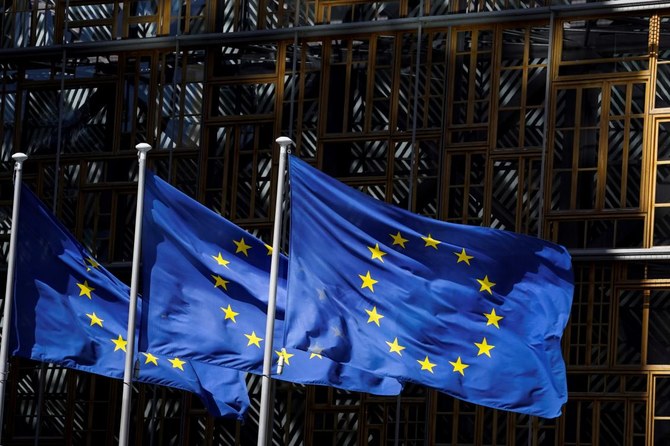
Both sides still say they hope to avoid the most economically damaging “no-deal” rupture. (File/AFP)
Short Url
Updated 03 August 2020
Follow

EU eyes softening key state aid demand in Brexit talks — sources

  • The 27 EU countries have long demanded so-called “level playing field” guarantees from Britain
  • Prime Minister Boris Johnson’s government refuses to be bound by EU state aid rules

BRUSSELS: The European Union is willing to compromise to help break a deadlock in Brexit talks by softening its demand that Britain heed EU rules on state aid in the future, diplomatic sources told Reuters.
They said Brussels could go for a compromise entailing a dispute-settling mechanism on any state aid granted by the UK to its companies in the future, rather than obliging London to follow the bloc’s own rules from the outset.
Provisions to ensure fair competition pose the biggest stumbling block in the troubled talks aimed at sealing a new trade accord from 2021 following Britain’s exit from the EU in January after 46 years of membership.
The 27 EU countries have long demanded so-called “level playing field” guarantees from Britain if it wants to continue selling goods freely in the bloc’s lucrative single market of 450 million people — after Britain’s standstill transition period following Brexit expires at the end of this year.
Without an agreement, trade and financial ties between the world’s fifth largest economy and its biggest trading bloc would collapse overnight, likely spreading havoc among markets, businesses and people.
But Prime Minister Boris Johnson’s government refuses to be bound by EU state aid rules, environmental standards or labor laws, saying the essence of Brexit was to let Britain decide alone on its own regulations.
Both sides still say they hope to avoid the most economically damaging “no-deal” rupture.

Dispute-settling mechanism
“The room for compromise lies in something that will let the UK decide on its own since ‘regaining sovereignty’ is such a big Brexit thing,” said a EU diplomat close to the Brexit talks.
“We would reserve the right to decide on any consequences vis-à-vis access to the single market for UK companies as a result.”
Another diplomatic source said such a dispute resolution mechanism could be a way to overcome the impasse.
A third diplomat, also speaking on condition of anonymity, acknowledged the EU was ready to ease its earlier demands that Britain agree to a “dynamic alignment” of its competition rules in the future with the bloc’s own.
The person said, however, Britain would still need to agree with the EU on a broad outline of company subsidies policy — rather than specific laws or cases — to allow the bloc to go for such a fix. EU Brexit negotiator Michel Barnier has repeatedly urged London to make its future plans on that known to the bloc.
“There must be a solid framework with independent oversight. If they agree to settle on broad rules for granting state aid and to have this independent institution, then we have a deal,” said the diplomat.


Indonesia threatens to ban Musk’s Grok AI over degrading images of children and women

Updated 5 sec ago
Follow

Indonesia threatens to ban Musk’s Grok AI over degrading images of children and women

  • Grok has been complying with user requests to alter images of real people  
  • Other countries, including Malaysia and France, have also threatened action against X 

JAKARTA: Indonesia’s Communications Ministry threatened on Wednesday to ban Elon Musk’s X and its artificial intelligence chatbot Grok after degrading pictures of women and children generated without consent surged on the social media platform. 

Grok has been complying with requests from X users to modify images of real women and children stripped to their underwear, creating a viral trend that has sparked concerns across the globe. 

A preliminary investigation found that Grok “does not yet have explicit and adequate regulations to prevent the production and distribution of pornographic content based on real photos” of Indonesian citizens,” Indonesia’s Ministry of Communications and Digital Affairs said in a statement. 

Indonesia has strict laws against the production and distribution of pornography, with the government regularly instructing internet service providers to block access to websites containing such content. 

“The obligation to comply with Indonesian laws and regulations applies to all digital platforms operating in Indonesia,” the ministry said. 

“Should there be non-compliance or lack of cooperation, the Ministry of Communications and Digital Affairs may impose administrative sanctions, including termination of access to Grok’s AI services and the X platform.” 

Indonesia has joined a growing list of countries, which includes Malaysia, India and France, that are calling for investigations and threatening action against Grok.

Concerns grew after a December update to the chatbot made it easier for users to post photographs of people and ask for their clothing to be removed.

In a report published on Tuesday, European non-profit organization AI Forensics said Grok is “systematically ‘undressing’ women.”  

Its analysis of 20,000 images generated by Grok between Dec. 25 and Jan.1 found that 53 percent of them contained individuals in minimal attire, with 81 percent of them being women, while two percent of the images depicted persons appearing to be 18 years old or younger. 

Indonesia’s Communications Ministry said AI service providers and users are also subject to administrative or criminal sanctions under Indonesian law if they are proven to have produced or distributed pornographic content or modified personal images without permission. 

“Every digital platform must ensure that the technology they provide does not become a medium for privacy violation, sexual exploitation or the degradation of a person’s dignity,” said Alexander Sabar, director-general of digital space at the ministry.  

“We urge all parties to use artificial intelligence technology responsibly. The digital space is not a lawless space; every citizen’s privacy and right to their image must be respected and protected.”